
One Hundred Days After the Disaster: The Long Road to Resuming Operations at a Beijing Farm
In the three months since the disaster, from worried consumers to government officials at every level, nearly everyone has asked Zhen Rui the same question: “What do you plan to do next?”
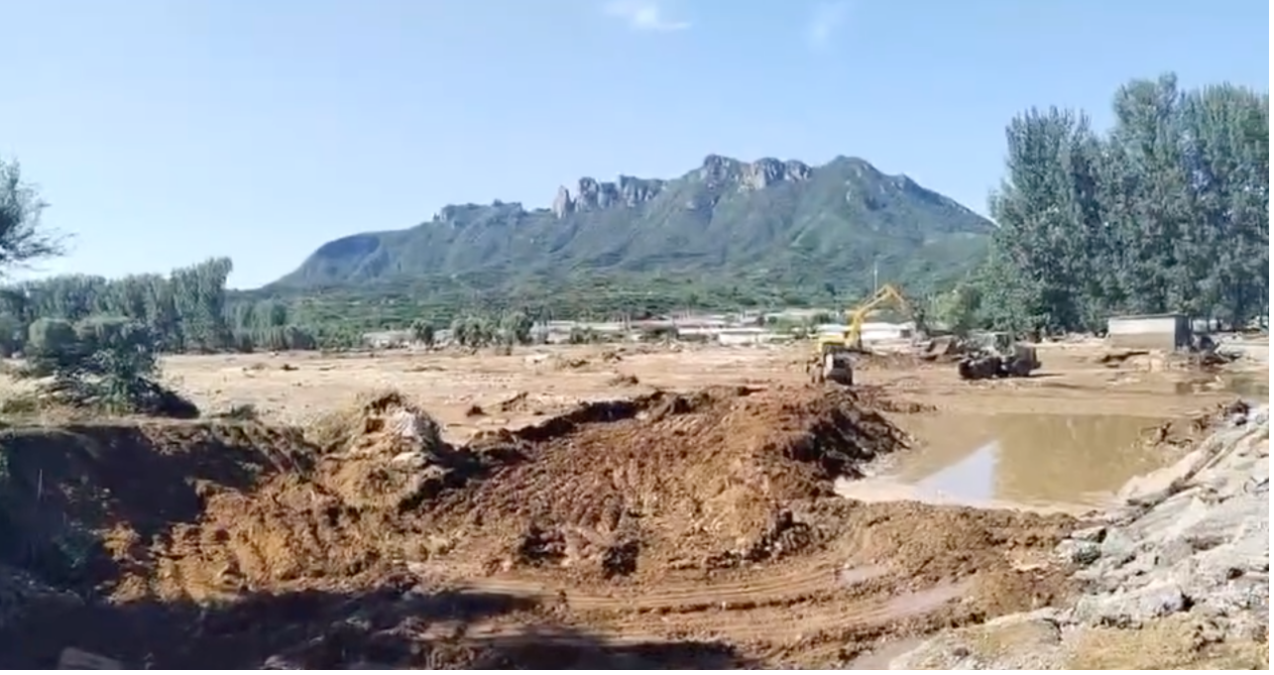
In the small hours of 28 July 2025, extreme torrential rain battered the mountainous north of Beijing. Mountain torrents laden with silt and debris swept over the embankments. By the Qingshui River in Beizhuang Town, Miyun District, Zhen Rui’s Sohu Farm was reduced to ruins overnight, and two local staff members barely survived the dark, churning flood.
The 450 mu of land represented thirteen years of heart and labour for Zhen Rui, a post-80s agriculture graduate. Since the autumn of 2012 he has cultivated fresh-eating corn (sweet corn), fruit trees, and vegetables here, tending the small family plots rented by more than 100 members. In recent years the farm has also hosted guests who camp by the riverside and watch the birds. From late June to early October, more than ten crops of corn ripen one after another, going straight from field to table.
For over three months now, Zhen Rui has been clearing rubble, assessing the damage, sitting in meetings with government departments, and scrambling to rebuild the farm. Yet the future remains uncertain. How can he keep farming? Where will the reconstruction money come from? Will disaster come again?
And his story is only a small slice of a wider picture. This abnormal, extreme downpour began on 23 July and swept across the Beijing-Tianjin-Hebei region over 147 hours, affecting 300,000 people, leaving 144 missing or dead, and destroying vast areas of permanent basic farmland. Extreme weather is growing ever more frequent, and as the rain belt shifts gradually northward, toward regions with less experience in flood defence, how are farmers to survive?
I. Cultivation Again?
A local government official told Zhen Rui that by the end of the year, in the annual land change survey conducted by the Ministry of Natural Resources, the land classification would be updated according to actual land use. If expert assessment confirmed that the farm site could not be returned to cultivation, the land would be reclassified from “arable land” to “forest land” or “grassland.”
Joint policy documents issued by the Ministry of Natural Resources, the Ministry of Agriculture and Rural Affairs, and the National Forestry and Grassland Administration show that to safeguard the “arable land red line,” arable land area generally needs to maintain “balance between gains and losses.” However, “damage from natural disasters that makes replanting difficult” is exempt.
“Don’t force cultivation on land that isn’t suitable; leave it as it is, and once the adjustments are made, look into how tourism might be developed,” the local town Party committee secretary told Zhen Rui.
After letting go of the idea of rebuilding on the original site, Zhen Rui began surveying the surrounding area. “Let’s huddle together for warmth and comfort each other.” A few weeks later, an idea gradually took shape: business grafting.
He has now reached a temporary partnership with a farm two kilometres away. That farm sits at higher ground, suffered lighter damage, and has 150 mu of high-standard farmland, newly built heated greenhouses, and a camping business. In the greenhouses, Zhen Rui has replanted his farm’s most representative crop: fresh-eating corn. In return, he is introducing his existing camping clients to the new farm.
On 24 September, the first batch of sweet corn sprouted tender shoots from the new land. Even though it is still uncertain whether these new shoots will survive the cold winter of the Beijing suburbs’ mountainous region in the coming hundred days, they remain the nearest hope Zhen Rui can see before him.

But Zhen Rui still cannot bring himself to give up the farm, because “there is responsibility, and there are feelings.”
“Even if this land can no longer be farmed the way it was before, if we can offer later people some warning or reference, that would still be a good thing,” he said.
II. Funding
 \n\n

\n\nThis flood wiped out at least 30 million yuan in past investments in the farm. After the torrential rain, the perimeter wall had collapsed, and those who came were in disarray. Over the course of a month, he and another local colleague worked to stand guard in the silt, salvaging metal frameworks from the storehouse, colour-coated steel door frames, and farm machinery wreckage, selling them off to scrap recyclers over time for a total of 30,000 yuan.\n\nAfter the disaster, the local government quickly required the farm to report data on the planting area and expected yield of agricultural products, as well as losses to agricultural hardware facilities and cultural tourism hardware facilities. But the compensation standards had not yet been announced.\n\nThe town government also stated that it would subsidise half the cost of rebuilding greenhouses, storehouses, and other facilities. “This is a natural disaster; the government truly has no obligation to ‘compensate.’ We are grateful,” Zhen Rui said, “but the problem is that after the disaster, our operations were virtually halted. The total cost of the greenhouses is 300,000 yuan – how are we to come up with that 150,000 yuan?”\n\nThe one thing certain is that this flood has been “a tremendous lesson,” Zhen Rui said.\n\nIn his more than 40 years of life, Zhen Rui had spent almost all of it in the dry north, having “only ever seen a flood on the news.” He was always the lucky one: in 2018, the rainy season was abnormally long, the corn struggled to pollinate and set ears, and the farm went twenty consecutive days without a single cob to sell. The Qingshui River beside the farm kept rising, sweeping away the fording bridge near the farm’s small gate. Watching the fording bridge topple, Zhen Rui realised for the first time that climate change seemed close to him. But the weather cleared up quickly, and the crisis passed.\n\nIn 2023, a typhoon-driven extreme downpour struck southern Beijing, killing 33 people and leaving 18 missing. Several farms belonging to fellow farmers in Fangshan were destroyed, and Zhen Rui felt “somewhat relieved.”\n\nLittle did he expect that, just two years later, an extreme downpour would strike Miyun. “On the matter of climate change, I was a bit complacent,” he said.\n\nZhen Rui had not taken out insurance on his crops or agricultural hardware. The reasoning was straightforward: if he were to insure, premiums could run to tens of thousands of yuan a year, yet the payout would be limited. In the more than ten years he had farmed, the only time Zhen Rui had considered buying agricultural insurance was when hail the previous year had damaged the farm’s apricot trees. He learned that Anhua Agricultural Insurance Company’s apricot tree insurance required a premium of more than 1,000 yuan. Whether he ultimately bought it or not, he could barely remember.\n\nEach year, he only purchased social insurance and accident insurance for his employees, and premises liability insurance for guests participating in camping, birdwatching, and other activities; the latter covers personal injury, death, and property damage caused by accidental incidents within the premises.\n\n

\n\nSince 2007, central and local governments have begun providing premium subsidies to farmers who purchase agricultural insurance. This type of “policy-based agricultural insurance” covers crop production, livestock and poultry farming, as well as agricultural property such as greenhouses and farm machinery.\n\nIn Beijing, for major crops such as corn, wheat, and rice, the central government subsidises 35% of the premium, the municipal government a further 25%, and farmers only need to pay 40%.\n\nInsurance payouts are generally determined by the sum-insured tier, the growth stage of the crop at the time of damage, and the affected area. Taking corn as an example, there are three sum-insured tiers: “planting insurance” (also known as “physical-cost insurance”), which covers basic planting costs such as seeds, fertiliser, pesticides, mechanised tillage, and irrigation; “full-cost insurance,” which also includes land rent and labour costs; and “planting income insurance,” which is based on the expected income per mu of corn and covers both the risk of yield loss from natural disasters and the risk of market price drops, with premiums rising accordingly.\n\nZhen Rui was previously “unaware of any of these details”; his understanding of agricultural insurance was mainly about guarding against “accidents.”\n\n

As of January 2024, data from the Fangshan District government showed that a total of 18,900 mu of farmland damaged by the 2023 extreme downpour received 16.2 million yuan in policy-based agricultural insurance compensation, averaging 857 yuan per mu. In addition, 66,000 household instances and 89 agricultural enterprises received 443 million yuan in government relief and subsidies.
Beijing’s policy-based agricultural insurance actually also includes agricultural property insurance, covering agricultural-related hardware such as farm machinery and greenhouses. Zhen Rui had not known this type of policy existed. “I did later think about what would have happened if I had bought it. But then I reconsidered – our industry already makes it extremely difficult to earn money, and spending tens of thousands of yuan a year to insure against an extremely low-probability event – I simply could not do it.”
III. A Cycle
The cycle began in the 1970s. The site of the farm was once a stretch of river flats. During the nationwide “Learn from Dazhai in Agriculture” movement launched to expand arable land, a layer of soil 30 to 40 centimetres thick was laid down on the flats. By the 1980s, the campaign was halted for damaging the environment.
“But the significance it symbolised has always remained,” Zhen Rui said, “which is the effort to transform the environment, to make it more suitable for production.”
In the autumn of 2012, another wave propelled Zhen Rui toward this land. As food safety scandals and smog repeatedly made headlines, many middle-class white-collar workers decided to “flee the city” and “return to the pastoral.” Among them was Zhen Rui, who had recently graduated from China Agricultural University and was working at a seed company.
“At the time, many voices emerged, pondering how we were actually going to live in the future. Or to put it more extremely, how exactly we were going to survive.”
When he first took over the farm, he had carried a shovel and dug in many corners of this land. In many places the soil was poor, with insufficient water- and nutrient-retention capacity.
So cow manure, bought cheaply from nearby farms, was spread across the fields – thick black layer upon layer covering the soil. “We used it heavily, as if cost didn’t matter.” To ensure a stable supply of fertiliser, the farm once raised more than 3,000 chickens and a dozen or so pigs, until avian influenza and swine fever successively forced the livestock shelters to shut down.
Many of his “middle-class-to-countryside” counterparts ultimately left the land, but Zhen Rui stayed. The soil quality improved day by day; as water retention strengthened, the frequency of irrigation gradually decreased. Once irregular plots were levelled and shaped into fields at different elevations, with different crops in different zones. Greenhouses rose from the ground. Roads were replanned to ease vehicle access. In response to the drive for “three-sector integration” to increase revenue, the farm also developed birdwatching, camping, and other activities.
Until this disaster, when he began to rethink the efforts he had made. From river flats to fertile fields, and back to the starting point overnight – was this a warning from nature? We may need to think carefully about what “adapting to local conditions” truly means. Before, everyone assumed that because this was closer to the villages where people lived and more convenient for farming, that made it “suitable.” Now, shouldn’t we first consider the natural form of the waterway and the trends of climate change, before reconsidering how to use the land?”
Thirteen years into farming, the same question – “how exactly are we going to live in the future?” – resurfaced. This time, the answer depends on an erratic climate.
Accidents have become the norm, extreme climate has repeatedly exceeded existing understanding, and farmers are forced to relearn how to adapt to nature. On the other hand, how systemic forces – land planning schemes, disaster prevention and relief capacity, insurance and subsidy policies – underpin rural areas under disaster risk remains to be clarified.
“If there is a next year, corn must grow again. There will be a next year. Let corn bear witness once more to how nourishment comes from mud, and how ruins can bloom again toward the sun.”
On 8 August, Zhen Rui wrote in a post on his public account.

Unless otherwise noted, all images in this article were provided by those interviewed.
Editor: Pei Dan