
An Autumn Harvest Investigation in Northern China’s Six Counties: How to “Hold Up an Umbrella” Under Relentless Rain?
Corn is not the only crop affected. Other cash crops have also suffered, and the economic losses for those farmers may be even greater.
This article records the predicament and struggle of farmers in northern China this year, under the abnormal, unending autumn rain. The climate has changed, but the large and small farmers striving to push back against it in every way they can are still missing the umbrella that would shield them from risk.
I. A Combine Harvester Unable to Enter the Fields for an Emergency Harvest

Over the past two months, the sun has been in short supply. One stretch of autumn rain seemed to have no end, dragging on from September into October. The soil has now absorbed all it can, and water from two days ago still lingers in the low-lying patches. Since September, Henan has experienced eight rounds of widespread significant rainfall, averaging 27.5 overcast rainy days — the highest for the same period since 1961. In parts of Hebei, including Handan and Xingtai, rain has fallen on and off for more than 20 days.
By his usual routine, corn is planted in June, harvested in September, and wheat goes in right after. This autumn rain has thrown the whole rhythm into disarray. It is already October, and some villagers have not yet brought in their corn. Elder Li says the corn growing cycle is only 115 days, but because of the continuous rain, this year’s growing season has stretched to 140 or 150 days. If it is not harvested soon, the corn will lodge, the stalks will harden, and once chopped up and incorporated into the soil they will not break down properly.
In some areas the harvest runs even later; in central Hebei it can stretch to mid-October. In Handan, in the south-east of Hebei, government officials in Jiecheng Town, Fengfeng Mining Area, told us on 16 October that, owing to elevation and local climate conditions, both the growing and harvesting seasons for corn here are relatively late. But corn left to stand in poorly ventilated fields and kept getting rained on will continue to mould and may even start sprouting.
Jiecheng Town has 8,000 mu of corn under cultivation. Local resident Zhao Feng (pseudonym) leases 1,000 mu of it. In his fields, Foodthink found that a good number of the corn plants had been hit by Penicillium and ear rot. The mould spots were also spreading further along kernels that had been pecked by birds or nibbled by insects.

The corn in the fields can wait no longer. But getting it harvested on time has proved difficult for growers. Large machines such as a wheeled combine harvester driven onto rain-soaked ground will compact the soil; even if they manage to operate, they may skid or sink into the mud and become immovable.
In Quzhou, Handan, a villager in Xiaoyizhuang Village who leases over 200 mu tried to drive his harvester into the field. He managed to cut a small patch of corn before the work had to be stopped, leaving the field marked with a tangle of muddy tracks. In Zhu Zhuang Village, Shangqiu, one farmer even stationed a tractor right beside the harvester, ready to pull it out if it got stuck.
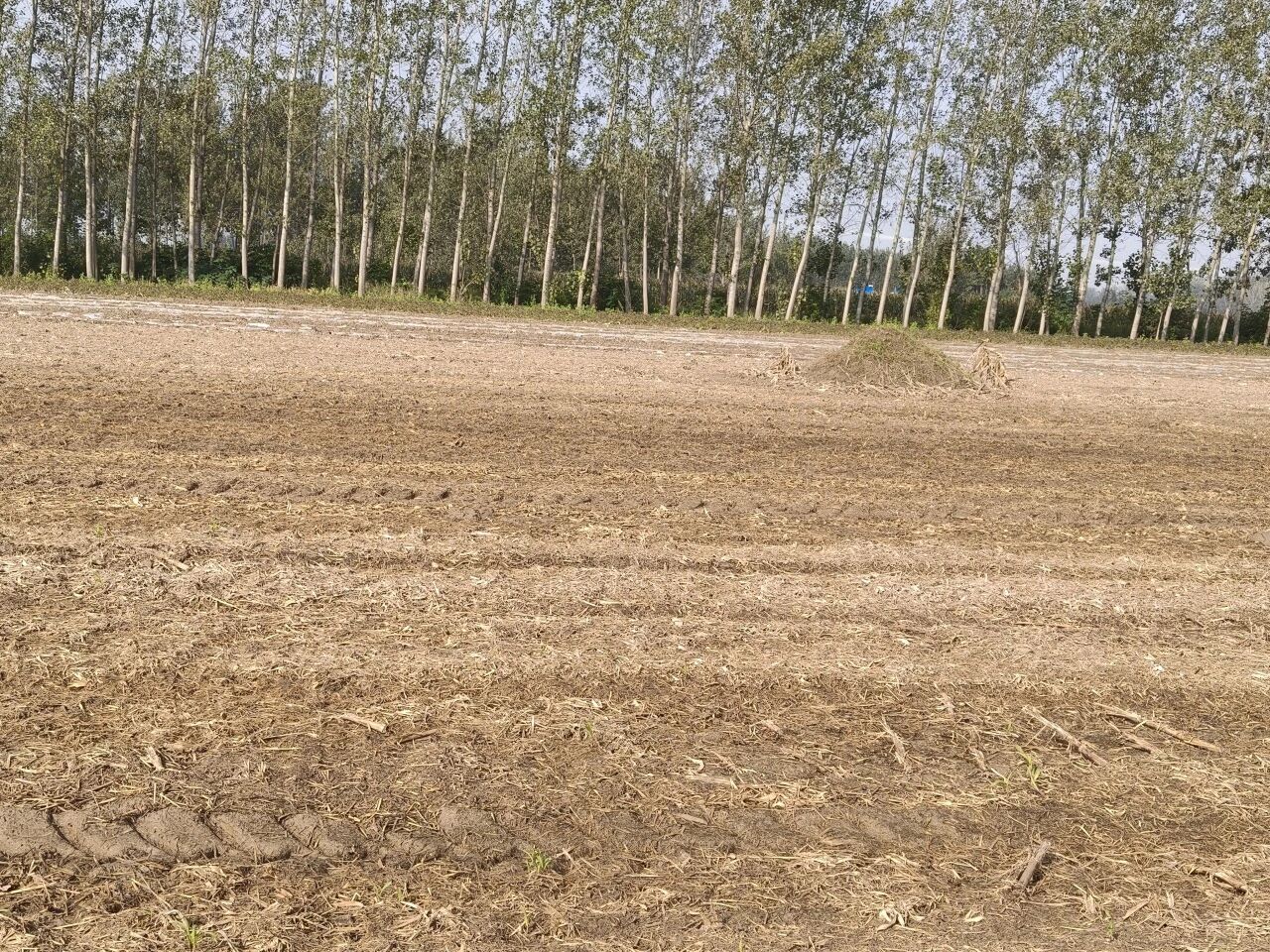
Zhao Feng, a thousand-mu grower in Jiecheng Town, Fengfeng Mining Area, has two tracked combine harvesters. This type of machine is lighter and uses tracks to distribute its weight, making it better suited to waterlogged ground. But he still could not harvest — the tractor used to collect the cobs still could not get into the field. His farm is so large that many plots are dozens or even hundreds of metres deep from the access road, so carrying by hand or using a three-wheeler is not practical. For Zhao Feng, 1,000 mu requires nine or ten workers harvesting continuously for 10 days to half a month. But on 17 October, the rain had only stopped for a few days before it started again locally. He has not found a good window to begin harvesting.

Elder Li in Shangqiu also picked over two mu by hand. The ground was so wet that even a three-wheeler would sink into the mud, so he had to chop down some corn stalks and lay them on the ground before he could drive the three-wheeler into his corn field. But hand-picking corn is slow and back-breaking, and people are not machines, Elder Li says: “The first day I could strip a full mu, but the next day I couldn’t manage a whole mu — only half.”
In the end, Elder Li did get a harvester in. Much of the corn on the remaining four mu had already started to mould, and he had to bring it in quickly.
To get the emergency harvest done, many farmers have paid considerably more than in previous years. In Mengcun, Xiuwu County, Jiaozuo, Henan, villager Cheng Xiaolin is a major local grower who, together with other large grain farmers, also set up a grain production co-operative. He explains that hiring a local harvester comes with a subsidy, but all the local machines are wheeled and unsuitable for damp soil. Many farmers would rather forgo the subsidy and hire a tracked combine harvester from elsewhere.
In Xiaoyizhuang Village, Feixiang District, Quzhou, Hebei, farmers do not even receive a harvesting subsidy. One villager used the brief two-day lull before the Mid-Autumn Festival to rush the corn harvest. Hiring farm machinery cost 80 yuan per mu, twenty or thirty yuan more than usual. Quite a few other villagers simply kept waiting — even with a wheeled harvester idling at the field edge, they were afraid of compaction damage and would rather delay the harvest.
By 18 October, whether in the Fengfeng Mining Area to the west of Handan or in Quzhou and Feixiang to the east, where grain acreage is even larger, Foodthink found that the main growers bringing in corn were still small, scattered farmers, carrying cobs out bag by bag, sack by sack, by hand. The large growers who farm several hundred mu and must rely on harvesters had not yet brought in their corn.
II. Drying Out, Drying In: The Cobs Still Went Mouldy and Sprouted

But freshly picked cobs may actually carry even more moisture than when they were still in the ground. Left damp without drying, they can go mouldy overnight.
Large enterprises such as Sinograin only buy “dry grain” — corn kernels with a moisture content below 14 per cent. The moisture content of freshly harvested corn, however, is typically 20 to 30 per cent. By experience from past years, Henan farmers spread the harvested kernels flat on open ground and can dry them out in two days.
But in sustained rainy weather, a stable drying yard with a hardened surface is a luxury most smallholder farmers cannot afford. On bare earth or brick ground, the cobs absorb moisture from below, heat up, and can begin to ferment or even spoil. Rain may continue to fall from above; lay a plastic sheet to keep it off and the trapped humidity inside becomes even worse. As one person put it online: “Leave them uncovered and they sprout; cover them and they mould.”
Larger drying spaces are even scarcer. A grower in Zhu Zhuang Village, Shangqiu, who leases over 100 mu, can only keep shifting his corn back and forth across a limited stretch of open ground. The grain stations and traders who buy corn in volume have to use a front-end loader to turn the cobs over every day.
Uncle Chen in Xicai Village, Xian County, Cangzhou, Hebei, leases 300 mu and has a large dedicated yard for drying, so he has been a bit more “lucky” — after the National Day holiday, rain fell for a week, but not as long as in Handan or Henan, and the several thousand jin of corn he had already brought in came through undamaged. However, the brick foundation of the drying yard was soaked through by the rain; bricks had rolled into the mud, and when trucks drove in their wheels went all over the place, so subsequent harvesting was also interrupted. The couple quickly hired workers to pour concrete, but as of 17 October only a small fraction of the work was done. The project has cost them more than 100,000 yuan.


In most of the villages Foodthink visited on this trip, villagers stack their corn cobs in cylindrical grain bins and pile them up in the courtyard or on the roof. Uncle Chen took a different approach: he bought steel pipes and wire mesh and built square corn racks that can also be raised off the ground at the base for ventilation. He told us proudly that his corn suffers fewer pest problems, and that rainwater finds it hard to seep in through the chewed-up kernel skin. He also believes the corn he harvested had fully matured past the milky stage, and that his storage methods are more sound. All of this, he feels, has kept his corn from going mouldy.
But even in corn racks just like Uncle Chen’s, in another town in the Fengfeng Mining Area to the west of Handan, corn trader Li Jun’s cobs still went mouldy quickly. He had rented a concrete yard and has a large warehouse specifically for storing corn; only this year did he spend the money to set up his corn racks. The rain in Fengfeng lasted longer, and the latitude is lower than Cangzhou’s, so corn here matures relatively earlier. They could only rush to thresh the corn and spread it on the ground to dry.

From 13 October the weather cleared, and they dried corn kernels on the concrete yard for three straight days. The moisture was finally starting to drop, but on the 17th the forecast called for another round of rain the following day. They spent the whole day in the fields rushing the harvest. “If we do not get it in tomorrow, it will all have been for nothing,” they said.
Drying in the open is hard; drying in a machine is harder still. Smallholder farmers lack drying equipment and have only two choices: either sell the freshly harvested “wet” cobs or kernels to middlemen at a low price, or give them a brief drying at home and then sell them as dry grain — which, even after deducting the weight of the cob cores and the moisture, works out at a better price. On top of that, corn prices on the spot market are volatile, so farmers also store their grain, hoping to get a higher price later than at harvest, or even holding it until the twelfth lunar month.
Li Jun would also like to buy a grain dryer. A single unit costs at least a hundred thousand yuan, and a large one can run into the millions. But the yard he rents is not a stable arrangement, and he does not dare to make such an investment on a whim.
III. Surviving the Drought’s Reduced Yield, but the Mould Is Harder to Bear
From early July to early August, Henan was hit by widespread high temperatures and drought. This period also coincided with the critical grain-filling stage of corn growth — the phase from tassel emergence and pollination through to full kernel maturity. To ensure plenty of heavy kernels with full grain filling, this is when the crop most needs water. The farmers had been praying for rain, but it did not come. To fight the drought, they could only keep pumping water from tube wells to irrigate their corn.
In Mengcun, Jiaozuo, farmers had to irrigate almost every fortnight, watering four or five times in total. Fortunately, the irrigation conditions in their fields were relatively good. But in some fields the water table in the tube wells was too deep, and they could manage at most two or three rounds of irrigation in the early period. So some of the large growers who farm several hundred mu could keep up with the watering at first, but after two or three rounds they could not.
In many parts of Hebei, deep groundwater wells are used. Zhao Feng’s town of Jiecheng in the Fengfeng Mining Area, Handan, sits at an elevation of over 200 metres. Water is pumped from the tube wells and then pumped again out to the fields; the electricity alone costs 60 yuan per hour, and it still does not thoroughly water a single mu. Li Jun in Xinpo Town, Handan, also recalled that during the drought the whole village dried up, and people started drawing water from two large ponds of about 50 mu each, until the fish farmers in the ponds protested.
“Bare-stalk corn, standing that tall without a single cob, the leaves curled at the edges.” Zhao Feng was caught between laughing and being exasperated by the “little dwarf” corn in his fields. He had paid the electricity bills for irrigation, but in some of the higher-lying plots the expected yield was less than half of last year’s.

Even Elder Li of Zhu Zhuang Village, Zhecheng County, Shangqiu, who had irrigated on time and managed to get through the drought, found his corn starting to mould in the ground by harvest time. “It just does not weigh as much on the scale anymore,” he said.
The combine harvester also has trouble cutting through rotten stalks — the cutting header has a fixed height, and if the stalks have rotted from the bottom, the fallen corn cannot be fully picked up. Elder Li said he had originally expected a fairly high yield per mu; in normal years he could recover 90 per cent of what was standing, but this year it was only 50 to 60 per cent, with the rest scattered across the field.
Mouldy corn is also hard to sell — grain processors have requirements on the mould rate. Corn that is too mouldy cannot even be used as feed grain. Some villagers only picked the good cobs by hand, leaving the rest of the mouldy ones on the stalks to be incorporated back into the soil.
In the end, Elder Li’s four-plus-mu plot in Henan yielded less than 3,000 jin of corn kernels, an average of six or seven hundred jin per mu — half of what he usually gets.
IV. Low Grain Prices: Frost on Snow

But the mould has been so severe that even the good corn they managed to rush in cannot command a proper price. Elder Li in Shangqiu, Henan, whose rushed harvest of under 3,000 jin of corn could fetch at most just over 0.3 yuan per jin, sold four mu of land for less than 1,000 yuan. It broke his heart.
Another farmer interviewed in Shangqiu said the corn he picked from his 2 mu 4 fen of land was all sold at 0.2 yuan per jin, earning him only 200 yuan — a tenth of what he usually gets.
Smallholders like Elder Li have very low costs beyond their own labour, and farming earns them only a few thousand yuan a year anyway. Even with heavy losses, their living can be supported by children working away from home.
But large-scale growers who lease land for conventional cropping face higher costs. Land rent alone is 600 to 1,000 yuan per mu, and can go as high as 1,300 yuan. Faced with natural disasters and market volatility, their business risk is multiplied.
Cheng Xiaolin leases 900 mu. Because of the reduced yield, he calculates he is losing 100 yuan per mu this year. In a normal year, a large grower only makes a few hundred yuan per mu. A thousand-mu grain grower in Jiecheng Town, Fengfeng Mining Area, Hebei, frankly admitted that this year’s wish is simply that after selling the corn he can settle all the rent, fertiliser, and seed costs to the landowners and have eighty or a hundred thousand yuan left over to cover his own living for the year.
Not only are farmers not making money; the risk of mould is cascading down the supply chain, and buyers may end up losing money too. Corn Li Jun bought in Nanyang at 0.58 yuan per jin rained on the whole way during transport. The cobs started sprouting in the truck, and by the time they arrived the moisture content was above 40 per cent — the maximum reading a moisture density meter can register. In the end, the corn kernels bought at 0.58 yuan were resold at half price, and three trucks of the trade actually cost him 50,000 yuan. Another corn trader in Quzhou County, Hebei, brought in several hundred thousand jin of cobs, all of which had sprouted. If sold, he would lose 0.25 yuan per jin of wet grain; if not sold, they might mould further.
Now, in Li Jun’s warehouse there are four grades of corn: the relatively good ones, 30 per cent mouldy, 50 per cent, and 70 per cent. The proportion of the worst is possibly still rising.
Amid the volatility, villagers are still hoping corn selling prices will rise. In Quzhou, Hebei, although the cobs they have brought in are all starting to mould and sprout, and the buying stations are no longer daring to take in any more, some villagers still believe that this year they “don’t necessarily” stand to lose money: if the price of wet cobs rises to 0.75 yuan per jin, even if they throw away a third, they might still make a small profit. Hoping this is more than just a case of Ah Q spirit.
V. Disasters Year After Year, Crops Rotting in Line
Although there is still a window before the ground freezes for winter wheat to be sown, some growers worry that the delayed planting will coincide with falling temperatures and could cost them yield. Cheng Xiaolin explains that the wheat’s tillering rate — the number of tillers a plant puts out — will be low, which means fewer ears. Normally a single wheat plant can produce four or five tillers; now it may manage only one, and a yield reduction is certain. To make up for it, farmers can only buy more seed: “Before it was 25 jin, now you need 40, and further down the line, even more on top of that.”
In Zhu Zhuang Village, Shangqiu, some growers choose to plant garlic after the corn harvest, and they are even more anxious. In a normal year, by this time the garlic would already have three or four leaves, but this year it still cannot be sown, and the garlic seed at home has already sprouted. According to agricultural experts, the latest possible date for planting garlic is 20 October; if it comes to that, it must go in during November. Time is no longer on their side.
Other crops have suffered losses as well. In the past few days the fig trees have come into full ripeness just as the rains have not let up. Xiao Zhu of Zhu Zhuang Village has been getting up before six in the morning to pick figs; on 18 October alone he harvested over a thousand jin, but many of the figs had split open. In that single day he threw away two to three hundred jin — roughly a full day’s picking in a normal year. Because of the rain, he can no longer sell his figs fresh this year and has to dry them all into dried fruit for sale.
It was not until after three in the afternoon that he finally found time to pump out the water. After days of unbroken overcast, entering the fig orchard to pick requires knee-high rubber boots. At the peak of the standing water this year, the level came almost to the top of the boots, and an elderly woman from the village who had come to help was forced to go home and change her boots when water poured in, then return to finish the day.
Being close to Bozhou in Anhui, and with the local area serving as a nationally known chili pepper trading centre, many large-scale growers in Zhu Zhuang Village, Shangqiu, lease land to plant cash crops such as Chinese medicinal herbs and chili peppers. These crops carry higher growing costs: Atractylodes macrocephala can run to more than 10,000 yuan per mu. When natural disasters like the ones of the past two years strike, the losses for large growers can reach several hundred thousand yuan, or even over a million.


But the disaster they face each year is a different one. Last year, Zhu Zhuang Village in Shangqiu was hit by that extraordinary downpour. According to weather station records, from 7 a.m. on 15 July to 7 a.m. on 18 July, the average rainfall in Shangqiu reached 295 mm, with five observation stations recording over 500 mm — almost half a year’s rain in three days.
“After last year’s downpour, the provincial road was completely flooded, and kids were out catching fish in it. There was nowhere to pump the water to; the ditches and the road surface were level with each other. My fig orchard was completely submerged for six whole days,” Xiao Zhu said. In the end, many of his fig trees drowned after that storm and had to be dug up.
Many villagers in Zhu Zhuang Village still remember that downpour vividly, but this year, although there was no single torrential storm, the unbroken stretch of overcast rain without a clear day was equally rare. “Last year it was a straight total crop failure. This year there is at least some yield, but it is far more exhausting.”
The consecutive natural disasters became the last straw for quite a few people, and some chose to quit. This year, land rent in Zhu Zhuang Village has already started to fall: what was originally 1,000 yuan per mu has dropped to 800, and what was 800 has fallen to 600.
VI. Technology and Equipment Tracking the Northward Shift of the Rain Belt
In this autumn rain, some farm machinery not previously used in northern China — tracked combine harvesters, grain drying towers — has begun to see practical use.
Whether in Henan or Hebei, tracked corn harvesters are not common. The flat terrain of Feixiang District, in the Quzhou area of Handan, is a major corn-growing region in Hebei, and heavy wheeled combine harvesters have traditionally been the most popular. The villagers of Xiaoyizhuang Village in Feixiang District alone bought 15 of them. They have high horsepower, are easy to work, and are farmers’ favourite: they can thresh the corn and crush and haul away the stalks all in one pass. Although one costs as much as 300,000 yuan, some operators earned back 150,000 yuan in a single year last year. Tracked harvesters, by contrast, have been considered by some growers to be inefficient and slow. Among the areas we visited, only the Fengfeng Mining Area in Hebei had introduced tracked harvesters two or three years ago. Because that area is in mountainous, hilly terrain with fragmented plots, turning and U-turning in the fields is difficult, and the low-slung tracked type is far less likely to tip over.

In this autumn rain, grain drying towers have also become a “miracle weapon” for farmers trying to save their harvest. Cheng Xiaolin is the owner of the first grain drying tower in Xiuwu County. In 2023, he felt that large lease-holders produce so much grain and are unwilling to air-dry it, and that mechanical drying would become the future trend, so he invested over a million yuan to buy two grain drying towers.
In less than three years, according to figures released by Xiuwu County, the county already had 13 grain drying towers by 2025, with a combined daily drying capacity of 1,200 tonnes. Cheng Xiaolin estimates that next year there will be even more — several businesses are already preparing to set up.
But the number of grain drying towers in Xiuwu County is still limited. Over the past few days his tower has been running round the clock; the workers eat and sleep at the plant and can only squeeze in a trip home to change clothes. Yet the corn that farmers are rushing to harvest continues to pour in at the buying station, and when the warehouse cannot hold it all, it is piled up in the courtyard, then dried as fast as possible.

Sun Ming, who grows Chinese medicinal herbs, has been putting his drying room to a decidedly “sledgehammer-for-a-nut” purpose this year, lending it to the corn autumn harvest as well. The room was of course designed for drying medicinal herbs; drying corn in it is not cost-effective. But this year the corn is so damp that there is no alternative but to make use of existing facilities to recoup losses, and people from nearby have been coming to him to dry their corn too.

With the rain keeping everyone idle, Sun Ming, who trained in automation, set about designing a small grain dryer. He drew the plans himself, then found workshops nearby to machine the parts, and spent 3,000 yuan building a basic unit. The dryer works by burning pellets made from corn cobs, or simply by burning firewood, and uses the hot air produced to dry the corn.
Using this homemade dryer, Sun Ming dried the remaining two or three thousand jin of corn from his own farm. However, it has not truly come into its own yet this year. Still, in the future it could well become a form of self-rescue. Sun Ming thinks that if the weather continues to behave as it has this year, households with six to ten mu of land might do well to keep a dryer like this on hand.


But these machines are still limited in number in Hebei and Henan, which is why they have also become a priority measure for government departments this year in helping farmers cope with the disaster.
Earlier, the Ministry of Finance, together with the Ministry of Agriculture and Rural Affairs, allocated 484 million yuan in central government disaster prevention and relief funds for agricultural production, to support disaster-affected areas in seven provinces including Hebei, Henan, and Shaanxi in accelerating emergency farm-machinery harvesting, wet grain drying, and field drainage. As of 10 October, the Ministry of Agriculture and Rural Affairs had also, in response to demand in the Huang-Huai-Hai region, reallocated and dispatched 246,300 tracked combine harvesters.
At the local level, as of 15 October, to ease the pressure on the emergency harvest, Henan mobilised nearly 8,000 tracked corn harvesters for operations and brought the fitting of headers onto tracked grain harvesters within the scope of farm-machinery purchase subsidies. Meanwhile, 832 regional farm-machinery service centres and 742 emergency farm-machinery work teams were deployed for emergency harvesting, and the locations and contact details of 4,963 drying machines across the province were made public to farmers. A total of 50 million yuan in disaster relief funds was allocated in stages for drying-machine subsidies, autumn grain harvest grants, and farm-machinery dispatch.
Hebei strengthened its farm-machinery emergency response. During the “three-autumn” season, the province expected to deploy 730,000 pieces of farm machinery, including 220,000 medium and large tractors, 76,000 corn harvesters, and 168,000 wheat seeders. It held 568 tracked corn harvesters and 1,292 grain dryers (towers) in reserve to meet emergency needs.
Although, during our mid-October visits, no farmers in Hebei or Henan reported having used farm machinery dispatched by local departments or having benefited from the dedicated funds.
Agricultural insurance has also been playing a role. Some farmers who had taken out corn insurance were still able to receive some compensation, though not much. Thanks to the insurance payouts, Cheng Xiaolin, whose indemnity was 100 yuan per mu, was almost able to break even. Some farmers in Zhu Zhuang Village also received around 100 yuan in compensation.
The question is how many farmers these measures can actually reach, and to what extent they can help farmers mitigate the losses caused by the disaster.
In Lubianqiao Village, Jiaozuo, the villager Foodthink met sold the corn from his two mu four fen of land for just 200 yuan this year. In the fields beside the village, large amounts of corn had gone mouldy, yet no agricultural insurance compensation was received. “The agent said this year’s situation doesn’t count as a total crop failure. The villagers got into an argument with him — he turned and walked away, and wouldn’t answer the phone afterwards. The claim decision is in their hands; if they say it’s not covered, there’s nothing we can do,” he said.
In farmers’ planting experience, drought and waterlogging are the two most common disasters. But drought is not so frightening — pumping water for irrigation can still address it. Waterlogging, however, is the situation they fear more. In the face of climate change, the planting experience farmers have accumulated over the years is also becoming obsolete, and they are even less able to save themselves. And similar disasters may well recur. Under the unending rain, who can “hold up an umbrella” for farmers?


Sun Ming, Zhao Feng, and Li Jun are pseudonyms
Foodthink members Ling Yu and Yuyang also contributed to this article
Editor: Tianle