
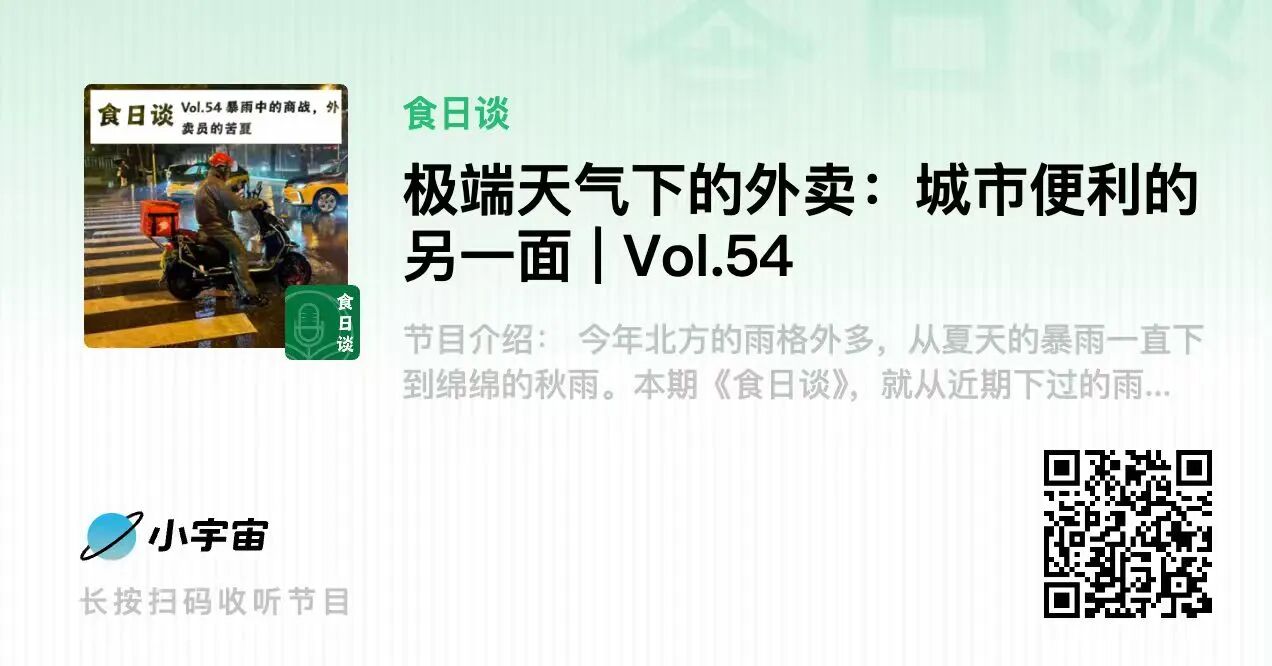
Food Delivery in Extreme Weather: The Other Side of City Convenience

This year, the north of China has seen an unusual amount of rain, from the violent summer downpours all the way through to the persistent autumn showers. This episode of Food Talk begins with that recent downpour. We are joined by Yuyang, a former delivery rider who now works as an editor at Foodthink, to pick up the thread from his article “Business Battles in the Downpour: A Delivery Rider’s Bitter Summer” and talk about the realities of food delivery in extreme weather.

In the episode, we hear further details about what life is really like for delivery riders. On rainy days and in extreme heat, there is no “weather allowance” – in fact, riders risk being fined simply for not clocking in. What look like caring gestures – the “heat allowance” and the “summer cool-down campaign” – turn out to be the platform’s way of using a neatly designed “tiered reward” scheme to shift even more risk and labour pressure onto the riders themselves.


In bad weather, riders have no sick leave and no circuit breaker mechanism. Delivery platforms build their model on sacrificing riders’ rights, in turn cultivating consumer dependence on “cheap delivery”. The paradox this creates is that when we ask “should I order delivery on a stormy day?”, we tend to assume the rider absorbs the cost on the consumer’s behalf, setting the two sides against each other. But has the cost really been transferred?
As physical markets and small family-run shops are squeezed out of existence – or simply vanish – we seem to be losing a warmer, healthier way of eating and living. Meanwhile, under the pressure of high commission rates, merchants produce cheap food that lacks proper safety guarantees, and delivery riders are involved in a steady stream of traffic accidents. These consequences can still come flying back, like boomerangs, to land on every one of us. Do we still have choices that could change things?
In this conversation about the downpour, many questions feel vast and unsolvable. A small but encouraging note is that we can still, together, imagine whether there might be another way to get through a rainy day – perhaps holding an umbrella and heading out to buy groceries, rummaging through the fridge, cooking a meal together with the family. After all, for each of us, those small shifts may well be where taking life back into our own hands begins.
Guests of This Episode
 Tianle
Founding Editor, Foodthink
 Yuyang
Editor at Foodthink
Host of This Episode
 Xiaojing
Host of Food Talk, with a focus on food culture and sustainable living
Timeline
14:52 The platform’s “heat allowance” is really an actuarial game – the finer the reward tiers, the more skillfully the risk is shifted onto the workers.
18:48 On downpour days, there is no “circuit breaker” – deliveries are still on the road. The city’s rhythm never pauses; the only thing that pauses is a person’s safety and a moment to catch their breath.
21:49 Order or not? The pull between convenience and empathy: we want to save time, yet we also ask ourselves – who is absorbing the cost of this convenience?
29:27 As wet markets shut their doors and small family-run shops disappear, delivery platforms have become the city’s new front door. There are more choices than ever, yet they are also more uniform than ever.
31:50 The warmth of a restaurant meal, the everyday hum of home cooking – all of it exists outside the algorithm. We eat faster and faster, and it gets harder and harder to remember what “flavour” even means.
36:39 When delivery becomes a “quasi-public service”: as convenient as the metro, yet with no public safeguards. What are we using to sustain this convenience?
45:17 On a rainy day, why not grab an umbrella and head out with a friend to buy groceries and cook; or rummage through the fridge and put together a creative rainy-day “stay-at-home meal”. Perhaps slowing down, just a little, is where taking life back into our own hands begins.
Related Reading ▼
A Discussion on “Should I Order Delivery on a Stormy Day?”
Business Battles in the Downpour: A Delivery Rider’s Bitter Summer
Film vs. Reality: What Is a Delivery Rider’s Life Really Like | Food Talk Vol. 38
The Moment They Decided to Stop Ordering Delivery | 3·15: Eat Something Good
“Pinhaofan”: Who Actually Gets to Eat a Good Meal?
How a French Delivery Platform Is Flipping Global Platform Capitalism?
Scan the QR code below
On Xiaoyuzhou | Ximalaya | Lizhi | Apple Podcasts
Subscribe to the Food Talk podcast

Feel free to leave a comment on any podcast platform; we reply from time to time. Scan the QR code below to add Shitongjun’s secondary WeChat account. Note “Food Talk” in your verification message to join the podcast listeners’ group chat.

Unless otherwise noted, all images are provided by this episode’s guests
Podcast music: Banong
Production: Xiaojing
Editing: Yuyang
Contact: [email protected]