
Fermented Delicacies Across China – Come and Taste This National Day
Foodthink Says
Since fermentation is, at its core, a process in which microorganisms interact with a specific surrounding material environment under human guidance, of all cooking techniques it is particularly able to reveal a place’s local colour and character.
So wherever you are, make sure to try the local fermented specialities!
Fermentation is more than a cooking technique – it is a way of life. Dongbei pickled cabbage might be a “liuzi” (student studying abroad) aching for home; sharing kombucha starter culture is a continuation of friendship; the recipe for pickled vegetables can be passed down through generations, and so can the pickling brine.
In the pages below, you will find Guizhou’s fermentation starters and sour soup, the Dongbei’s pine-nut malt candy, Kunming’s aubergine zhā, Shanxi’s tousu, Jiangxi’s steamed rice cakes, Hunan’s chopped chilli… If you are lucky enough to taste any of these, do share in the comments! And if there are other fermented foods you would like to recommend, feel free to leave a comment – let us keep building this “Guide to Fermented Delicacies Across China” together.
Fermentation Secrets ❶❶❶❶❶❶❶❶
Know a Friend Who Ferments
Xiaofang (Beijing, female, born in the 1990s)
One evening while making pickles, I could hear a clank every few minutes. I imagine the pickle jar was breathing – quite endearing, a bit earnest and a bit mischievous.
But my pickle jar did grow bloom in the water rim, and the kombucha once turned over-acidic because work was so hectic I had no time to tend to it, which stretched the fermentation and made the taste too sharp. I don’t think either of these counts as a failure. Clean the water rim, add a pinch of salt, and it’s back to normal. Over-acidic kombucha can be used as starter culture – just make another jar. It also works as a vinegar substitute: great for a salad dressing, or for pickling radish.


To start, I was a complete fermentation novice, with a few misconceptions to boot – that homemade fermented food is unsanitary, that I shouldn’t eat it for fear of exceeding bacterial limits, and so on. The Beijing Organic Farmers’ Market has hosted many workshops on making fermented foods, and I’ve been fortunate to connect with several farmer-friends and makers who know their fermentation. I bought a bottle of kombucha from shuyu, which gave me starter culture to begin experimenting on my own. I learned Sichuan pickled vegetables from Wanlin. Some things I’ve learned with my eyes but haven’t yet put into practice – like the sweet fermented rice and rice wine I learned from Qingcao Shanren, or the miso from Xiuzai Doufang.
The most memorable fermented dish for me was when Jinpeng, a farmer at the Beijing Organic Farmers’ Market, made fresh pine-nut malt candy, truly exquisite. First you toast the pine nuts and the fragrance has already begun to spread. When the maltose syrup is cooked to just the right point, the pine nuts go into the pot and the sweet aroma intensifies – I’m practically drooling. Cut into pieces while still warm, the pine nuts distributed evenly throughout. Take a bite: first the maltose, mellow and delicately sweet, then the pine nuts’ crunch and their rich, oily fragrance burst out with a satisfying crack. If I weren’t worried about the calories and about looking unseemly for eating too much, I genuinely couldn’t stop 😅.


The pickled vegetables my husband brought from his hometown in Yunnan, put into our pickle jar here in Beijing, simply won’t last. By “won’t last” I mean they grow mould. I suspected the jar wasn’t clean enough or didn’t seal properly, but cleaning it and resealing with the water rim didn’t solve the problem. Eventually I accepted it: apparently pickled vegetables can suffer from local acclimatisation, too.
That said, online sharing tends to start from personal experience, and in the telling it’s easy to overlook the specific factors of one’s environment: whether the local tap water contains chlorine; how the local temperature and humidity are, whether the day–night range is wide; where the ingredients come from, whether they carry heavy pesticide residues; or whether they’ve been through lengthy transport and storage and are no longer fresh enough, requiring more elaborate preparation; the varieties grown in different regions will also produce different results… and so on.
The information in books tends to be organised in greater detail; reading them page by page can be a bit dry, but they work well as a reference while you’re in the thick of things. After practising all sorts of fermented foods, you start to find the common threads, connecting the dots until everything clicks.
For someone just starting out with fermentation, I think the best path is still learning in person from someone experienced, absorbing their knowledge firsthand. Fermentation is an instinctive activity that calls on the senses – to smell, to touch, to exchange microorganisms with the food, to taste, and to feel its changes as time passes. Unless you’re using industrially purified cultures in a strictly temperature- and humidity-controlled environment, I generally resist following a very precise recipe with exact ratios, because different regions have their own climates, even their own taste aesthetics. If you’re in the habit of applying one formula to every fermentation process, what’s the point of making fermented foods at home in the first place?
Back home in Sichuan, there are all sorts of pickled vegetables and broad bean paste. After leaving Neijiang, I tried making pickled vegetables on my own. I have no secret recipe; I mainly rely on my aunt guiding me from a distance – whatever she and my mum tell me to do, I do.
Fermentation Secrets ❷❷❷❷❷❷❷❷
Share and Let Fermentation Flow
Since moving to Hangzhou, the culture and I have together embarked on a new round of climate adaptation. From early spring through the scorching heat, we’ve weathered a late-spring cold snap, the plum-rain season, torrential downpours, and a record-breaking 60-plus days of extreme heat. There have been times when I’ve been rattled – for work or personal reasons – and neglected its care, dodging the responsibility of tending it. But we are adapting, after all. Both human and microbe have resilience; once through the damp cold, the mould, and the low pressure, several jars of kombucha began producing steadily, bubbling away. Our new life has finally fermented to the stage where it can be shared with others.
Beyond drinking, I collect the leftover pellicle. Thin or thick, soft or hard, dark or pale – it metabolises climate, time, and mood into physical texture. So I tried deconstructing the microbial cellulose into the fibres of textile language, recording life in a different form, expressing microclimates. After posting on Xiaohongshu about fabric I made with kombucha, the owner of an independent chocolate shop in Chengdu (chocolate is a fermented food, too) sent me a direct message. The zero-waste, reuse aspect of the pellicle struck a chord with her, and she proactively offered to provide me with pellicle. Me, who used to give away starter cultures everywhere, never imagined I’d one day be hunting down pellicle to recycle. Fermentation always holds new surprises and possibilities.


There’s also a little story about this starter liquid during its journey. When I first took my friend’s mother culture onto the plane, security questioned the unidentifiable liquid and opened my case for inspection. I made up an excuse and said it was a homemade beauty fermentation product, something like SK-II – I even demonstrated on the spot how to apply it to my hand and said it was drinkable and harmless. Of course, the straight-up male security officer couldn’t parse my explanation and told me to throw it away. I naturally insisted it couldn’t go – it was my precious treasure – and so we were stuck in a standoff at security until he had to go fetch his supervisor. In the end, the starter liquid wasn’t thrown out. The supervisor came, found me a small decanting bottle, and I took home roughly 20 ml. I’ve also suspected that the starter got contaminated during the decanting, which is why my kombucha never properly fermented.

Because my mum loves it, there’s basically always fermented food in the house – every meal has some. Consistently eating fermented food really does make your gut feel great. And it adds flavour to every meal – no lie.

As the friend started baking, he also began distributing this yeast among bread-making friends in Berlin, and I was fortunate enough to receive 100 g of the leaven.
These past two years I’ve been baking while continuously sharing the yeast in my social circle, and of course my friends keep spreading it through theirs. It’s gotten to the point where, when I’m visiting different people’s homes, I occasionally see a look of delighted shock from complete strangers: So you’re the yeast owner!!
I feel like, without realising it, I’ve founded some kind of massive organisation.
Several years ago I used to culture yogurt and was very curious about Finnish viili. I happened to have a friend travelling in Finland at the time. She bought viili at a supermarket, planning to bring it to me as a souvenir, but only found out at airport customs that dairy products are restricted and can’t be taken out. At the time, I was fascinated by the idea of air-drying yogurt on a handkerchief for travel, then using the dried yogurt as a starter to cultivate new yogurt at the destination. Inspired by this, my friend got a bright idea: she dipped a tissue in a little yogurt, put it in a small jar, and sailed through customs that way. She told me to re-culture this “smuggled” starter with milk in Berlin and build it up again.
Living in Germany, tempeh, as an alternative protein food, is very popular with vegetarians. But my several experiences of buying tempeh at the supermarket have drawn a big X over it in my mind – they’ve usually been freeze-dried and wrapped in vacuum plastic bags. Sliced and stir-fried, they’re hard to flavour, and tasting them is literally chewing wax.
Until last year, when I visited Singapore for an exhibition, two fellow exhibiting designers showed their work: a tempeh necklace. The wearer mixes soaked beans with tempeh culture and hangs it around their neck; body temperature provides the ideal fermentation range for the tempeh mould. Of course, the use of tempeh culture itself originates in Southeast Asia, and it works even better in Singapore’s humid, tropical climate – like its home turf.
After more than a day of wearing the tempeh necklace, I tasted fresh tempeh – incubated by my own body heat – for the first time. Only then did I realise its texture carries the gentleness of mycelium, the microbial community breaking down the soy to produce a deep umami richness – I can easily imagine it absorbing flavours in cooking the way tofu does. But eaten on its own, it’s also incredibly gentle and deeply savoury – perfect as a tea-time snack, a modest little treat that doesn’t steal the show. In short, it’s a completely different thing from what you find in German supermarkets!!
Fermentation Secrets ❸❸❸❸❸❸❸
Constant Temperature, Sterilization, and Contamination Prevention
It still stings when my kombucha grows the wrong kind of mycelium, and I haven’t managed to salvage it. I also made a gorgeous blueberry enzyme but couldn’t propagate the culture successfully. On the other hand, if the initial fermentation fails but you can rescue it in time and get it going properly again, that’s still really satisfying.
Luckily, mulberry + rock sugar worked – sweet with a tang, diluted with water, and no worse than a lemon drink. Once I can make it myself, I end up buying fewer industrially produced beverages.

Fermented food can extend shelf life, which is convenient. When I’m too lazy to cook, a jar of fermented food is a dish in itself – a lazy person’s blessing. Something like kombucha is relatively healthy, no excessive sugar, and there’s no guilt in drinking it. I’ve already quit milk tea, hahaha 🤣
Recently two more bottles of kombucha failed. The pellicle grew fuzzy mould on the surface, probably because I was too lazy to swap jars and sterilise. I fished the pellicle out, poured some of the liquid away, and added fresh sweet tea in the hope of salvaging it, but it still didn’t work. I had to pour it all out, wash and sterilise the jar again. Fortunately I still have one jar of “fire seed”.
Because I only make enzyme and kombucha, I feel like a lot of people don’t quite get it, and I’m not great at sharing with others. My enzyme is made for cleaning – works brilliantly. One year, when getting my rental deposit back, the inspection was extremely strict, so I used all the enzyme to scrub away every last trace of old grease. Incredibly effective, and I got praise from the landlord’s caretaker.
I actually really enjoy eating small fermented pickles. There are so many I love: sour pickled cabbage, pickled long beans, pickled Chinese chives, pickled radish strips, pickled chillies. The most memorable fermented dish I’ve had in Kunming has to be eggplant zhā – with eggplant zhā I could eat two extra bowls of rice 🍚
Last year, during my pregnancy, I really craved Kunming eggplant zhā, so I decided to try recreating it at home. I looked up recipes online and consulted a former colleague in Kunming who loves cooking. Ambitiously planning to do it all at home – from picking eggplant in the garden 🍆, cutting it into strips and drying them, mixing with rice flour, steaming, then jarred for fermentation – the first attempt failed. It turned into steamed dried eggplant in rice flour. But I still wanted to taste eggplant zhā, so I thought maybe I could ask a friend in Kunming to buy some and mail it over. Except it was summer, and by the time it reached Jiangxi it would probably have gone off. So I tried a second time – failed again. Mum’s garden had plenty of eggplant, so I tried a third time. I still couldn’t replicate the taste of Kunming eggplant zhā, but the flavour had improved a bit – maybe a two-out-of-ten resemblance. With the baby in there, all I wanted was that flavour. It’s become a memorable little pregnancy story.

After all these different attempts, I’ve come to realise that once you acknowledge the presence of microorganisms and understand that different microbial communities take the lead at different stages of different fermented foods, and treat them like pets – providing suitable living conditions: anaerobic? oxygen-free? What temperature and humidity range? – using fresh, organic ingredients and chlorine-free water – and finally stopping the microbial activity at the right time, it’s hard to fail.
In my view, a truly failed fermentation is food contaminated by unwanted bacteria to the point of rotting or moulding – of course, you have to decisively throw it out. But if it’s just that you missed the exact moment to stop the fermentation and the flavour isn’t what you expected, most of the time I decide based on my own taste whether I can work it into something else.
My secret recipe, naturally, is rice bran apples. Here’s an excerpt from notes I wrote elsewhere before:
Two attempts, both failures. I don’t know what the ideal flavour of rice bran in food should be; I have no such taste memory, and my sense for gauging fermentation time is very vague, so that every time I dug food out of the bran bed and popped it in my mouth, my first reaction was to immediately spit it out: a salty, strange taste (the bran flavour) thoroughly soaked into the food – who on earth likes that?
Unpleasant food makes you lose the will to keep it going. The poor rice bran bed naturally headed towards its fate of moulding away in a corner.”
Back in Berlin, I tidied up the leftover rice bran bed starter I’d had from a Japanese supermarket and resolved to give myself one more chance.
I live in Germany long-term; this isn’t a rice-growing region. Supermarkets don’t carry rice bran, but there’s plenty of wheat bran and oat bran. I saw Nordic Food Lab demonstrate on their website how they build a bran bed with oat bran and beer, so I had no more doubts about using wheat bran to maintain one. All the experiences over these years have made me less obsessed with recreating the original flavours of distant regions. Instead, I learn the logic of pairings, source ingredients from what’s around me, and rewrite local flavours with new formulas. So Sichuan peppercorn and pomelo were swapped for more readily available black pepper and lemon.
This time I decided to indulge a bit of laziness and keep the bran bed in the cold store to feed it. At the same time, I also started cultivating sake starter Sakadane. On days I’m not making toast, the discarded starter becomes fodder for the bran bed.
With all these adjustments, turning over the bran bed each day – fragrant with lemon, pepper, and the combined aroma of rice and wheat bran – became the healing moment of my day. It also led me to accidentally discover that the best pairing I’ve tried with bran-pickled food is actually apple!
The malt and rice bran aromas just gently envelope the apple, set off beautifully by the bright, clean scent of the pepper, while the apple’s own flavour is still there. If you let it ferment a little longer (about a day and a half), you can also feel the lactic acid bacteria at work, giving the apple’s texture just a hint of effervescence. And suddenly I understood why people say eat bran-pickled in summer, miso in winter!
This year I visited a friend’s farm in Liangzhu, Hangzhou. The rice bran from rice grown using natural farming – without a drop of pesticide – is naturally the best nourishment for a rice bran bed. We both got into rice bran pickles at the same time, sharing tips and swapping notes every other day. While I’m devoted to this one bran bed and my daily apple ritual, she’s so energetic she’s already expanded her microbial crew to three – each with its own flavour, its own personality.
And I can’t help but imagine our reunion at the end of autumn or start of winter this year – meeting in person to swap and taste the different flavours raised with different brans in different regions!!
Making fermented food has anchored my life’s cycles: tending yeast and nurturing the bran bed by the day, refreshing kombucha by the week, ageing vinegar and miso by the month, even the year… I’ve found my own rhythm within these cyclical patterns, letting the microorganisms and the pace of my life gradually fall into sync.
At the same time, in choosing ingredients and providing living conditions for microorganisms, I’ve become more aware that fermentation should follow the seasons and adapt to local conditions. This fermentation-focused way of looking makes me pay more attention to how seasonal ingredients change, be more sensitive to temperature shifts, and hold more reverence for the land.
And learning how similar fermentation techniques have developed into different paths and aesthetic flavours across regions and cultures – that is a joy unique to cross-cultural fermentation practice.

⓿⓿⓿⓿⓿⓿
Making Sourdough Is So Hard
My family cooks a lot of Northeastern Chinese food. After going abroad, I really missed the big Northeastern pickled cabbage. At first I couldn’t find it in any Chinese supermarket – only southern pickled mustard greens. I used to watch Sister Gao’s videos and wanted to try making it myself, but I couldn’t find a big enough stone to press the cabbage down, so I just gave up. I ended up using Eastern European sauerkraut as a substitute – close enough, I figure.
I haven’t really stuck with fermentation myself, but the emergence of fermented food is absolutely one of the main reasons any culinary tradition took the shape it did. I believe time is what gives food its flavour.
I’ve tried sourdough bread as well, but my technique isn’t up to scratch – I can only say it’s edible;) Making sourdough is still quite hard. It’s either overproofed or underproofed, though neither stops it being edible. If it’s really overproofed, turning it into a pancake still tastes good.
The first time you make something fermented, success is always a real thrill. Once you’ve done it enough, it just becomes part of the daily rhythm.
If you want to get into fermentation, there are so many resources out there now: online articles, videos. I’ve also read a book called Nourishing Traditions, which has quite a few fermented food methods. Most are fairly easy to replicate, apart from bread – that’s more complex, sensitive to temperature and starter activity, and not so easy to nail.
The most memorable fermented food for me is probably dou zhi (fermented mung bean drink). The first time I drank it, it took me right back to the taste of my grandmother’s pickle brine when I was a kid – I actually quite liked it. When I was little, my family would often braise pork or fish with pickled vegetables; it was wonderfully savoury. Now and then I still make braised pork with pickled rapeseed greens, though I buy the greens these days. I do often cook pork belly with kimchi or stir-fry beef with pickled cabbage – both very good too.
⓿⓿⓿⓿⓿⓿⓿⓿⓿
A Map of Fermented Foods Across the Country
In some places it’s also called suan cai (sour vegetables) or sou cai (spoilt vegetables). When I was little, I thought it was basically the same as kitchen swill. Later I discovered that once you accept it, you can taste how full this vegetable broth is with probiotics – my gut loves it!
Beyond that, Yunnan’s fermented foods also include all kinds of zhā – both vegetable and meat varieties – plus pickled vegetables, preserved vegetables, and more. I could go on forever.
Of course, the most famous of all is chou gan zi (black stinky tofu). Miles from home, there are always moments when I’m ambitiously determined to recreate stinky tofu at home. But that ambition every single time hits a wall the moment I realise just how complicated the fermentation brine is to make… Sometimes you simply have to accept that a place has its own taste, and that home’s flavour can only be found back home. But, regrettably, these days there are fewer and fewer places that properly make the brine and use fermentation to turn the tofu black – which is probably why Changsha chou gan zi is gradually disappearing from the streets.
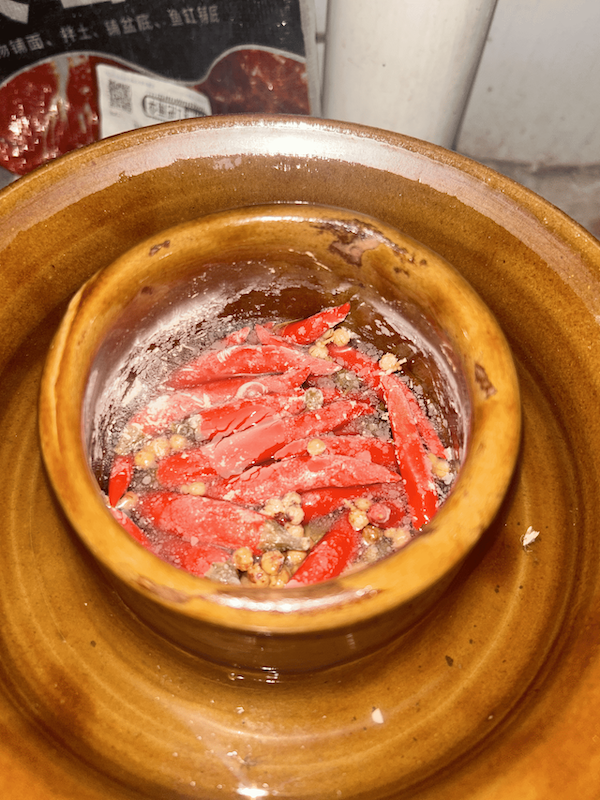
My ai qie (maternal grandmother) used to make chopped chillies often. Technically, oil-preserved chopped chillies aren’t a fermented food but a pickled one. Still, salt-tolerant lactic acid bacteria can survive and work in the chillies’ own moisture, quietly fermenting in the fridge. Every time you open the jar you can hear a little “pfft” of gas releasing. That’s probably why chopped chillies get better the longer they sit.
In Germany, because of the higher latitude, it’s hard to buy fresh chillies in large quantities all at once. If I only made a small jar each time I chopped chillies, I’d really be hampered. Besides, different varieties taste different, and it never quite feels the same, so I use every trip back to China to haul big jars of chopped chillies home to Germany.
But this year, when I went back, I received a bottle of fermentation jar water from my ai qie’s friend – she’d been tending that jar for over twenty years. As soon as I got back to Germany, I poured it into my pickle jar, and it felt like overnight my jar had grown from a baby into an adult. And that ladle of jar water has become the thread tying my conversations with ai qie together – in our daily check-ins about how things are, I always end up reporting on the jar’s status. I feel like I’ve been entrusted with an important life, a bond, and a flavour.

Every herb used in the starter cakes is gathered by me from the mountains. It starts every year on the sixth day of the sixth lunar month. The deep forests are beautiful, and each herb grows in a different place and in a different season. Gathering all the more than 120 kinds of herbs needed takes over a month. For example, there’s a blood vine – it’s a vine hundreds of years old, and they come in pairs, male and female. Our tradition is to revere nature; we only take a small amount of bark and never damage its healthy growth.
Also, after going up the mountain to gather herbs, I like to have a little wine afterwards – it lifts my spirits the next day. Even during my postpartum confinement period I could still have some. You heat it up and boil an egg in it – delicious and nourishing.
I’m from Anshun. Anshun’s sourness shows up in its pickled vegetables. When I was little, every household made pickles, and different seasons called for different types. In winter, for example, you’d ferment rapeseed greens, cut them up, and stir-fry them with cured pork and sausage. I think the Guizhou fermentation closest to beer brewing is Kaili white sour soup – it uses the starch in rice for natural inoculation and fermentation. Among the ethnic minorities in the southeastern part of the province, especially the Miao people, every household has a jar where they keep their white sour soup starter. They tend it for decades or even over a century, adding starch and sugar every month to keep the yeast active. When it’s time to eat, they expand the yeast culture, mix it with fresh rice water, and make a hot pot.

