
As the Weather Gets Drier, How Else Can Rice Be Grown?
More than a year ago, at a community exchange on agriculture’s response to climate change, I first heard of a model called “climate-friendly rice cultivation.” Last month, I travelled with farming friends from Panzhihua in Sichuan, Wuhu in Anhui, and Fuyuan in Heilongjiang to the project sites of the Yunnan SiLi Ecological Substitution Technology Centre (hereafter “SiLi”) in Kunming, Pu’er, and Honghe, to see how this technology takes root in diverse rural settings.
On the surface, it is a technique for growing rice using aerobic tillage, reducing the time and area of soil submersion to achieve emission reduction.
But “greenhouse gas emission reduction” was not the topic farming friends raised along the way. In this reduced-water model, the pressing questions were how well the rice tillered, how yield performance held up, and just how deep a well you would need to dig in a drought-prone village. Compared with “climate change” in the abstract, people cared more about whether this technology could help them grow better rice with less water.
Uncle Li comes from Lianhe Village, Hongge Town, Yanbian County, Panzhihua. Lately, villagers have been coming to recognise the importance of a second rice crop in terms of food security and autonomy. But years of intensive vegetable farming have placed a heavy demand on groundwater, and the drought brought about by climate change has only made water scarcer still. Brother Wang in Wuhu has been growing water-saving, drought-resistant rice varieties for several years now; in the past two years, the early-year drought in Xihu Ancient Town, where he lives, has continued to worsen, and summer heat has become increasingly extreme.
Fuyuan sits at the easternmost tip of China, in the triangular delta where the Heilongjiang and Ussuri Rivers converge. There is no urgent water anxiety here, but villager Brother Zhu has also felt the policy’s steer on how everyone uses water, through government subsidies. Local rice producers irrigating with surface water receive a subsidy 60 yuan per mu higher than those relying on groundwater.
Heading south from Kunming, the climate characteristics and soil conditions shift from city to city and county to county, and the “climate-friendly rice cultivation” practices we witnessed took on different forms in each place. “Adaptation-based mitigation (climate change) action,” SiLi’s executive director Zuo Zhi summarised their outreach approach.
What is climate-friendly rice cultivation? When rice production costs keep climbing and there is little room for trading prices to rise, how do you get farmers who were never particularly keen on rice in the first place to embrace this new model? What does “adaptive” action actually mean? All the way down, SiLi’s practice gave my lingering questions a sense of direction.

I. “Climate-Friendly” Rice Cultivation
It is late August. Heading rice is rising from the ridges, sending out waves of rice fragrance. Each ridge is covered with transparent plastic mulch film, and there are scattered puddles in the furrows. The varieties used are conventional japonica rice—Shengnong No. 4, No. 7, and Yunjing No. 37—bred by the Yunnan Shengnong Rice Crop Research Institute and the Cereal Crops Research Institute of the Yunnan Academy of Agricultural Sciences.
“The water we use for irrigation mostly stays in the furrows; most of the time there is no water on the bed surface.” Zhao Hao, the project lead for SiLi’s climate-friendly rice cultivation, stood by the information board explaining to everyone this reduced-water ridge-and-furrow planting method, also known as ridge-and-furrow irrigation moist cultivation.

In agriculture, ridge-building refers to piling soil into raised linear ridges above ground level to form planting beds of specific height and width, known as beds. Furrowing refers to digging channels below ground level between ridges to facilitate drainage. This dryland ridge-and-furrow model is similar to the “two-ridge three-furrow technique” I once saw in the dryland vegetable-growing area of Lanzhou. Both involve planting crops on ridges and covering them with plastic mulch film. In arid and semi-arid vegetable-growing areas, ridge-and-furrow helps save water: the furrows collect rainfall or irrigation water, while the mulch on the ridges reduces soil moisture evaporation and suppresses weeds.
In the context of climate change, the ridge-and-furrow method is regarded as a climate-friendly rice cultivation model because it does not require flood irrigation, thereby reducing the likelihood of methane emissions from rice paddies.

In traditional flood-irrigated paddies, continuous submersion creates anaerobic conditions in the soil due to oxygen depletion. In such an environment, soil microorganisms continuously decompose organic matter—submerged crop residues, root remnants, and the like—releasing small molecules step by step. These small molecules are ultimately converted into methane by methanogens and released into the atmosphere.
The ridge-and-furrow method helps reduce methane emissions from rice paddies while also improving field management efficiency and working intensity.
A villager I met in Wagong Community told me that this 100-mu demonstration field, before the ridge-and-furrow model was adopted, required 15 people for field management—spraying pesticides, applying fertiliser. This year that number has been reduced to six. After the water reduction, people can walk into the field, and the work is easier than managing a flooded paddy.
At another experimental demonstration site in Wagong Community, SiLi also uses direct-seeding point-planting technology for upland rice, growing traditional local rice varieties. This skips the labour-intensive nursery-raising and transplanting stage, sowing seeds directly onto mulched or otherwise covered ridges, using appropriate covering to suppress weeds and retain soil moisture.
This dryland technique requires no flooding at all, fitting the characteristics of climate-friendly rice cultivation. In terms of yield, upland rice produces approximately 300 kilograms per mu, about 200 kilograms less per mu than flooded cultivation.

But direct seeding saves more labour than transplanting, and upland rice has stronger drought resistance, suiting the increasingly severe drought conditions in Yunnan.
According to data from the 2024 Yunnan Provincial Climate Bulletin, Yunnan has experienced below-average rainfall for six consecutive years. Entering winter and spring, droughts of varying severity occur across the province. Over the past five years, drought distribution in Yunnan has expanded from the core drought zone in central Yunnan and the areas to its east and south, spreading to northwestern, western, and southern Yunnan.
Two months ago, in Yongning Town and Youmi Village in Lijiang, I met smallholders who had begun small-scale trials of direct-seeded upland rice. Drought was also a main reason they were willing to try it.
II. Who to Partner With for Outreach?
Smallholders generally have little enthusiasm for growing staple crops like rice. In terms of price, rice’s market price is far below that of fruit and vegetable cash crops. On the input side, farmers also face rising costs of agricultural materials and labour. Given this context, when they face more severe drought during the rice transplanting season, the simplest and most effective option is to abandon rice and put their limited land and energy into higher-yield crops, or go to the city for work.
“Without subsidies, it is very hard to make money from (growing) rice. There is no reason to make them bear such a huge social responsibility for (climate change),” said Zuo Zhi. Faced with this reality, SiLi chose to partner with various grassroots organisations, with agricultural technology stations being one of their main partners at present.
Such institutions tend to have more motivation and need to promote rice cultivation.
As grassroots implementers of administrative departments, agricultural technology stations carry the task of ensuring grain production, while also having a mandate for technology extension. In particular, since 2022, the Yunnan Provincial Department of Agriculture and Rural Affairs has begun promoting dryland techniques for hybrid rice within the province to address increasingly severe spring drought. These factors form the basis for SiLi’s partnerships with county- and village-level agricultural technology stations.
“In our Yunnan, we have very distinct dry and rainy seasons. Over the past few years, rainfall during the rainy season has decreased. Especially in March and April, when it is time for rice transplanting, we are still in the dry season with very little rain—the seedlings simply cannot be planted.” A staff member at the agricultural technology station in Shiping County, Honghe Prefecture, explained to farming friends from various places. This is one of the earliest drought-prone counties in Yunnan to begin promoting reduced-water rice cultivation.
Behind the staff member are the contiguous trial fields in Doudibay Village, Yilong Town. Last year, the rice paddies here using ridge-and-furrow irrigation moist cultivation yielded over 700 kilograms per mu. Along the entire shore of Yilong Lake, rice paddies using this model total approximately 3,400 mu, for which SiLi provides technical support.

A staff member at the town agricultural technology station told us that, in order to complete their grain production targets, they had to put in considerable effort to persuade villagers to release their land for rice.
“Land rent in Shiping is 4,000 yuan per mu,” Zhao Hao added. If this land were used for vegetables, output value could reach 10,000 to 20,000 yuan per mu. Some vegetable crops can be planted four or five successive rounds and exported to markets in developed regions such as Beijing and Southeast Asia, with annual output value per mu potentially even higher.
To encourage villagers to release land for rice, the agricultural technology station not only provides seeds, organic fertiliser, and other essential agricultural inputs free of charge, but also conducts uniform aerial spraying and mechanical harvesting for the paddies. They also provide ecological compensation to rice-growing farmers in the area, at 1,500 yuan per mu.
Uncle Li exclaimed upon hearing this, “Back where I’m from, even a few dozen or a hundred yuan would be extraordinary!” In Panzhihua, he had hardly heard of subsidies at such a level.
Measured against local per-mu returns, this amount is not large. But as a subsidy for rice production, it is a considerable sum of compensation. This money comes from Shiping County’s ecological subsidy for protecting the Yilong Lake basin. Yilong Lake is one of Yunnan’s nine major plateau lakes, and as a lakeside village, Doudibay also carries the ecological protection mandate for this plateau lake.
Rice fits both the agricultural technology station’s grain supply target and the basin protection of Yilong Lake.

Fertiliser not absorbed during potato production accumulates heavily in the soil. Without the rice paddies to take it up, it would be washed into the lake in large quantities by rain, thereby increasing the risk of eutrophication in Yilong Lake. Rotating rice not only meets food security needs but also helps with the ecological protection of Yilong Lake.
III. Adaptation-Based Action
Not every region is situated on the shore of a plateau lake. In areas without an ecological protection mandate, the agricultural technology station’s primary concern is still how to meet grain production targets. “In the outreach process, we mostly focus on finding various points where our work can align with existing policy,” Zuo Zhi said.
Staff at agricultural technology stations in different areas interpret and implement policy to varying degrees. Some places focus on how to solve rice planting challenges; others emphasise how to carry out conservation tillage. In each new area, they need to find a point of consensus that fits the local context and promote the technology in a way that suits local conditions.

On the technical side, SiLi is still exploring new models to balance producers’ interests. In their demonstration area in Wagong Community, Kunming, we saw upland rice intercropped with citrus trees. Zhao Hao added that this design was mainly intended to offset the lower returns from upland rice, with fruit trees helping supplement some of the farmers’ income. In addition, intercropping fruit trees in upland rice fields does not involve any change to the land-use classification.
Beyond partnering with agricultural technology stations, SiLi has also been trying to collaborate with social organisations active across Yunnan. The latter have often accumulated extensive community experience in Yunnan’s rural areas and inevitably work with individual smallholders’ agricultural production. Through partnerships with such organisations, SiLi reaches individual smallholders scattered across Yunnan’s mountainous regions who still wish to grow rice.
We saw this type of cooperation model in Qielong Zhongzhai. The collaboration between local villager Che Zhixiong and SiLi was mainly facilitated by Village Eyes, a social organisation that has been working in the village for a long time and encourages villagers to use video to record the village’s daily production and life.
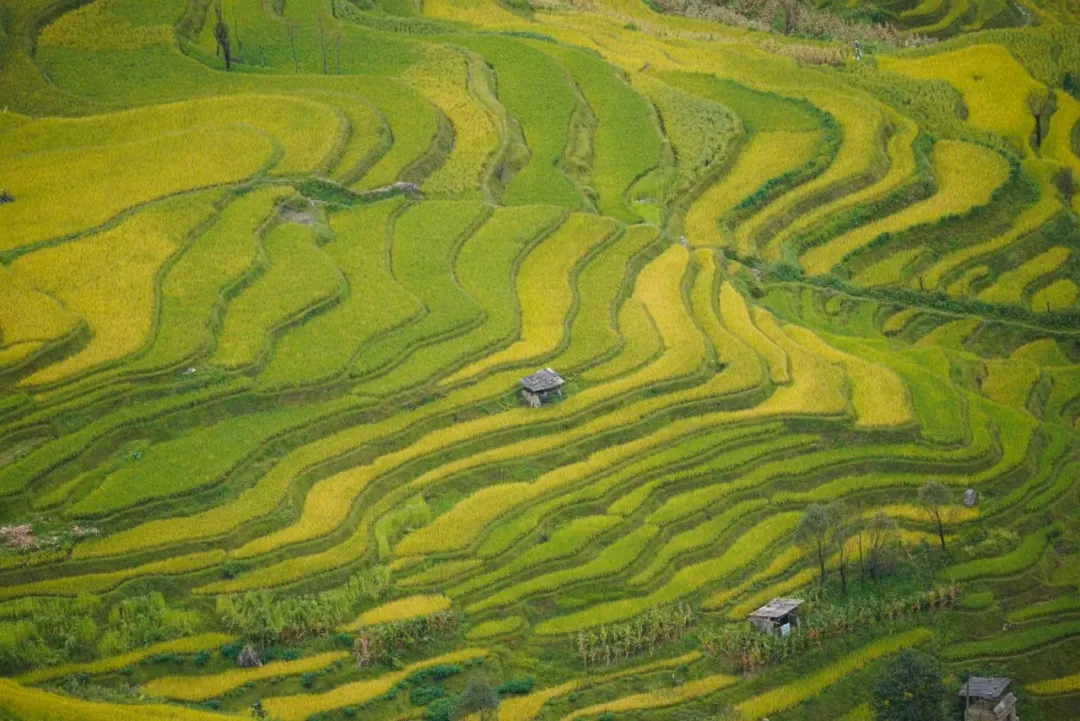
Che Zhixiong is one of the villagers that Village Eyes works with in Qielong Zhongzhai. After returning home, he continued to tend the family’s terraced fields. Che Zhixiong feels that terraced fields and rice cultivation are an indispensable part of Hani culture.
But in recent years, local rice production has been challenged by labour outmigration and water scarcity. The water issue is something that can be addressed through technology. So Village Eyes reached out to SiLi to explore a partnership.
This year is the first year of their collaboration, and SiLi has designed various approaches for the terraced fields on Che Zhixiong’s land.

Taking into account the local pattern of scarce water on the upper slopes and more abundant water below, they adopted direct-seeded upland rice on the highest terraces, ridge-and-furrow irrigation moist cultivation in the middle, and traditional flooded (paddy) cultivation at the lowest level. Each method includes both local traditional varieties and hybrid varieties for comparative trials.

Standing beside rice taller than a person, Zhao Hao told the farming friends and visitors at the edge of the terraces, “Yuan Longping’s dream of cooling off under the rice has been realised here.”
This small patch of rice, taller than a person, is the local traditional variety Hongniaoniaoneng, which can grow up to two metres at its tallest. “We found that traditional old varieties have remarkably strong drought resistance. It relies entirely on natural rainfall for the entire growing season—we did not irrigate with a single drop of water,” he said.
Hongniaoniaoneng is also the best-yielding of the several traditional varieties participating in the trial at Qielong Zhongzhai. Through sample-based yield measurement, SiLi technician Qin Yuchao estimated that this variety has very strong yield-increase potential under the ridge-and-furrow irrigation model. The patch of directly seeded Hongniaoniaoneng we visited has also shown yield-increase potential compared with traditional flooded (paddy) cultivation.

At Qielong Zhongzhai, other rice varieties have also shown varying degrees of yield improvement after switching to dryland or moist cultivation.
On the morning we left Qielong Zhongzhai, Che Zhixiong took us to a cliff near a neighbouring village. Below the cliff, vast contiguous terraced fields drew repeated exclamations from the farming friends: “Wow! Wow!” From the perspective of an outside visitor, if such a unique landscape and planting tradition could not be preserved, it would indeed be a great loss.

But without maintenance, compounded by drought, the terraced landscape can also be damaged.
Standing at the top of the terraces, Zuo Zhi pointed into the distance. “If you look carefully, you can see that many of the terraces have already been converted to maize.” He went on to explain that if the terraces are left without water retention for a long time, and if farmers stop reinforcing the field ridges each planting season, a heavy rain causing flooding can easily trigger terrace collapse.
From a purely technical standpoint, the ridge-and-furrow irrigation planting model can, to some extent, balance the tension between farmers’ water scarcity and the need to maintain the terraces. Zuo Zhi felt that this also reflected how “climate-friendly rice cultivation” adapts to local needs—taking into account environmental change while also, to a degree, meeting the requirements of local cultural heritage.
This year, SiLi has added seven or eight new project sites across Yunnan similar to those in Qielong Zhongzhai and Yilong Town.
But Qin Yuchao cautioned again that the yield of direct-seeded dryland rice in some areas can also be affected by pests, diseases, weeds, and poor management. Whether direct seeding or ridge-and-furrow moist cultivation is better for a given variety is not a certainty. “It still comes down to adapting to local conditions—it varies from place to place.”
IV. Beneath the Climate Shell, Rice Cultivation Is a Solid Technique
For producers, whether a technology is adopted depends on whether it meets practical needs — whether it can boost yield, reduce water use, or whether the rice itself shows better resistance to stress. It was born out of the macro context of mitigating the climate change driven by greenhouse gases, but SiLi has gradually found a local context in Yunnan for promoting it. However, this outreach work has only just begun; how it can be continuously refined and whether it can adapt to more regions remains to be tested.
Although overall drought is the broad trend in Yunnan, this year’s rainy season brought unusually heavy rain to Kunming. In the upland rice experimental field in Wagong Community, Wuhua District, the newly installed sprinkler irrigation system has not come into use for now. “Last year’s rainy season was especially dry; we tried all kinds of solutions, and then this year the rain came pouring down.” Qin Yuchao quipped. More intense climate change also brings more uncertainty to their adaptive experiments.


Editor: Pei Dan