
Bending Low in the Fields: Why Did I Come to Love “Repetitive Labour”?
I. More Than a Bystander
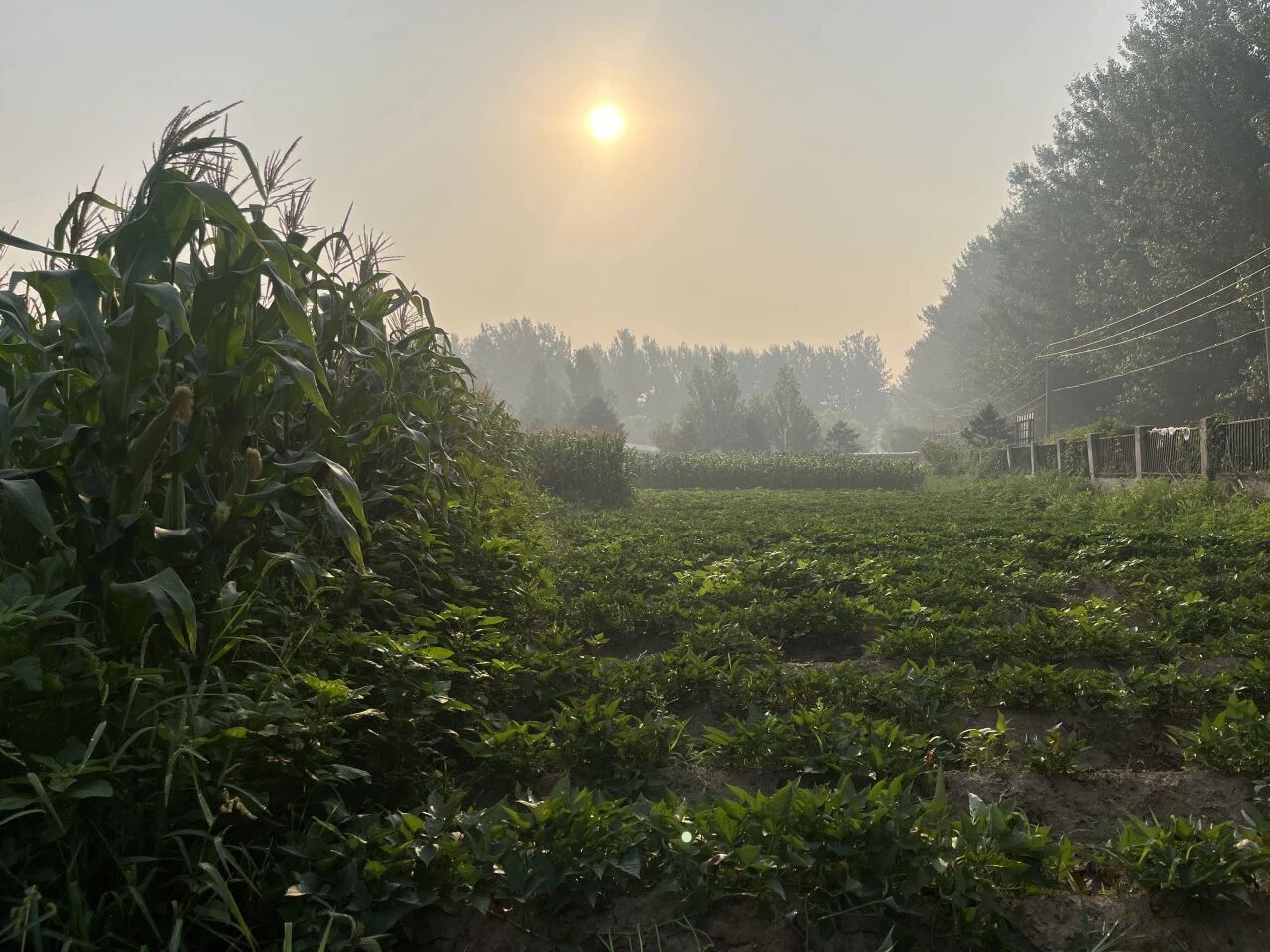
Back then, everywhere I looked in daily life, nature filled the view. Yet when passing through farmland, most of the time I could be nothing more than a bystander who merely thought it looked beautiful.
For the local farmers, cultivation is a livelihood. But how do they collaborate with the land and with nature, making them part of their own lives? From the past to the present, what has this wisdom of survival shed, and what has it kept? That was a world of experience I could not enter as a bystander — one hard to put into words, existing only in the daily labour.
I did not want to be forever just a bystander, though. I wanted to take part in agricultural production myself and see what that world was like. So this spring I signed up for Foodthink’s “Ecological Agriculture Internship Programme” and arrived at Xiqing Farm in Zhangziying Town, Daxing, Beijing.
Looking back on every task I carried out in the fields over those three months, I think what I did was, in practice, “getting to know the land”. To an outsider such work might seem repetitive and tedious, yet without it one could never truly feel the deep bond between the land, weeds, insects, crops and other natural food.
II. Weeds Are More Than Just Weeds
In truth, every weed has its own name. As “permanent residents”, they are among the creatures that know this ground best — through them one can read the vital signals of a place. Understand their growing habits well enough, and they can even become crucial collaborators in lifting agricultural productivity at a decisive moment.
When I first arrived, the plot at the far end of the polytunnel had lain desolate all winter. Hardly desolate, though, for the golden chickweed was growing thick and lush. Not long after spring arrived, we ridged the same plot and transplanted sweet pepper seedlings, clearing only a small circle of bare soil around each planting hole while leaving the rest of the ground largely undisturbed. The chickweed would continue to grow thick here, not only helping the soil retain moisture but also suppressing the growth of other weeds.

On a routine walk around the plots, I noticed that along the edge of one row in the maize field the soil was turning pale and dry, while the strip beside it stayed damp. The pale patch had no weeds to shade it, whereas near the damp ground grew knee-high redroot pigweed, their oval leaves unfurling in overlapping layers to cast a small stretch of shade below.
Sow thistle and lyre-leaved hemistepta are also common weeds in the fields. At the end of March I first spotted dense clusters of aphids clinging to a sow thistle stem; a month later, I was delighted to find seven-spot ladybird larvae hatching in the very same thicket. On the one hand, the aphids’ preference for sow thistle and hemistepta draws them away from the crops; on the other, the seven-spot ladybird — the aphid’s natural predator — finds a hospitable home here too.

As I recall, Beijing had only three rainfalls in May. Weeding a dry sweet potato field, I found Indian goosegrass curling its leaves and spreading flat against the ground — a light tug could pull up a whole clump. As Poaceae, they demand a great deal of water and struggle to put down roots without it. A rain fell at the end of the month, and the very next day, weeding the same spot, I found that even the tender young shoots of Indian goosegrass no longer came up so easily. In barely a day their root systems had grown vigorous and strong. So it turns out that tidings of the land and the weather are written into the bodies of these small grasses.

III. Dealing with Bugs
On March nights, slugs gorge themselves in the baby pak choi beds. There is no need to search for them deliberately; just flip back a couple of leaves and you will scoop up a whole cluster. They emerge on cool, damp evenings to devour the endosperm inside maize kernels, and if not caught promptly, the seed trays will be left with nothing but paper-thin, empty seed husks in no time at all.

In April, mole crickets emerged in numbers, feasting on the tender roots and stems of young crop seedlings. Night after night, tomato seedlings were attacked, toppling one by one — yet with mole crickets working underground, there was little to be done. By sheer luck and chance, we could sometimes demolish their subterranean nests while watering, following the current of water to snare them.
Since the arrival of spring, the ants have been ceaselessly busy. They are always at work: building new homes whenever the sky clears after rain; waging war against rival colonies over territory; herding aphid eggs up and down the sweet pepper plants, scouting for the perfect spot to settle them. The ants shield the aphids from their predator, the seven-spot ladybird, and in return, the sweet exudate left by aphids feeding on plant sap becomes the ants’ dearest staple.

In May, the cabbage white butterfly enters its hatching season, depositing vast numbers of cabbage white caterpillars on the leaves of Brassicaceae crops such as cauliflower and cabbage. The caterpillars gnaw through the leaves and leave behind emerald-green droppings. To be precise, they eat only the soft, succulent mesophyll; the veins, tough with fibre, are too hard for them to bite, leaving them the sole surviving parts of the leaf. The larvae are a translucent yellow-green. As they grow, their colour deepens, blending ever more closely with the cabbage leaf. They even mimic the translucent white texture of the waxy cuticle on the leaf’s surface — these small creatures know well the art of survival.
More often than not, it is not the creatures themselves you will see: the small mounds of piled-up oval castings left by earthworms; the golden trails bees trace as they linger on a leaf; the zigzag ribbons of crumbled soil where mole crickets bore through the upper layers of earth; the leaf miner’s scrawls on a blade, an insect script still undeciphered… Merely tracking down the traces of their presence somewhere is already a great delight.

IV. The Wisdom of Crop Life
After pinching off the axillary buds of a few robust tomato seedlings, I set them into the soil as cuttings, giving each a handful of water every morning while I waited for them to root and take hold. In those first few days the cuttings lay slumped on the ground, their leaves drooping and listless, as though their last hour were near. A few days later, the upper halves of the leaves had begun to curl and dry out before my eyes, yet the lower parts of the very same leaves were putting forth fresh, vivid green — every one of them narrating the story where death and new life converge.

A stunted, yellow-leafed sweet pepper seedling was the first to flower among the crop. Its growing conditions were considerably harsher than those of the other seedlings yet to bloom — planted at the edge of the polytunnel where sunlight beats down fiercely and the soil loses moisture rapidly, it was frequently water-starved, the key reason behind its feeble growth. The plant had long since sensed as much, and so it chose to divert the nutrients that would otherwise feed stem and leaf growth towards reproductive growth, allotting its scarce resources to flowering and seeding first.

The taste of strawberries shifts dramatically between seasons: in winter, sweet, sugar-rich strawberries stockpile sugars to fend off the biting cold; by summer, that tartness is the fruit’s own active choice — a defence against oxidation under intense heat. Clever birds and insects are drawn only to fully ripe strawberries, becoming the seeds’ dispersers. A ripe strawberry will choose the right moment to “speak” — releasing a clean, sweet, appetising fragrance to tell the world: you are welcome to come and eat me now!

V. Witnessing Food’s Past and Present Life
In great part, this closeness to food and the privilege of accompanying its growth were made possible by the ecological cultivation that Wang Xin, the farm’s owner, has practised from the very beginning — an approach built on “rebuilding the biodiversity of the immediate neighbourhood”.
In an ordinary market, fruit and vegetables come only in two states: ripe or not yet ripe. The secrets of their past and present lives seem as legendary as that of the Stone Monkey. Who could have imagined that one day I would see an entire family of cucumbers, ranging from the smallest to the largest, lined up neatly along the vine; tiny watermelon babies the size of a date pip, swaddled in a ring of fine down; green, unripe tomatoes whose slender calyxes stretch determinedly toward the sky, a gossamer coat of fuzz gleaming on their taut skin in the sunlight; maize stalks sprouting dozens of aerial roots like tiny feet, pressing deep into the earth to draw up nutrients and feed the organs above ground; delicate pink female ears emerging from the pointed tips of young maize cobs, swaying in the breeze……

In an interview, Yoshii Shinobu recalled her time on a farm: “While I was there I was exhausted, yet I truly felt I was living with purpose — the sense that life and death were both tethered to me was something extraordinary.”
Only after I had the chance to witness crops completing their entire life cycle did I fully understand what she meant.
Three months felt like a very long time, and yet at the same time it seemed to pass in a single breath. I can still remember the day we sowed, how the tiny seeds left my palms and, in every instant invisible to human eyes, began to grow:
The seed falls into the soil. In the darkness, a building force pushes it upward; the surface cracks and loosens; a stem and its closed cotyledons, still wearing the seed coat and clinging to a small tuft of earth, break through;
If fortune favours them, growth continues — the stem rises, the leaves grow fuller, vegetative growth gives way to reproductive growth; they flower, pollination is completed by diverse means, tiny fruits set and swell, and one day you look up to find the branches heavy with plump, ripe fruit.

Throughout this process my heart swayed between elation and sorrow, but what I felt most was awe — the sense that, so long as I was willing to draw close, I could always see in their tenacious lives a power that reached beyond themselves.
VI. The “Joy” of Repetitive Labour

Now, looking back over these months of turning the soil, hand-weeding, raising seedlings, watering, and catching pests in the fields, I replay in my mind the images of swinging a sickle to fell the old maize stalks, dragging a levelling rake across pitted ground, and casting fertiliser with a spade across freshly ploughed earth…… I realise that the long, repetitive labour itself is more precious than the harvest. In the day-after-day toil, I feel my body, my heart, in certain moments, joined to the land — honest, tangible, and whole. In such moments I taste a kind of unworldly peace and joy.
Such moments are exceedingly rare. Far more often it is tedium, fatigue, and awkwardness that surround me, with the thought “I’ve had enough — I want to quit” rising again and again. And it is precisely because of those uncomfortable feelings that I can recall with such clarity the arrival of each moment of calm and delight. I know that moment existed; I know, and I hope it will come around again at some corner of life.
In closing, I would like to quote a line from the “Xiu wu xun” chapter of the Huainanzi — a line that, over these months, has come to express the role I have slowly come to understand as mine in agricultural production:
“Grain crops spring up in the spring; humans must lend their toil, and so the five grains grow to fullness.”
In nature, crops grow in accord with the seasons; farmers, acting as collaborators, stir that vitality to life through sowing, fertilising, and tilling, and the five grains grow in fullness, so that people at last welcome a harvest. When we offer nature sufficient reverence and respect, there is no exploitation, no conquest — the gifts of the earth simply come about on their own.

Ecological Agriculture Internship Programme
To date, four recruitment rounds have been completed, supporting over 80 fellow participants in placements ranging from three months to a full year across more than ten ecological farms nationwide.
Editing: Zheng Yuyang