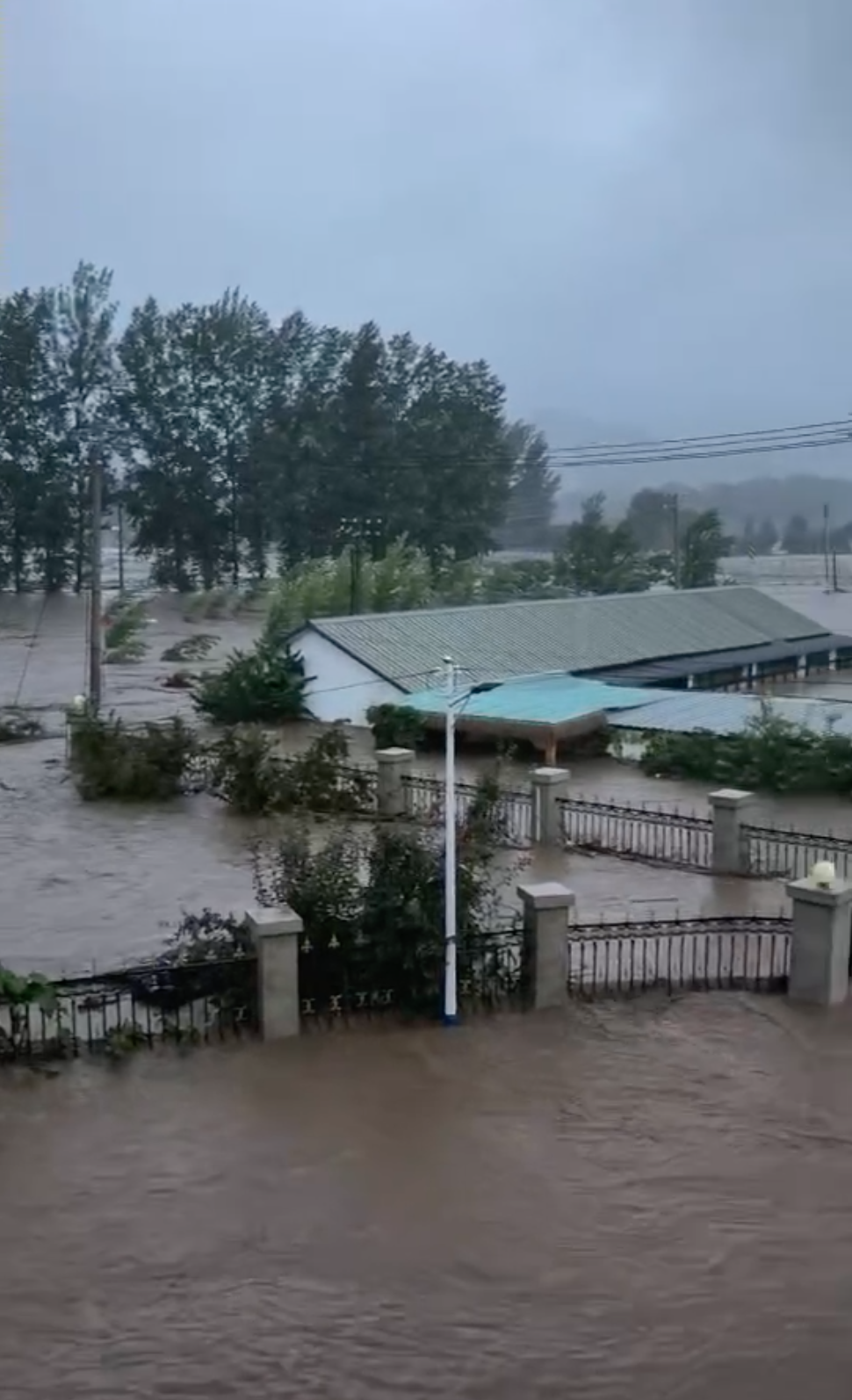
An extreme rainstorm has struck Beijing once again. This time, the flooding has swept through the northern mountain areas. The inflow at the upper reaches of Miyun Reservoir has reached the highest recorded since the reservoir was built in 1959, hitting 6,550 cubic metres per second — and what does that figure mean? Multiple towns and villages upstream of the reservoir have been submerged, with severe waterlogging. So far, 30 fatalities have been reported in Miyun and Yanqing.
What is truly alarming about this flood is not merely the destructive force of the extreme rainfall, but the fact that this kind of disaster has already outstripped the capacity of early warning systems — and with climate change intensifying, such events will only increase in the future.
Take the Qingshui River, for example. It rises on Wuling Mountain in Xinglong County, Hebei Province, flows through Beizhuang Town and Taishitun Town in Miyun District, and then feeds into Miyun Reservoir. Miyun has experienced two rounds of extreme rainfall this time. The second heavy downpour fell mainly over Xinglong County — yet in mountainous areas, where the terrain is steep and complex, flood peaks tend to form rapidly but are difficult to monitor in time. From the evening of the 27th into the early hours of the 28th, flash floods from upstream surged into the Qingshui River and, in the small hours of Monday morning while people were still asleep, swept through Beizhuang Town and Taishitun Town downstream in Miyun.
Sohu Farm, situated by the Qingshui River in Beizhuang Town, had all 450 mu of its land swallowed by the flood. The following is an account in the words of the farm’s owner, Zhen Rui.
I. A Narrow Escape from Death
The water reached the farm at four in the morning on the 28th. Everyone was still asleep. Within half an hour the water had risen to a metre. A further half hour later, it was at two metres. We received no evacuation notice whatsoever; two colleagues were trapped at the farm.
Earlier, no one had taken it seriously. The afternoon before, another staff member had been leaving the farm for home and saw that the river was still entirely within its bounds. The current was fierce and swift, but the water was still thirty or forty centimetres below the bank, and everyone assumed it couldn’t possibly overflow. Besides, around three in the morning on the 28th, the owner of a guesthouse on the far bank had also come out to check, and the river was still contained within its banks.
By four in the morning, one colleague heard the sound of shattering glass — a nearby glass house had been smashed by the current. He got up and looked: inside, water was already twenty or thirty centimetres deep; outside, it was fifty to sixty centimetres. Beyond the glass house stretched an endless sea of water.
He hurriedly called the other colleague, who was sleeping by the gate. When the call reached that colleague, normal phone communication was already impossible — they could only see the incoming call but couldn’t hear a sound.
The colleague at the gate sensed something was wrong. Coming out, he saw the floodwater had already spilled over the bridge and was surging toward the farm. The two of them ran for the exit, but the current made running nearly impossible. The water in the farm was seventy or eighty centimetres deep — waist-high. He ran by feel toward higher ground, and before long his feet were off the ground entirely, the flood carrying him three or four hundred metres all the way to the southwest corner of our grounds. There was a relatively high slope there, some distance from the river. He clung to a tree and hauled himself up the slope, then followed it down to the southernmost edge of the farm, kicked open the perimeter fencing, and made it out to the main road. The whole ordeal took less than half an hour.
◉ The last moment of the farm, captured on a phone after a colleague narrowly escaped death in the small hours of the 28th.
They got out at just after five in the morning and called me, telling me to hurry and alert the town, because they weren’t sure the town officials would realise how bad the water had become. I called the on-duty town head and other local friends, but mid-call the signal dropped and all communications went down. I had been away the previous week and hadn’t come back; that morning I was just about to head back to Beijing, and I spent the entire morning on the phone.
The two of them made it to a local colleague’s home (on relatively safe, higher ground). I simply couldn’t sleep those two days — all I wanted was to get them out as quickly as possible, no matter what. It was far too dangerous. But the national road had been completely washed out: no water, no electricity, no network — nothing. On top of that, the forecast called for more rain over Miyun on Monday evening.
It did rain, but fortunately it was only light rain, and the river didn’t rise any further. On Tuesday morning the motorway reopened, and I drove them back into the city. They had a few cuts and scrapes; the one swept by the current had inhaled some water, but thankfully there was no risk to life.
They were shaken up and need to go back to their hometowns to rest for a while. The impact was truly enormous. It is hard to imagine the flood surging in so quickly and levelling the entire farm — calling it a narrow escape from death is no exaggeration.
The motorway is open now, and local residents who could be relocated have been relocated. As for villagers who are still in the area, the government is providing relief — helicopter drops of supply packs, for instance. But the damage across the entire township is extremely severe, and I estimate the casualties will be considerable. The water came at four in the morning, that massive and so sudden — many people were still asleep at home and had received no evacuation notice.
◉ The flood has erased almost every trace of the farm, leaving only a washed-out roadbed, mud soaked in water, and a scattering of construction debris.
II. The Flood Washes Away Thirty Million
Our 450 mu of farmland were levelled to the ground by the storm. We’re a large operation with diverse activities. Every year, more than 100 members rent plots for their own small family vegetable gardens, and the farm provides them with regular deliveries. We also grow large areas of vegetables, fruit trees, and grain crops, with fresh-eating sweet corn as our signature product. We plant more than ten successive crops of corn each year, so the supply window is long — from the end of June to mid-October, customers come every morning to pick the ears, we ship the same day, and clients in Beijing receive them the same day. When these customers didn’t get their corn for a few days, they came to the group chat asking what was going on. They were among the first to learn something had happened to us. In addition, there were fifty to sixty mu of camping grounds and dining facilities. All gone now too.
Our farm sits right on the Qingshui River; it is riverbank land. The reason a farm could exist here at all is that decades ago, as part of the local “learn agriculture from Dazhai” campaign, the ground was built up by thirty or forty centimetres of soil. People worked together to create farmland and make the conditions for it. But when we first took over, the growing conditions were still very poor — the soil was extremely sandy with very little cohesion. To grow vegetables, we put enormous effort into improving the soil, including doubling the amount of cow manure used.
◉ The farm’s operations are diverse: alongside self-grown organic produce, there are small rented family vegetable gardens, camping, and dining services.
Over all these years, we had mostly finished improving the plots we cultivate regularly. But the flood washed away the entire top layer of soil — thirty or forty centimetres thick — from all 450 mu of farmland. What is exposed now is nothing but sand and gravel, and that is the most devastating part. How do you recover from that? Would we have to build the soil up again, dozens of centimetres deep?
For a farm, what does it mean when the soil is gone? Then there are the unheated greenhouses, cold storage, warehouses, loaders, rotary tillers, tractors … everything accumulated over more than a decade is gone.
Moreover, the farm’s infrastructure and ground foundations have all been destroyed. The riverside road has been completely washed out. The farm and the riverbank have merged into one — this land will be riverbank from now on. We don’t need to consider whether there is any possibility of rebuilding here at all. Adapting to the new reality and putting the land to some other use is the only solution.
◉ Just twenty days ago, Zhen Rui was cheerfully promoting this year’s fresh-eating sweet corn on a video channel: “That familiar taste — a taste of ten years.”
If our farm were in a designated flood retention area, we might eventually receive some financial compensation and offset a portion of the economic loss, but I’m not too familiar with how that works here. We had accident insurance for farm staff, but no property insurance. Who could have imagined the flood would wipe out the entire place in an instant? Who would have thought a flood like the ones in southern China could happen in Beijing? Local villagers only knew from their elders that a major flood had hit here in 1958 — fifty or sixty years ago. If a real flood came, no one could withstand it.
We also looked into what happened in Fangshan the year before last when the floods hit. Many friends of mine whose parks were affected ended up receiving not a penny in compensation. Whether we will ultimately receive any government compensation? I don’t know.
These past two days I’ve been in terrible shape emotionally, and I just can’t accept what happened. The farm has been operating for over a decade. Not counting other hidden inputs, the documented investment alone is close to thirty million — wiped to zero overnight. When I went to pick up my colleagues yesterday, I didn’t even go to the site, because I couldn’t bring myself to look. Built up bit by bit over more than a decade, and overnight there was nothing left. I don’t know how to deal with what comes next.
◉ That same afternoon, in the aftermath of the flood, Zhen Rui posted on WeChat Moments mourning the loss of the farm.Over the past couple of days, friends have been chatting, and everyone keeps saying “samsara”: before the “learn agriculture from Dazhai” campaign, the land may well have looked exactly as it does now, and through this disaster it has been restored to what it was fifty or sixty years ago. But we need to reflect now: is the idea that “man can overcome nature” flawed? Is our approach of forcibly reshaping nature problematic?
The north is undergoing a long-term trend of warming and wetting, and the rain belt is shifting northward. The future climate trend is more rain in the north and drought in the south — this has become the new normal. It will directly affect the siting of farms and guesthouses in the north, and this incident is a lesson for everyone.
In fact, Miyun has been surrounded by rain since 23 July. According to The Paper, as of 11:00 on the 29th, rain in Beijing had been falling continuously for 147 hours. And in this round of northern rainfall, Beijing was just one of the affected areas. In the mere week since the 23rd, extreme rainstorms have struck multiple areas including Inner Mongolia and northern Hebei. Across the north, 13 national meteorological stations recorded rainfall that broke all-time records. Yi County even “rained through its entire year’s worth of Hebei rainfall in a single day.”
Upstream on the Qingshui River, in various parts of Xinglong County, Chengde, Hebei, many villagers are still unaccounted for. Some villages began evacuating from the early hours of the 28th. Some young villagers walked all the way to the Hebei–Beijing border, while the elderly stayed in the villages waiting for rescue. In Luanping County, Chengde, at least eight people were killed by a landslide.
◉ Distribution map of extreme rainfall across China, 26–27 July. Northern Hebei, Beijing, and Inner Mongolia are the centres of the disaster. Source: Central Meteorological Observatory.
Humans may not be able to “conquer” nature, but we have certainly “transformed” it. Climate change driven by greenhouse gas emissions has both accelerated the long-term warming and wetting trend in the north and brought more frequent and intense extreme rainfall.
A disaster risk expert, in an interview with Caixin, pointed out that from late June this year, rainfall in the north has been significantly above normal. In three distinct periods — late June, early July, and late July — rainfall in the north was markedly above the historical average for the same periods. Chen Tao, chief forecaster at the Central Meteorological Observatory, also noted that the rainy season in North China normally lasts a month, running from 18 July to 17 August, but this year it began on 5 July — the earliest on record since 1961 — which is abnormally early.
When the north, which has always been relatively weak in flood preparedness, begins to face more and more extreme storms and floods, what should we do?
Unless otherwise noted, all photographs are provided by Zhen Rui.