
After a Woman’s Departure, She Goes to an Organic Farm | Reviewing Inner Sand
The film’s narrative space gradually unfolds: at the end of the Yangtze, on the edge of the sea, cargo ships symbolising globalisation ebb and flow here, while on the isolated island an organic farm struggles to stay afloat. The marginality of geographical space is compounded by the marginality of the “organic” conceptual space.
I. A Marginal Farm in a Marginal World
“Organic agriculture” always requires repetitive explanatory labour. The film’s male protagonist, Teacher Tang, like a real organic farmer, must explain “What is organic agriculture?” to visitors from the very opening.
Unlike industrialised agriculture, characterised by high inputs, high pollution, and “high technology,” organic agriculture eschews chemical inputs such as pesticides and synthetic fertilisers, emphasising ecological cycling and environmentally friendly farming practices. It also concerns ethical positions and choices of lifestyle, using food and agriculture to move humanity from exploitation and alienation of nature toward cooperation and intimacy.
In the developmental narrative of modernisation, industrialised agriculture is not only the dominant mode in practice but also the orthodoxy in cognition and emotion. In China, having endured the various upheavals of the modern era, “hunger” persists as a traumatic collective memory; “having enough to eat” is beyond question. Yet now, with involution and downturn pressing simultaneously, “eating well” has accordingly regressed. The various “moral” claims of organic agriculture sometimes look like an “immorality”—a disregard for the suffering previous generations endured and for the class barriers later generations find hard to cross.
So, although organic agriculture vociferously opposes industrialised agriculture, it has never been on equal footing with the very thing it opposes. Faced with the industrialisation-led national development strategy and the logic of capital allocation, organic agriculture has always existed as an alternative food system, a non-mainstream alternative food movement, a marginal zone of idealist practice.
In the film, the organic farm is a metaphorical space; rather than an idealist’s utopia, it is better described as a heterotopia of survival in the cracks. There is no pastoral, idyllic fantasy here. The many real-world difficulties an organic farm might face are gathered and juxtaposed, unfolding through a parallel plot structure: shareholders dissolving the partnership, family members scattering, consumer complaints, strained labour relations, land-lease disputes, an unreasonable certification scheme, debt exceeding assets, grassroots politics, capital encroachment… and, at the film’s end, a natural disaster.
And so, the foreseeable ending arrives: the farm is ultimately transferred, and capital reabsorbs it into the mainstream order. At the contract-signing meeting, a staff member accidentally plays a video shot by the female protagonist, Xiao Yu. Teacher Tang tells them to keep it rolling. It is a compilation of staff interviews on “What is an organic farm?”—the explanatory labour of the concept repeated all the way to the story’s end.
As he listens to everyone’s answers, Teacher Tang gradually becomes moved, smiling and weeping. Were this a text of Hollywood experience narrative, this would be the turning point in the hero’s journey where the mission is reawakened. Teacher Tang would renounce the transfer, would not forget his original intention in practising organic agriculture, would form a new “father-daughter alliance” with Xiao Yu, would persist and revitalise the farm, and there would be a happy ending. But Teacher Tang is not a hero. He is always distilling or drinking liquor; alcohol is his companion in despondency, his middle-aged partner. He is an exhausted, failed idealist, and in the end, he must become a realist who cuts his losses.
But the director does not linger on the failure narrative of an idealist middle-aged man. She goes deeper into the farm, and lets us enter the power textures and emotional details of an organic farm.

II. A Marginal Woman in a Marginal Farm
As a worker engaged in ecological agriculture and rural development, I have already encountered, in the real world, far too many male narratives revolving around organic agriculture and returnee youth: the protagonist is always a man, with a respectable degree or career, who returns home out of idealism to establish an organic farm, but the villagers do not understand and his family does not support him… After enduring all manner of failures and setbacks, he still holds on. And so he either finds love and gains a wife, or pays a price and loses one, or hopes to start a family and calls for a wife.
I had indeed braced myself. This might be a story centred on Teacher Tang, with a professor’s research visit to the organic farm as the narrative thread. Sure enough, within minutes, it is established that Teacher Tang is divorced—he has lost a wife. I have always deeply respected individual organic agriculture practitioners, but with this narrative structure, I find myself genuinely weary: women are always presented through their romantic relationships to men.
Once inside the farm space, a montage of fixed shots and long takes, with a documentary-like patience and texture, recreates the farm’s daily labour. The girl pushes her cart again, bustling about; her labour scenes carry equal screen weight with those of the farm owner, Teacher Tang. She gradually develops from the background into focus.
When the female protagonist, Xiao Yu, first appears in a frontal close-up, looking straight into the camera, we finally see her clearly and hear her voice. The professor asks, “Why did you come to the farm?” She answers, “I was a volunteer at first, and then I just stayed.” Behind her, a young calf ambles past, and the story’s ending has already been foreshadowed here.


Teacher Tang’s steadfastness is also a kind of entrapment; his body has never left the farm’s space. Meanwhile, Xiao Yu, as the subject of action, threads through the entire film, moving between island and city, homeland and farm, dream and reality. The audience follows in her footsteps through the film’s three movements: the first is the mother’s visit, the middle is the return home to honour the father, and the final chapter is the return to the farm.
III. The Mother’s Intrusion


Mother brings her daughter red apples that were offered as Buddhist offerings at a temple—tenderness tinged with the smell of incense. She carries a portable player broadcasting Buddhist sutras, moving through the farm with a bystander’s ambiguous presence, neither fully engaged nor fully detached, drawing out Xiao Yu’s working scenes and the farm’s operational reality.
The film is shot at a real, functioning organic farm. The rhythms of labour and details of scenes shown almost constitute, for ecological farming practitioners in the real world, a kind of collective embodied memory. When Mother hangs the little sutra player on the framework of the dragon fruit polytunnel, the farming friends in the ecological community who see it might smile knowingly—after all, there is indeed a farming tradition of growing vegetables to Buddhist sutras—or frown with doubt: where is the “nature” in those energy-intensive dragon fruit polytunnels imported from Yunnan?
Just as an organic farm’s production is not a single crop, Xiao Yu’s labour here is not a single job. Beyond shooting videos, she feeds the cattle and shovels manure, teaches food education classes to children, participates in farm meetings, calms local villagers, and even delivers contracts to Teacher Tang’s ex-wife on his behalf.


At the farm, work and life are intertwined, difficult to separate. Xiao Yu bears both physical labour and the emotional and care labour structurally assigned to women—she listens, mediates, comforts, “patching things up” all over this crisis-ridden farm. But structural assignment always comes with structural erasure: Xiao Yu’s multiple labours are not recorded in any formal wage calculation or power distribution. She has no salary and no decision-making authority.
At the three-person dinner of Mother, Xiao Yu, and Teacher Tang, Mother and Teacher Tang sit facing each other while Xiao Yu moves between them, adding seasoning and serving food with chopsticks. Even the easygoing, good-tempered Mother cannot help but, the moment her daughter steps away from the table, press about her salary and her future.
The farm cannot pay wages, and Teacher Tang helplessly decides, “Then let’s slaughter a cow.” Xiao Yu, who tends the herd, asks tentatively, “Can we not kill the cow?” On the day of the slaughter, however, Xiao Yu is sent into town to deliver documents to Teacher Tang’s ex-wife.
When Xiao Yu returns to the farm that evening, she stands in the cowshed, one head lighter, just a silent, restrained figure seen from behind. In the dining hall, a steaming dinner is underway. At the table: Teacher Tang, the production manager, the professor, and the village head. The director has set the table, and through it, recreates the complexity and fluidity of power relations.
No sooner has Xiao Yu sat down than she is urged to come taste the fresh beef slaughtered that day. Teacher Tang soothes her with his eyes and gestures; Xiao Yu nods, displaying a suitably composed “bigger-picture” grace. But she is genuinely heartbroken. Teacher Tang gestures several times for her to pour and drink, and she simply sits there, docile and silent. Between drunken ramblings and sober truths, the village head cries out a slogan: “Let everyone hold on to their homesickness,” “We must build this place into a Beautiful Countryside.” Among the many difficulties the farm faces, a corner of the grassroots politics wrapped in the “Beautiful Countryside” construction rhetoric peeks out.


Xiao Yu steps out to fetch more liquor. The professor then rises to step outside for a moment; drunk, he refuses others’ offers to steady him and staggers after her. This triggers an almost instinctive wariness born of collective female experience—we know what might happen. In the end, Xiao Yu locks the “drunk and loose-tongued” professor in the cowshed.
The professor’s intrusion is, in truth, the advance outpost of capital’s entry into the farm. The next day, the cowshed gates stand wide open. The professor has left, and there are fewer cows. The farm’s unraveling continues to ferment. The cattle are diminishing—slaughtered or fled. Before leaving, Xiao Yu calmly carries out the routine work in the cowshed. She is about to accompany her mother home to honour their father.

IV. The Father’s Ghost and the Lost Hometown
The ghost of the father lingers and will not disperse. Mother says, “Your father has followed you all the way here.” She speaks in dialect throughout, insisting on the existence of home in the voice of home. Mother is insistent on going home to perform the rites, hoping to complete her father’s passage into the afterlife through the patriarchal lineage ethics of “leaves returning to the root.” Xiao Yu gently suggests: wherever we are, that is where we make the offering. Her care for her mother is not a repetition of the previous generation’s narrative but a rewriting rooted in the present. At the same time, she does not rewrite her mother but chooses understanding and companionship.


That night, Mother cannot check into a hotel without an ID card. Mother and daughter enter an unfinished building. In the ruins of capitalism, in the real estate bubble, in this cold space where no one belongs, they build a small fire, share an apple, and huddle together in silence.
In the flux of rural displacement, every tower block looks almost exactly the same; they nearly get lost. After being homeless, they now face having no hometown to return to. And in the inorganic replication of rapid urban expansion, it is the vague silhouette of a river, a tree, that lets Mother organically identify where the old house used to be.
They burn joss paper in the communal space of a residential compound, a rite to send off the dead. A security guard steps forward to obstruct this private mourning held in a public space. Mother recognises him as a former village neighbour and erupts in unprecedented fury and curses, because he once had her committed to a psychiatric hospital under the label of “madwoman.” He once smugly defended the ethics of the traditional rural community; now he is the security guard of a modern urban residential compound. Between the uniform tower blocks and apartments are atomised modern individuals, and all he can defend is the physical boundary of one compound.
Mother’s departure was forced. With her husband’s death and the transformation of the countryside, she has been systematically, step by step, pushed to the edge of society. The temple has become a dual sanctuary for her body and her spirit. She has lost her ID card, and with it the “identity” recognised by society.
After facing homelessness and the loss of hometown head-on, Mother has Xiao Yu set down that bundle of bedding the sister-in-law gave—historical “baggage”—and she completes this rite of sending off and remembrance.
V. The Nth Power of Loss

One hand still holding the mint water, the other picks up the farm transfer document Teacher Tang has left behind by accident. The truth suddenly lays itself bare in a moment of fragility. After losing her hometown, she is about to lose her new countryside. Then she receives a video sent from the temple: Mother has undergone the tonsure ceremony and chosen to take monastic vows. She has lost her mother. “Loss” accumulates and compounds.
Xiao Yu begins to dream; the dreamscapes are a signature the director is working into her practice. Mother’s dreams are haunted by the patriarchal ghost; in the end, she uses “leaving the home” (the monastic sense) to complete “leaving the home” (the worldly sense). Withdrawal from the world is a subjective renunciation of social structure. In Xiao Yu’s dreams, she is the agent: she nocks an arrow and looks around, chases a car, runs—but the agent cannot yet anchor a target; the goal hangs in suspension. The arrow that cannot be loosed, the car that cannot be caught, are the layered pressures of everyday life—anger banked and waiting, but also a marathon of endurance, a chase without end. In her dreams, Xiao Yu is engaging in a kind of feminist strength training.
Gnawing into the vivid red dragon fruit, burying the rotting apple—these fruits, blessed by Mother and by Buddhist sutras, become the physical texture of pain and trauma. The boundary between dream and reality blurs. She is at today’s farm and in yesterday’s home. In a dreamcore drift, Xiao Yu undergoes a multiple loss: the acknowledgement and mourning of losing her hometown, losing her mother, and losing the farm. This is a ritual farewell.

Ultimately, the storm within Xiao Yu converges with a real natural disaster. Women and nature, under capitalist patriarchy, are isomorphic. A howling wind in the dead of night jolts Xiao Yu awake; she rushes to the polytunnel, organising workers to save the spring seedlings. Teacher Tang has vanished. His bed is empty, leaving only a light note reading “Follow your heart; fear not the future.”
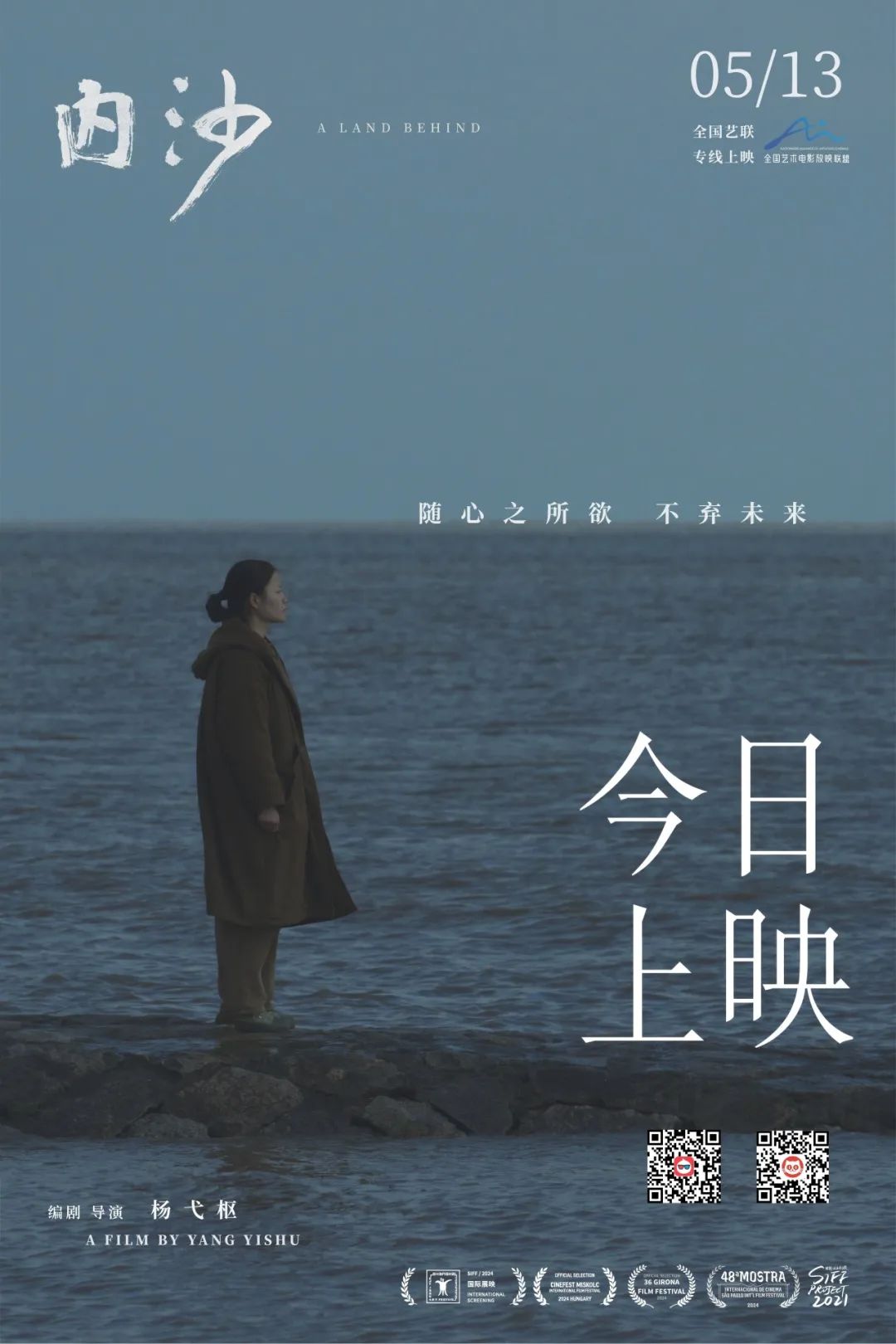
I find myself genuinely frowning. The boss gets to “follow his heart” while telling employees to “fear not the future.” The elder gets to “follow his heart” while telling the younger generation to “fear not the future.” Men get to “follow their hearts” while telling women to “fear not the future.” This line becomes the film’s main promotional tagline on the poster, and like all Chinese-style philosophical expressions, it leaves infinite room for ambiguity and interpretation. My inner question is this: on what historical inheritance and material conditions do we rest when we are told to “fear not the future”?

In the collapsed cowshed she finds the farm’s last cow. One woman, one cow, walking into the reed flat on the sandbar. She looks out in every direction and says to the cow, “Shall we stay here?” Her “staying” is less about remaining at an organic farm with an uncertain future than a declaration of rebuilding herself—having lost everything, with no kin, no ties, no root, no home, she steps into the wild. She will break new ground, make something from nothing.
VI. Double Presence: a Rural-Development Woman’s Self-Portrayal
The interview footage shown in the film is also genuinely shot by Zhang Dan herself; her subjective vantage point is woven into the film, and she uses her own body as a medium to dissolve the boundary between inside and outside the frame. The workers who answer the questions are in fact real farm labourers. More worth catching than their answers, perhaps, are the northern Jiangsu and northern Anhui accents that surface between the words. Reality is peeled back at another corner: the margin here is the margin of the Yangtze River estuary, the countryside of China’s economic heartland. Behind the avant-garde experiment of organic agriculture lies a broader, more complex Three Rurals spectrum. Beneath the self-exploration of an educated woman lie countless silent, unmanifested female figures.
Finally, Inner Sand, much as organic agriculture relates to conventional farming, does not display the productivism of high-standard farmland and industrialised production. It answers to the alternative food-and-farming movement and to women’s marginal experience with an alternative auteur sensibility. Inner Sand carries a smallholding temperament—soil building and composting, intensive cultivation—defending its own auteur expression within the industrial system: mature yet clumsy, diligent yet unhurried. I am glad to have, in the gap between main-melody cinema and Hollywood, a film-watching choice like this one.

Director Yang Yishu has recently been on a nationwide roadshow for Inner Sand. All are welcome to come along and chat with the director in person.

All images in this article are from the film’s official posters and trailer.
Editor: Yuyang