
Some Question Ethical Consumption — Are We Still Just Shopping, Shopping, Shopping?
Foodthink Says
Paying for your conscience, spending on the causes and principles you believe in — that is ethical consumption, quite distinct from the traditional “shop, shop, shop”. It embodies the idea that consumers can support the values they hold through their purchases: organic certification, Fair Trade certification, Deforestation-free certification, products made entirely from renewable materials… But when we take product labels at their word, are we not falling into yet another consumer trap?
Is this another snare set by capital? How can we avoid it and practise genuinely responsible consumption? Foodthink has been granted permission to translate “A Manifesto Against ‘Anti-Capitalist Consumption'”, published in The Jester, the student newspaper at Wageningen University. We hope it will spark some thought.
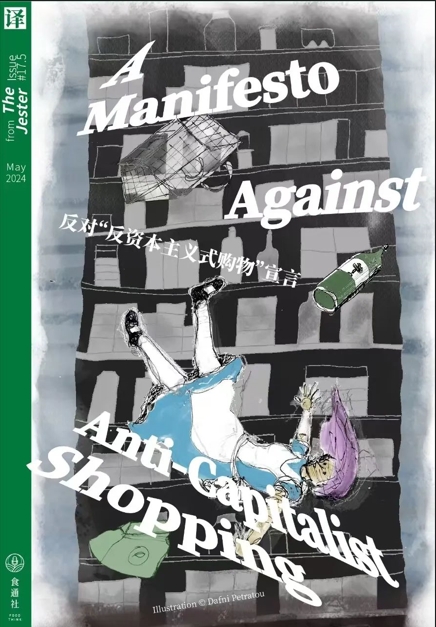
Anti-capitalist consumption takes many forms; common examples include supporting small businesses and “responsible baking”. It also manifests in product codes and labels — Fair Trade, cruelty-free, and ethical product certifications, to name a few — all aimed at the anti-capitalist Generation Z shopper.
Though Generation Z has grown wary of greenwashing and the “woke” brands flooding social media, it has forgotten a fundamental truth: “There is no ethical consumption under capitalism.”
I once used shopping as a form of self-care. After school, wandering the aisles of Jumbo or Albert Heijn (both well-known Dutch supermarket chains) was a pleasant way to unwind — to forget the noise of the world and let the magic of a tempting dinner and good food reinvigorate my soul. But gradually, the shelves began to tell me things about this world.
At first, it was nutrition labels whispering in my ear, telling me that the foods I had grown up eating were not at all healthy. Then came the Bio (European organic certification) or organic labels. I needed to know whether what I was buying was genuinely organic or terrifying Synthetics. The spectre of rivers overflowing with microplastics steered me towards organic products.
Then a “V” appeared — the Vegan product label. To my astonishment, many products that seemed to have nothing to do with animals turned out to contain animal-derived ingredients. Why is there milk powder in crisps? Now, every item must pass four rounds of inspection before it earns a place in my basket.
But on certain shelves, I spotted yet another label. The Fair Trade label hinted at the injustice of conventional trade. The entire shop began to disintegrate before my eyes. By now, perhaps only three products in the whole store were fit for my trolley.
All these labels function as product codes, and behind each code lies a story. Fertiliser is harmful to biodiversity and the environment; we need to develop more organic farming. Animal food production is not only cruel to creatures bred for slaughter but also unsustainable, driving up global greenhouse gas emissions. Products such as chocolate, Avocado and coconut milk come from around the world, where workers at the source are subjected to brutal, appalling exploitation. We need to find ways to restore exploited workers to the fair value their labour deserves.
These product codes lay bare the injustices of the capitalist production system, yet they also carry a vision — that a just world is possible. If Tony’s Chocolonely (a Dutch chocolate brand celebrated for its slave-free products) can do it, why can’t all chocolate production be free of slave labour?

Ethical product codes require a degree of consumer awareness to work. For example, at the Saturday market in Wageningen, unless you spare a moment to look into where this Colombian coffee actually comes from, Fair Trade means nothing. Every idea behind labels of this kind has a long history; the struggles, violence and activism that accompanied them pushed these dreams of liberation before Western consumers, so that a mere label could tug at their conscience.
These dreams all embody a longing to transcend the limits of capitalist production — a longing for a world liberated from slavery, environmental destruction, animal abuse and climate change. This is an anti-capitalist longing.
And yet this raises a new question: dressing it all up in eye-catching design so that a no forced labour label is as prominent as a caramel or hazelnut flavour label—Isn’t it somewhat disrespectful to reduce human stories that intertwine suffering with revolutionary hope to a mere product label? Yet this is the logic of ethical production under capitalism. And how can we turn liberation into a business? How can we monetise revolution?

No small number of companies have already begun to do just that, promising revolutionary change within the framework of capitalism. Fossil fuel cars are a problem? Then build an electric car that will change the world. And so a host of electric car companies sprang up, yet manufacturing these vehicles often consumes vast quantities of natural resources and materials, doing little good for the planet. But once a company’s share price rises, the planet ceases to matter.
Purifying our longing for change and liberation, repackaging it, and re-embedding it within the very structures that bind us is one of capitalism’s great tricks. It translates these anti-capitalist movements into coded product entries. The result is that, in a sense, consumers end up carrying the blame for capitalism’s ills. We are told it is our duty to make the “right” choices, to step up, to be grown-ups, and to put this broken world back on track.
The absurdity of ethical marketing should be self-evident — surely no one at Wageningen truly believes that buying organic food can repair our Food and farming system? Or that if everyone went vegan, Albert Heijn’s vegan aisle would solve the climate crisis?
And yet ethical marketing still pulls us in, because deep down we long for the very same world — one in which the food system does far less harm and animals are not born to be slaughtered. This pull works just as powerfully on issues we do not understand, or know nothing about at all. All this responsibility lands squarely on our shoulders, demanding that we become ethical consumers and face impossible choices.
And so the great cycle of consumption grinds on. When sales of iPhones, Oreos and Coca-Cola stall, they simply invent new products — the same old sugar water, new flavour. The ethical products that promise to right these wrongs are reduced to mere categories struggling to stay on the shelf.

The pragmatic approach might be this: do the best we can with the ethical choices available and, even without broader systemic change, nudge capitalist production towards being more ethical, less harmful and less oppressive.
Making ethical consumption choices demands a great deal of knowledge — you need to understand the processes behind the labels and also what the labels fail to cover. Imagine having to do all this every time you do your weekly shop, at every single purchase decision. If our knowledge were systematic enough, if we paid for products and brands that drive real change and punished those that refuse to amend their behaviour, if we sustained ethical consumption over the long term and drew more people into it — then changing the system with our wallets would be possible.
This strategy calls to mind the language of boycotts, Divestment campaigns and “cancelling” brands — boycotting Shell, pressuring Nike to pay sweatshop workers more.

And yet this obscures the nature of capitalism today. It assumes that fixing one company solves everything. But it does not. From smartphones to water bottles — most of what you can buy has between ten and a hundred companies across the globe involved in its production. That is the nature of the global supply chain. The very same supply chain infrastructure supplies both so-called “ethical” products and unethical ones.
The world we live in is full of platforms and virtual marketplaces. From virtual bookshelves to undersea server clusters, these all-encompassing markets peddle Computing power to every industry on the planet. Amazon sells everything. Unilever’s portfolio of brands spans everything from The Vegetarian Butcher (a Plant-based meat brand) to frozen meat producers with abysmal animal welfare standards and costs squeezed to the absolute minimum.
Here, there is no room to choose a side. On both the ethical and the unethical end of the industry, it is the same technology, the same methods, the same people and the same marketing playbooks at work.

The problem still lies in production. The system of commodity production has grown so vast and globalised that individual companies exist only as fictions on the stock market. Every link in the chain of manufacturing and producing goods demands the movement of people, industries, and capital across the world.
This is why symbolic gestures aimed at holding companies to account are so powerless.
When Nike is accused of wrongdoing, it simply outsources its garment production to another company. At the end of the day, Nike is not a manufacturer of clothing at all — it merely holds the trademark rights. When you boycott Amazon to support your local bookshop, that bookshop is still supplied by a company under Amazon’s umbrella. Almost everything we do online is carried out through server clusters owned by Google, Amazon or Microsoft.
Within the larger framework of financial capitalism, even these corporate giants cease to exist; they are owned and operated by multi-billion-dollar investment funds. These funds invest in revolutionary start-ups while hedging that bet by investing in traditional, “oppressive” companies. Whichever brand a consumer chooses, the net effect is a rise in return on capital.
In this way, we face a great many choices that amount to nothing. They have little bearing on the existing system or the change it promises, yet they invariably shape our state of mind. They nibble away at our energy little by little, leaving us unable to contribute to change in any meaningful way. The grand narratives they offer — easy, feel-good stories that cost us nothing — are essentially a false sense of achievement. We must not fall for this. We need to conserve our energy to bring about genuinely meaningful change.

The illusion of choice is capitalism’s lifeline. Not because it changes capitalism, but because it perpetuates its existence. We let capitalism govern every domain of our lives because it promises this mythical freedom of choice. Choosing food, choosing what to study, choosing a room and a job. (For the Trainspotting fans.)
But this choice has never been real. It is an illusion manufactured by advertising agencies. Even sunsets can be sold, as though a natural landscape could truly be tucked into our pockets. Only when we let go of the illusion of choice can we see capitalism’s chains. Strip away that illusion and much of the “freedom” in our lives begins to vanish. The truth is unbearable — people perform utterly meaningless work in order to fuel consumption.
Only by abandoning anti-capitalist consumption can we begin to ask the real questions about anti-capitalist production.
Editor: Shitong Jun
Design: Z X