
Nearly a Year On, Has Ukraine’s Grain Export Crisis Eased?
In early November, Odesa had not yet been caught up in widespread missile strikes and a power-cut crisis, and the shops on the streets were all open as usual. Farmer Aleksey arranged to meet me at a café in the city centre.
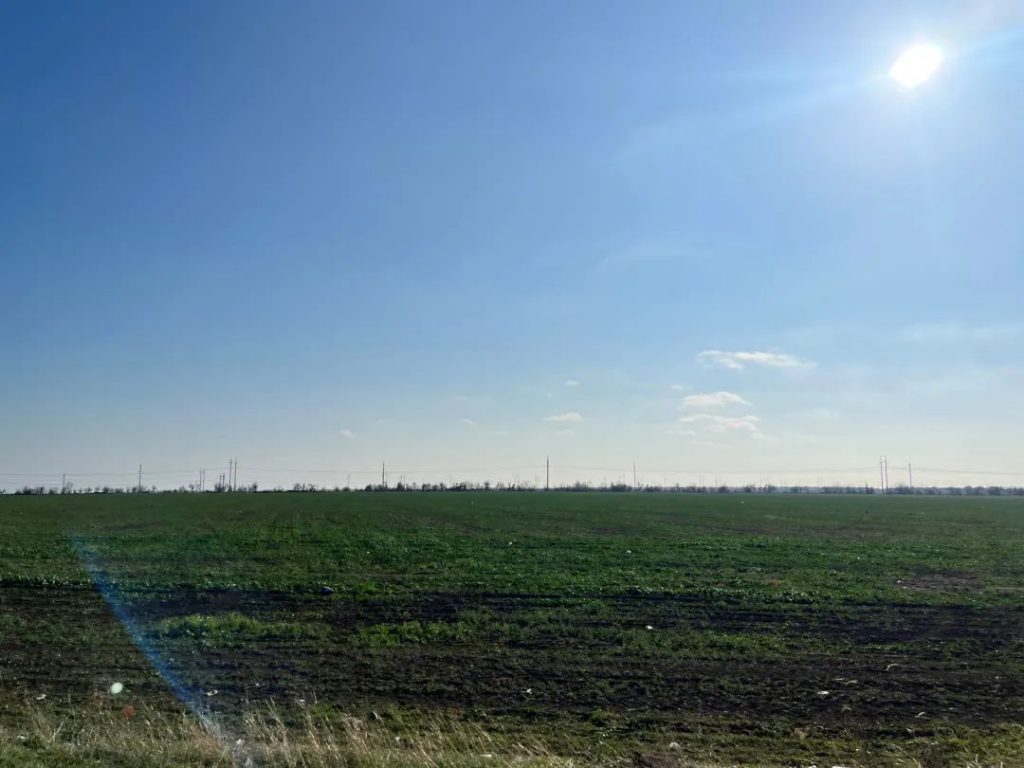
Aleksey’s farm, located near Odesa, covers 1,000 hectares of land, according to him, and includes its own flour mill and bakery. In Ukraine, a country with vast stretches of farmland, this is not particularly large in scale.
No sooner had we sat down than he began complaining that the closure of the Black Sea grain corridor had seriously affected the livelihoods of Ukrainian farmers.
The Black Sea Grain Initiative was signed on 22 July, brokered by the United Nations and Turkey, so that Ukraine, one of the world’s largest grain exporters, could continue to ship grain through Black Sea ports, preventing countries that depend on Ukrainian grain exports—mainly densely populated developing nations—from falling into food crisis.
At the end of October, Ukrainian forces attacked the Russian Black Sea Fleet in Sevastopol on the Crimean Peninsula with drones and unmanned boats. Russian forces then announced on 29 October the suspension of the grain corridor, which had been in operation for less than three months.

Because his grain was sitting unsold, Aleksey had to find his own outlets, handling sales as well as production and processing. When I met him, he had just completed a grain deal in Bulgaria and returned to Ukraine. Past forty, Aleksey has three children. He told me that it was precisely because of them that he was exempt from Ukraine’s ban on adult men leaving the country (Note: On 24 February 2021, the Ukrainian government announced that Ukrainian men aged 18 to 60 were not permitted to leave the country, but fathers of three children were exempt), and that he had been shuttling back and forth across borders to conduct his grain export business. By contrast, Ukrainian farmers without three children were not so lucky.
In the weeks that followed, with Turkish mediation, the Black Sea Grain Initiative was resumed. However, for Aleksey’s farm, the sales focus had already shifted to neighbouring countries, including Moldova and Bulgaria. “I’m arranging to export more to Bulgaria; then turning part of the wheat into refined flour to sell to Moldova; and the rest into bread, for Ukraine’s domestic market.”
In the shadow of war, Ukrainian grain—once exported in large volumes to Third World countries—is now flooding into Europe.
I. I. Europe as an Alternative?
Before the war, the EU was not a major market for Ukrainian agricultural products.
Ukrainian labour is cheap and agricultural yields are high, giving Ukrainian produce a price advantage over EU products. For example, in August 2022, Ukrainian wheat was priced at US$272 per tonne and maize at US$251 per tonne, while the average prices on the European internal market at the same time were US$324 per tonne and US$307 per tonne respectively. However, to protect its agricultural sector, the EU imposed strict quality inspection requirements and tariff policies on imported agricultural products, making it very difficult for Ukrainian produce to enter the market.
As a result, Ukrainian grain was mainly exported to more distant developing countries. This grain was primarily shipped by sea through ports in southern Ukraine, with Odesa, Mykolaiv, and Berdyansk all serving as important seaports. After the war began, Mykolaiv was subjected to prolonged Russian missile attacks and blockades, while Berdyansk and other locations fell even more firmly under Russian control. Odesa’s port facilities, though still operational, remain at risk from mines in the water to this day. All the local port facilities, being strategic installations, have been ringed with layers of barbed wire, and ordinary civilians can no longer go to the coast for leisure as they used to.
UN statistics show that before the war, between 120 and 160 cargo ships departed from Ukrainian ports each week. After the war began, this number once dropped below 40, and only around 20 per cent were ocean-going vessels.
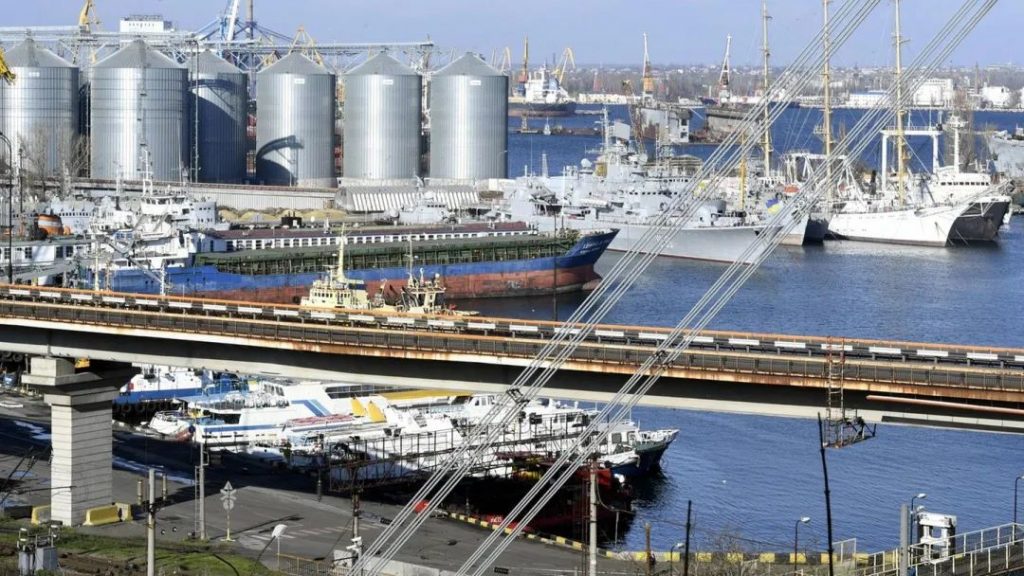
The sharp drop in port throughput has forced Ukraine to shift more of its grain exports onto rail, road, and inland waterways—but each of these modes of transport comes with its own set of drawbacks.
First, there is rail. Ukraine and Europe use different track gauges, so no direct trains can run; cargo must be transhipped at the border. In addition, Ukraine’s main agricultural region lies in the chernozem belt to the south-east, a considerable distance from the primary export corridors in the north-west.
Trucks, on the other hand, are “too expensive.” Aleksey explains that his farm sells Ukrainian wheat to Bulgaria at roughly US$220 a tonne, of which truck transport alone costs around US$120 a tonne. In other words, the cost of trucking alone exceeds half the selling price. On top of that, border crossings are heavily congested, making freight trucks hard to come by. “Sometimes we have to wait more than a week to get a truck, so we have even bought three trucks of our own.”
Inland waterway transport requires that grain first be hauled overland to a handful of small river-port towns on the Danube in southernmost Ukraine, where it borders Romania—Kiliya, Reni, and Izmail—and then shipped out by barge. This makes transport slightly cheaper than by road. According to Aleksey, shipping wheat from Kyiv in central-northern Ukraine to Reni on the Danube in the south costs roughly US$80 a tonne, and the wheat selling price at Reni is around US$210 a tonne.
What all three routes have in common is that they funnel grain—previously shipped out by ocean-going vessel—into neighbouring EU countries.
II. Eastern European Farmers Protest
However, Aleksey, who exports grain to South-eastern Europe, has run into a new problem: “Farmers in Bulgaria and Romania are protesting that we’re exporting too much Ukrainian grain, and it’s undercutting their markets.”
What he described was by no means limited to those two countries. At the end of November, a group of Polish farmers protested in the eastern city of Lublin. According to Polish media reports, the protest was organised by the farmers’ organisation Agrounia, whose leader told the media that excessive volumes of Ukrainian grain were flooding into the Polish market, causing local grain prices to plunge and affecting farmers’ livelihoods. According to Polish government statistics, Poland imported 640,000 tonnes of Ukrainian grain in the first half of 2022, while in recent months 450,000 tonnes have been entering Poland each month—sixteen times the figure for the same period in 2021 and 1.5 times the mid-2022 level. Agrounia believes the actual quantities are considerably higher than this official statistic.
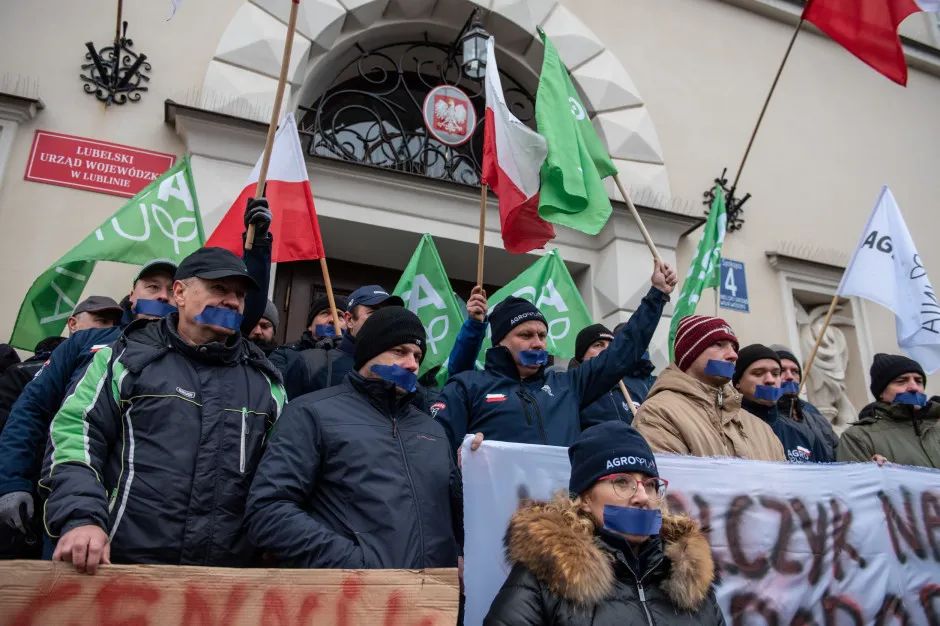
This situation stems from the solidarity corridors policy introduced by the EU on 12 May this year, which temporarily exempts Ukrainian grain from tariffs, allowing it to be routed through the EU to ports on the Baltic coast. The policy permits Ukrainian grain only to transit through for onward export, not to enter the European market. Polish Prime Minister Mateusz Morawiecki has also repeatedly assured farmers that Ukrainian grain will not stay in Poland, but will merely be transhipped to other export destinations.
Opening up the EU market has brought considerable convenience to smallholder farmers like Aleksey. But it also means that Ukrainian agricultural products are entering Europe in small, fragmented quantities through small and medium-sized producers like him, making it difficult to ensure that they will be exported to third countries as the solidarity corridors scheme originally intended.
According to observations by Michael Scannell, Deputy Director-General of the Directorate-General for Agriculture and Rural Development in the European Commission, made in July 2022, a significant amount of Ukrainian grain entering the EU through the solidarity corridors scheme has been “stuck” in the first EU countries it reaches, and has not even made it to EU countries that need grain more urgently, such as Italy and Spain, which typically import Ukrainian maize for feed.
From July 2022 to the present, this problem does not appear to have improved. According to an EU report from November 2022, not only grain but also imports of Ukrainian agricultural products—including poultry meat products and dairy—have seen “significant growth.” This has also begun to rob the solidarity corridors of their solidarity: right-wing conservative parties in the EU have already started calling for new restrictions on Ukrainian food products to protect their farmers’ voter base.
III. Has the Third World Been Starved?
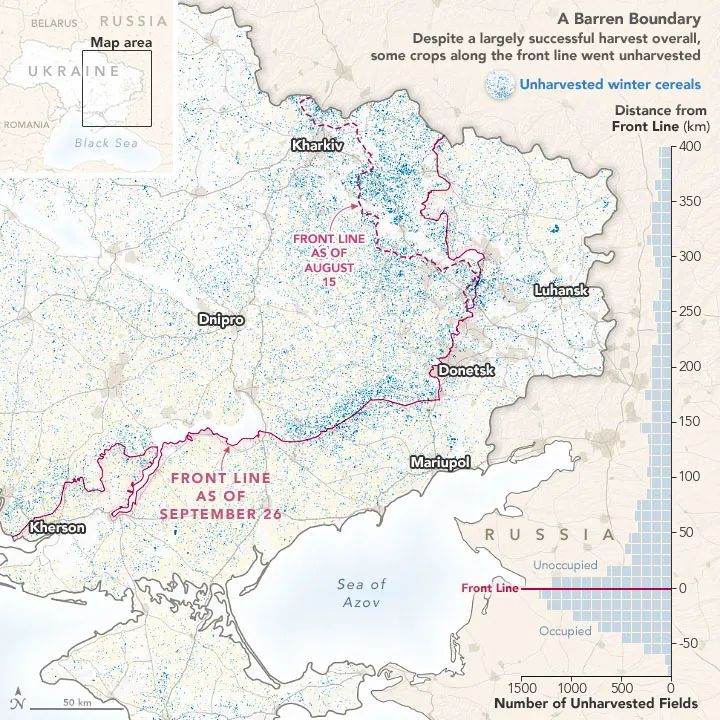
On 5 December, NASA published its latest remote sensing data analysis, estimating Ukraine’s winter wheat harvest (including Russian-occupied areas) at 26.6 million tonnes. Although this is down from the bumper 33 million tonnes of the previous year, it is not too bad. The good news is that while the winter wheat harvesting area in 2022 shrank by 6 per cent, 94 per cent was still brought in. Previous forecasts had predicted that 20 to 30 per cent of the winter wheat crop would go unharvested in 2022. Meanwhile, 22 per cent of the wheat was harvested within Russian-occupied territory.
According to estimates by Ukraine’s Ministry of Agriculture, the country harvested approximately 51 million tonnes of grain in 2022, compared with 86 million tonnes in 2021—a 40 per cent reduction, mainly attributable to lower yields per hectare and the occupation of territory.
Meanwhile, in some low-income countries that depend heavily on Ukrainian grain, the risks of food crisis and famine are rising. In a mid-December 2022 assessment, the International Rescue Committee (IRC) concluded that, with the droughts brought by climate change in 2023, hunger in East African countries—especially Somalia—would be particularly acute.
Before the war, grain imports for some East African countries, including Somalia, came almost entirely from Ukraine. In Egypt, half of the annual wheat supply depended on imports, of which roughly 15 per cent came from Ukraine.
Despite the Black Sea Grain Initiative, the pace of Ukrainian grain exports to these countries remained far slower than before the war. According to data published on 26 December 2022 by Turkish Transport Minister Adil Karaismailoglu, from August onwards, 15 million tonnes of agricultural products on 585 cargo ships had been exported from Ukraine through the Black Sea Grain Initiative. Of that total, 44 per cent went to Europe, 16 per cent to Turkey, and only 14 per cent to African countries. In 2021, Ukrainian wheat destined for Egypt and Indonesia alone each represented more than 15 per cent of total exports. Analysts have noted that the Black Sea Grain Agreement’s benefit to low-income countries is more indirect—chiefly by expanding supply to help stabilise prices, making it easier for low-income nations to procure grain on the international market.
The tightness of supply in Third World countries varies from case to case. While Somalia faces hunger, Egypt has already secured its wheat supply through early 2023 via a range of trade agreements. After the war began, Egypt quickly purchased wheat from European countries and India to guarantee market supply—particularly the steady provision of government-subsidised cheap bread—to maintain social stability. Egypt’s Ministry of Trade and Supply recently stated that the country’s wheat reserves are sufficient for the next five months. The Egyptian grain shortage that so many feared in early 2022 has not materialised. Indeed, the Egyptian government did not purchase its first post-war batch of Ukrainian wheat—175,000 tonnes—until December 2022. Against Egypt’s average annual consumption of 25 million tonnes, this purchase is modest by comparison.
It is Russia, on the other hand, that has taken aim at where Ukrainian grain exports end up. Putin has come forward to accuse Ukraine of sending its grain to Europe in the end, without it reaching the low-income countries that need it most.
This criticism is, of course, overstated. But Ukraine, too, has recognised the need to give more consideration to the needs of low-income countries—at least to make a visible effort to help. Beyond UN programmes, Ukraine has launched its own grain export initiative. On 26 November, Zelenskyy convened a grain summit in Kyiv to discuss Ukrainian grain exports. At the summit, he stated that Ukraine had received US$150 million from 20 countries and would establish a separate “Ukraine Grain Plan” to send at least 125,000 tonnes of grain to countries in Asia and Africa in urgent need, and to dispatch 60 cargo ships of grain to Asian and African nations before the following spring. The Ukrainian government’s official description of the plan reads: “Our goal is to alleviate hunger for at least five million people.”
IV. Changes Out of Necessity
But a plan is only a plan. In Aleksey’s view, the biggest problem remains the transport bottleneck and the disruption to the supply chain.
Before the war, Aleksey would sell his grain every year to domestic wholesalers in Ukraine, who decided whether it would go to the home market or be shipped from Odesa by sea to other countries. But once the war began, the entire order of the supply chain was thrown into chaos. Grain was hard to get out, and domestic sales were equally sluggish. The mass exodus of Ukrainians and the decline in their purchasing power have caused the home market to shrink considerably.
Aleksey says that many people, including himself, are considering whether to scale down production or adjust their production model.
He has heard that farmers in northern Ukraine are increasingly reluctant to grow maize, because it requires drying and threshing, which uses a great deal of gas. Since the war began, gas has become very expensive, accounting for 20 to 30 per cent of maize’s final price. “More people have switched to growing sunflowers, even converting fields that used to grow wheat to sunflowers—because sunflowers can fetch US$450 a tonne, which earns more than wheat.”
With cash flow constrained, Ukrainian farmers are becoming increasingly frugal with fertiliser. “Many farmers are cutting back on fertiliser use, some even reducing it to half of what they used to apply, just to save money. The fertiliser market has shrunk accordingly.” Aleksey shakes his head.
When I asked him what his plans were for the coming year, he paused and said he would still try to sell his produce to South-eastern Europe. “After all, we have a price advantage.”
Ukrainian farmers in wartime are striving to find new paths forward. After all, as the war continues, Ukraine is drawing ever closer to the European market, and the pre-war grain market and safety framework can never be restored.
References
- https://www.wsj.com/articles/ukraine-grain-flowing-into-eu-tests-european-solidarity-11663419604
- https://unctad.org/system/files/official-document/osginf2022d6_en.pdf
- https://notesfrompoland.com/2022/12/02/over-450000-tonnes-of-ukrainian-grain-being-transported-through-poland-monthly/
- https://www.euractiv.com/section/agriculture-food/news/ukrainian-grain-barely-reaches-countries-in-need-via-solidarity-lanes-commission-says/
- https://circabc.europa.eu/ui/group/09242a36-a438-40fd-a7af-fe32e36cbd0e/library/2b349d40-10e7-47b8-8c53-c471451529ed/details?download=true
- https://www.statista.com/statistics/877201/ukraine-wheat-export-value-by-country/#:~:text=In%202021%2C%20Ukraine%20exported%20wheat,million%20U.S.%20dollars%2C%20ranked%20second.
- https://earthobservatory.nasa.gov/images/150590/larger-wheat-harvest-in-ukraine-than-expected
- https://www.rescue.org/article/crisis-somalia-catastrophic-hunger-amid-drought-and-conflict
- https://www.gtreview.com/news/global/ukraine-to-increase-exports-to-low-income-countries-after-grain-initiative-criticism/
- https://www.arabnews.com/node/2206516/world
- https://www.president.gov.ua/en/news/volodimir-zelenskij-vidkriv-pershij-mizhnarodnij-samit-shodo-79457
Unless otherwise noted, images are by the author
Author: Aqi
Editor: Wang Hao