
Whose Mechanisation? Upgraded Harvesters and Unemployed Farmers
I. A Gen Z’s Memories of Agricultural Machinery
Harvesters worked plot by plot. Families queued waiting for their turn, and as rain approached, we would rush to harvest overnight. The village had to provide food and lodging for the harvester operators. Whoever’s crops were being cut at midday hosted the operator for lunch, and in the evening, the operator stayed with the family who had arranged the harvest. After threshing, we’d spread the rice on the threshing floor (village grain-drying area) right in front of our doors. A threshing floor was an open patch of land flattened and compacted with a stone roller for drying grain. As a child, I’d often stand on the stone roller’s fixed base, hand resting on its four wheels, surveying my territory.
It wasn’t until 2009 that my family bought a harvester. The first was a Kubota 488. That same year, we also bought a second-hand green vintage harvester. That model was the most common at the time. Almost every harvester that came to our village looked similar, and the green machines stood out vividly against the golden fields.
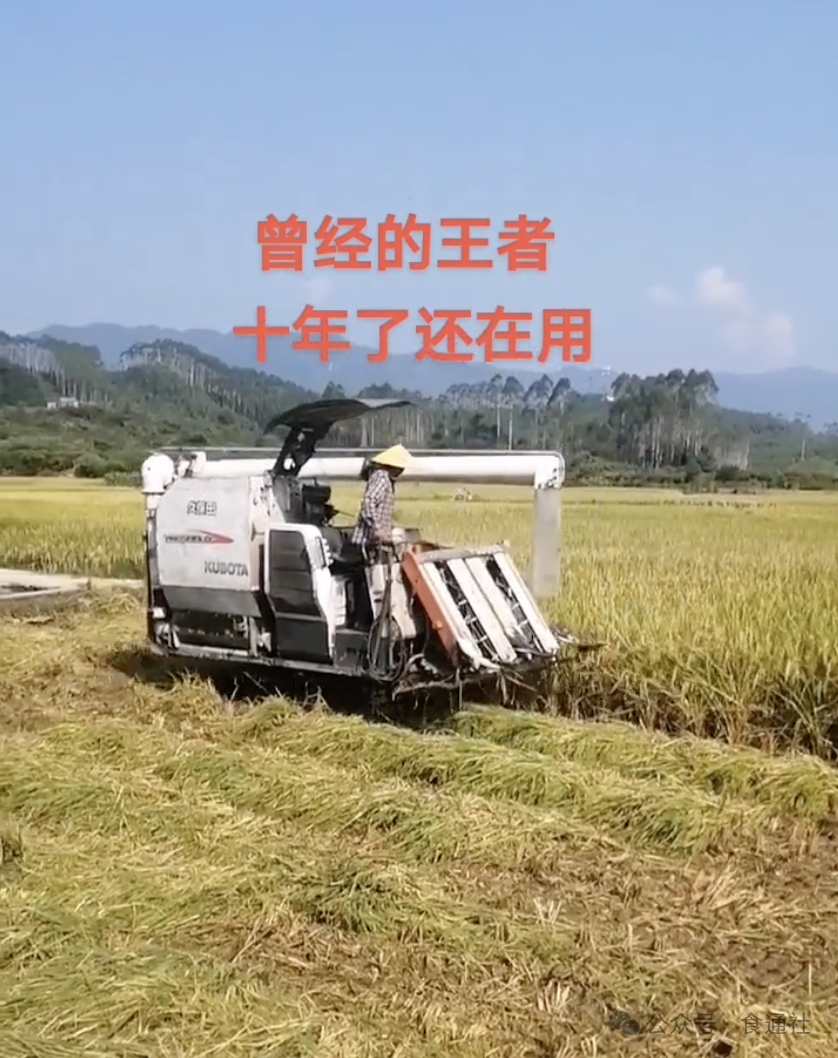
Once the green harvesters faded from use, the Kubota models, which spilled far less grain, became the villagers’ preference. However, the Kubota 488 had a drawback: a relatively small grain hopper. Models like the Kubota 488 and 588 required someone to manually secure sacks to a metal frame, then open the grain discharge chute to fill them. Once full, the sacks were roughly tied shut and left in the field, each holding roughly 100 jin (50 kg). So, besides the agricultural machinery operator, a “bag collector” was also essential.
Back then, this role was mostly taken by men. At least 1,200 jin (600 kg) of rice per mu (≈667 m²) meant 120 sacks. The northern Anhui region is largely flat with expansive plots, making the workload during the harvest rush enormous.
During harvest, it was common to see a single harvester creeping across a vast paddy field. The driver sat in the cab breathing in dust, while another person managed the sacks and simultaneously used a device to measure the land area. The field would be littered with unharvested rice and bulging sacks—yellow urea bags mixed with the pink-and-yellow dual-tone Red Sifang (fertiliser brand) bags. Farmers and their three-wheelers would wait at the field’s edge, ready to collect the filled sacks.
II. Fourth Uncle’s Unemployment
Because they met the criteria for cross-regional harvesting operations (holding a cross-regional operation certificate, matching documentation to the machine, and ensuring vehicles were within size and weight limits with no mixed cargo), harvesters engaged in these operations were exempt from expressway tolls. In the past, my father drove a large lorry carrying a harvester that required a bag collector, with Fourth Uncle in the passenger seat and a thick atlas of China spread out on his lap. In the days before GPS, veteran operators relied entirely on paper maps to travel across the country.
Fourth Uncle used to work in construction, but he would return to the village during the busy farming season to help with the harvest rush. When contracting land to set up family farms was not yet common, there was a widespread belief: even if you worked away from home, you couldn’t let the family land go fallow.
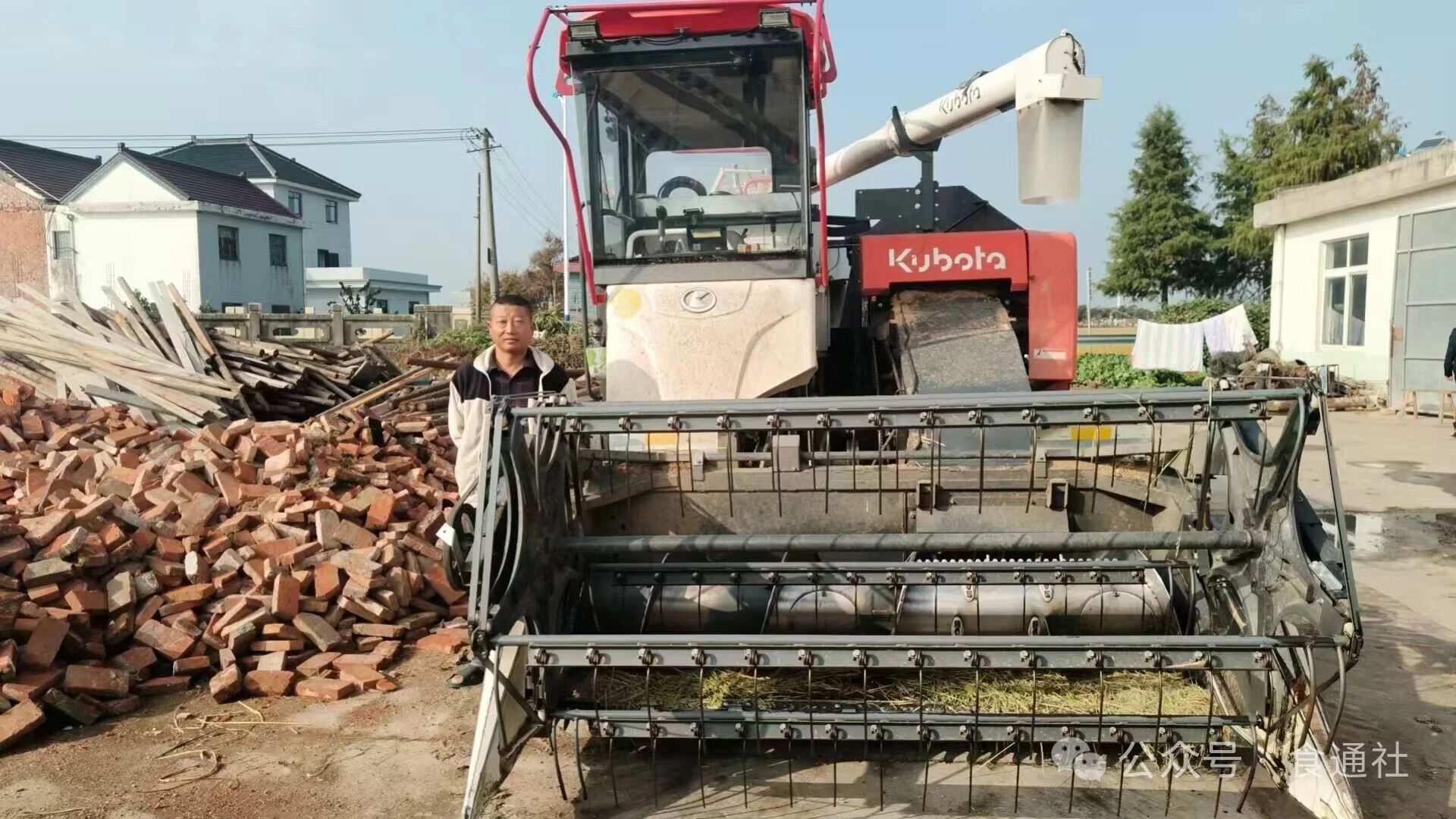
Eventually, though, Fourth Uncle lost his job. He was too old for construction sites, and the harvest rush no longer needed bag collectors. Modern Kubota harvesters feature air-conditioned cabs with sealed glass partitions that block dust, preventing respiratory issues. Large grain hoppers are now standard, so farmers no longer need to lug sacks across the fields to their vehicles. They simply position a three-wheeler with a large cargo bed nearby to receive the grain once the hopper is full.
The bag collector role naturally vanished. Fourth Uncle was left to stay home, occasionally taking on small odd jobs for neighbours, like helping dry grain or build houses.
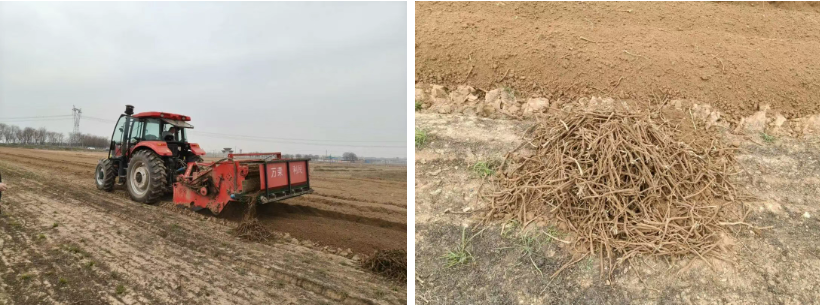
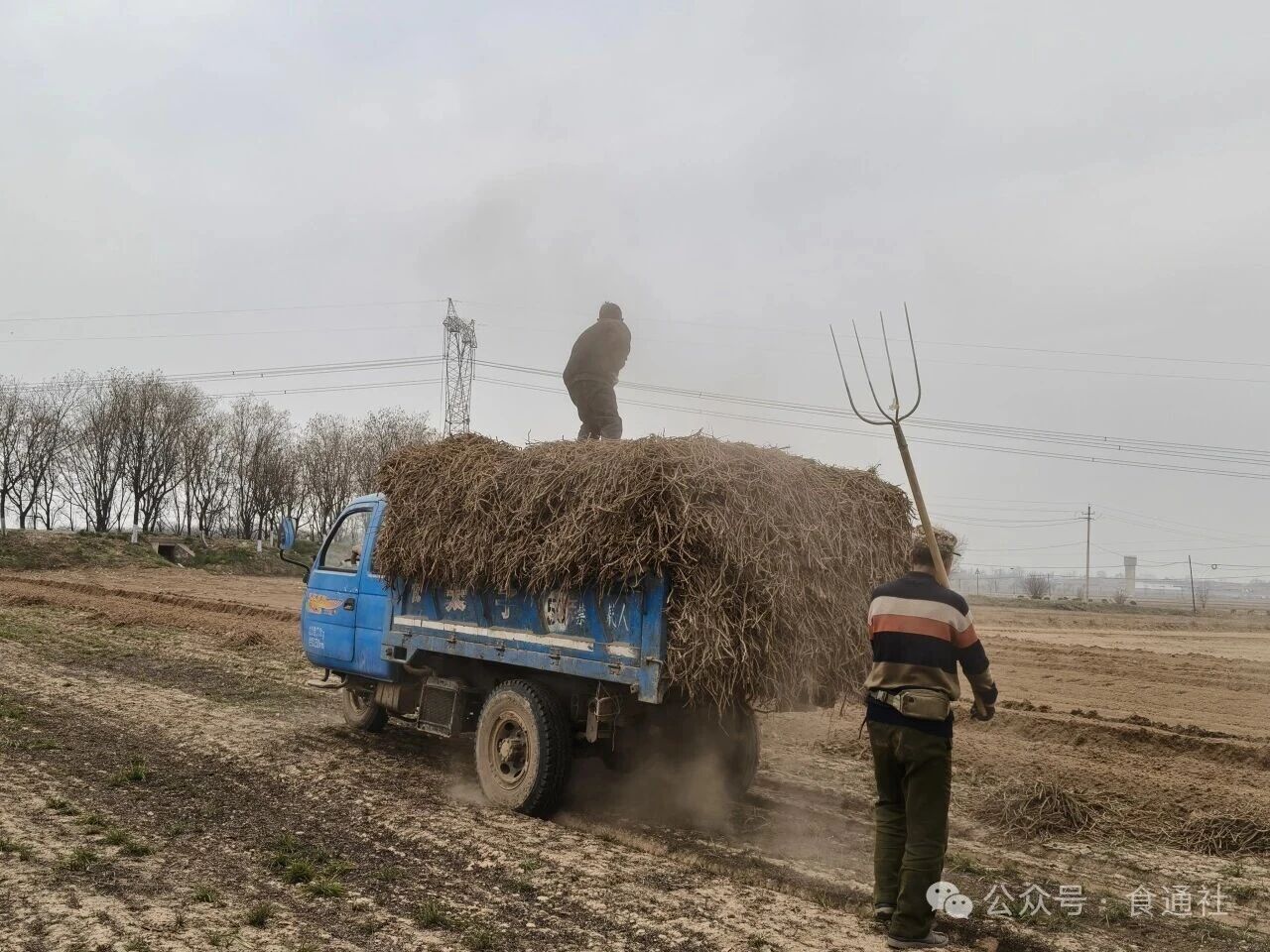
Once the rice harvest ends, it’s time to plant wheat. Red-coated wheat seeds (note: seeds treated with pesticide to protect against soil pests and bacteria; the coating is typically red) are scattered across the soil. Planting rice is more labour-intensive than wheat. Traditionally, rice transplanting was done entirely by hand, paid by the mu at an average of 220 yuan, with food and lodging included. Later, transplanters were introduced, significantly boosting efficiency and saving time and effort. However, these machines can only operate in shallow water; deep paddies and small plots still require manual labour.
In recent years, during the harvest rush, government officials still station themselves at expressway entrances to intercept harvesters, guide operators to the fields, and hand out “cross-regional operation service kits”. These kits contain towels, soap, bottled water, masks, heatstroke prevention supplies, and operation guidelines. By providing consultation and guidance, the government helps alleviate local machinery shortages, ensuring operators have work when they arrive and can depart smoothly.
Those who did this work were mostly men, freelance labourers with strong builds who took on odd jobs here and there. Spreading fertiliser involved hoisting a basket full of granules over your shoulder, putting on gloves, walking into the fields, and scattering it evenly, handful by handful. Spraying pesticides meant either carrying a heavy sprayer on your back or laying out long hoses along the path at the field’s edge and dragging them through to spray. The sprayers were heavy and the hoses made walking difficult. Before agricultural drones became widespread, pesticide spraying and fertiliser spreading would take half a month to complete. With drones, the job for 30 mu can be finished in 8 to 10 minutes.
The evolution of agricultural machinery has run through the memories of my growing up. Technological progress has brought tremendous development to agriculture, and drying grain is no longer as troublesome as it used to be, thanks to grain suction machines, grain turners, and grain dryers. Threshing floors have gradually been replaced by concrete surfaces, and stone rollers sit tucked under eaves, as if silently proving that dripping water wears away stone. But the eaves have been demolished; new houses lack them entirely, leaving the stone rollers with nowhere to rest.
The wind of smart agriculture may eventually blow into every village. The agricultural drones operating overhead and the giant wind turbines standing in the fields to generate power will become the first impression of agricultural production for children in remote areas: “Look, giant wind turbines are spinning in the sky, and drones are flying over the fields.”
III. Electric or diesel tractors?
Located in western Huaiyuan County, Anhui Province, Longkang State Farm is one of 20 large and medium-sized state-owned farms directly under the Anhui Agricultural Reclamation Group. As our coach bus bounced into the farm, an endless expanse of wheat fields stretched out, blindingly vast. This was not the familiar patchwork of smallholder fields typical of northern Anhui, but vast, neatly consolidated tracts of farmland. Even more staggering were the giants parked in the warehouses: John Deere, CLAAS, and Yanmar self-propelled full-feed combine harvesters.
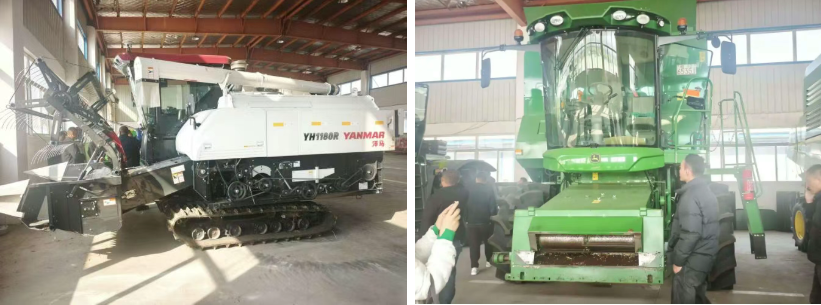
The cabs of these large harvesters are brightly lit, complete with air conditioning and Bluetooth. The most mind-boggling feature is the driverless harvester: without human intervention, it follows the field edges with pinpoint precision, cutting neither too much nor missing a single row. With just a mouse click from a technician at the command centre, a tractor kilometres away automatically heads into the fields. Once the job is done, a screen displays the mapped plots turning green—indicating they have been fully harvested.
In the second half of the machinery training, I also visited Wuhu Zoomlion. As a manufacturing giant, Wuhu Zoomlion produces and exports agricultural equipment, as well as operating its own experimental farms. The compound was filled with machines featuring green casings. A company representative explained: “This is our latest model of tractor, fully electric. The harvester next to it is electric as well.”
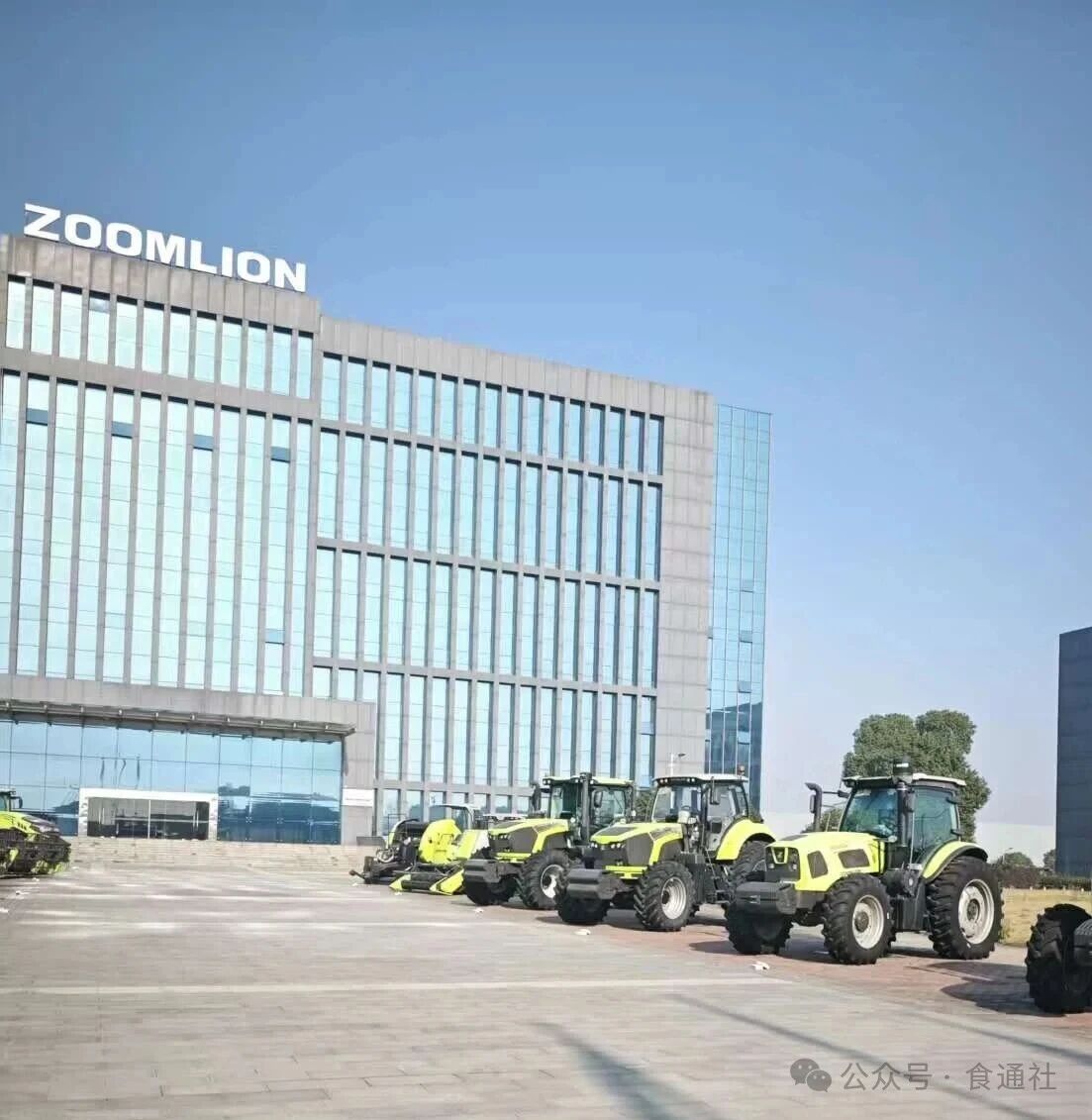
The collective gasp from the crowd overlapped in my mind with my father’s sigh when he decided to sell that old green harvester years ago.
I know that in Fuyang, most farming households will still opt for diesel tractors because they are cheaper, easier to repair, and “fuel stations are everywhere”.
Some might argue that larger farm operators and cooperative leaders, leveraging their financial, organisational, and informational advantages, have jumped into the mechanisation “fast lane” first. Meanwhile, smallholders lacking capital and technical skills are marginalised, further widening the income and development gap within rural communities. Much like educational inequality, this is an objective reality.
Yet smallholders are also experimenting with mechanised production and are no longer entirely reliant on traditional methods. Take my village as an example: it has over 9,000 mu of arable land, most of which has been contracted to family farms. The village has one agricultural machinery cooperative and around ten family farms. Just in my local district (note: the village is large and divided into districts, similar to urban neighbourhoods), there are two harvesters, three tractors, and two agricultural drones, all purchased by family farm managers operating plots of over 100 mu. Other households, who cultivate smaller areas, hire machinery operators and rent their equipment for harvesting, settling the bill at around 68 yuan per mu.
In my village, harvesters, tractors, and agricultural drones are in surplus, so some operators form teams to carry out cross-regional operations in other areas. However, the village lacks smart agricultural machinery such as autonomous harvesters and tractors. Smart machinery is expensive and considered “impractical” for small family farms and small cooperatives with limited scale. The cost of a single piece of smart agricultural machinery could buy us two to three conventional machines.
Farmers have their own calculus when buying agricultural machinery. In my village, people generally opt for second-hand tractors, favouring the Dongfanghong brand, with a budget of 40,000 to 60,000 yuan. For a new tractor, the budget is around 100,000 yuan; with a 10,000-yuan government subsidy for machinery purchases, the final out-of-pocket cost is just over 90,000 yuan. Harvesters are typically Kubota models, though Lovol ones are also available. Taking the Kubota EX118MQ-s as an example, this model features a chassis lift system that adjusts chassis height on uneven terrain. It sells for 240,000 yuan, with a 29,000-yuan subsidy, bringing the net price to just over 210,000 yuan. Most people choose to buy new harvesters, as the subsidy makes it more cost-effective; they use them for a few years, sell them, and then upgrade to a newer model.
Perhaps in the future, everyone will be able to use smart agricultural machinery. My generation is destined to be the bridge between the last “craftspeople” and the first “commanders”.
Editor: Xiao Dan