
The 30-minute online grocery delivery myth starts with the picker’s 3 minutes

Foodthink says
In January this year, a Beijing resident ordered fresh lily bulbs from Hema but received toxic daffodil bulbs instead, leading to their 71-year-old mother and 12-year-old son being hospitalised after eating them. Hema attributed the error to a sorter who, during the picking process, accidentally placed daffodil bulbs from another order processed at the same time into the customer’s parcel.
Is a sorter’s mistake simply a matter of bad luck? As fresh food e-commerce becomes a crucial battleground for tech giants such as Meituan (Little Elephant), Alibaba (Hema), and JD (7FRESH) vying for the local lifestyle market, the delivery speed of riders and the picking speed of sorters have become vital to maintaining traffic and user retention. During a stint as a part-time worker at Little Elephant Supermarket, this article’s author, Yakou, found that sorters on these platforms operate under relentless pressure shaped by algorithms, data tracking, and piece-rate pay. Mis-picked or omitted items are therefore an inevitable structural issue. With alienated labour on one side and unsafe food consumption on the other, before we fall into a simplistic binary pitting workers against consumers, we ought to first scrutinise the intensifying “speedism” of fresh food e-commerce platforms.
“Don’t the others eat dinner?”
“They… eat after finishing work. Part-time work basically doesn’t include a dinner break.”
In March, after the Chinese New Year, I took on a part-time sorting job at a Little Elephant Supermarket in a tier-one city in Guangdong. My main task was to pick items once customers placed their orders, pack them, and hand them over to the delivery riders.
I had initially planned to stay for at least two weeks, but after six straight hours of gruelling work on the third day, I developed a fever. It could have been the constant trips in and out of the cold room to retrieve frozen items, or simply an overwhelming workload. That day, if I hadn’t insisted on having dinner, the station manager would have kept me working non-stop from 4:30 PM until 10:30 PM.
My body simply couldn’t cope, so I handed in my notice. But even after I left, I knew a handful of full-time staff would still be pushing themselves to the limit: six days on, one day off, with shifts of at least twelve hours, logging tens of thousands of steps carrying heavy loads, and getting just one meal break a day.
As competition in the food delivery market intensifies and regulation tightens, Elephant Supermarket’s push to tap into and meet online demand for fresh food has become Meituan’s new weapon for sustaining its traffic advantage in local commerce. Yet the foundation for all of this is the efficiency and convenience underpinned by intensive labour, and the cost is the sorters’ bodies and work, subjected to such stringent control.
The Invisible Xiaoxiang Supermarket
The Invisible Sorters
Nowadays, more and more people are getting into the habit of using Xiaoxiang Supermarket for their grocery shopping. On the Meituan app’s homepage, the Xiaoxiang Supermarket tile is highly prominent, positioned in the second row of the first column, directly beneath the food delivery option.
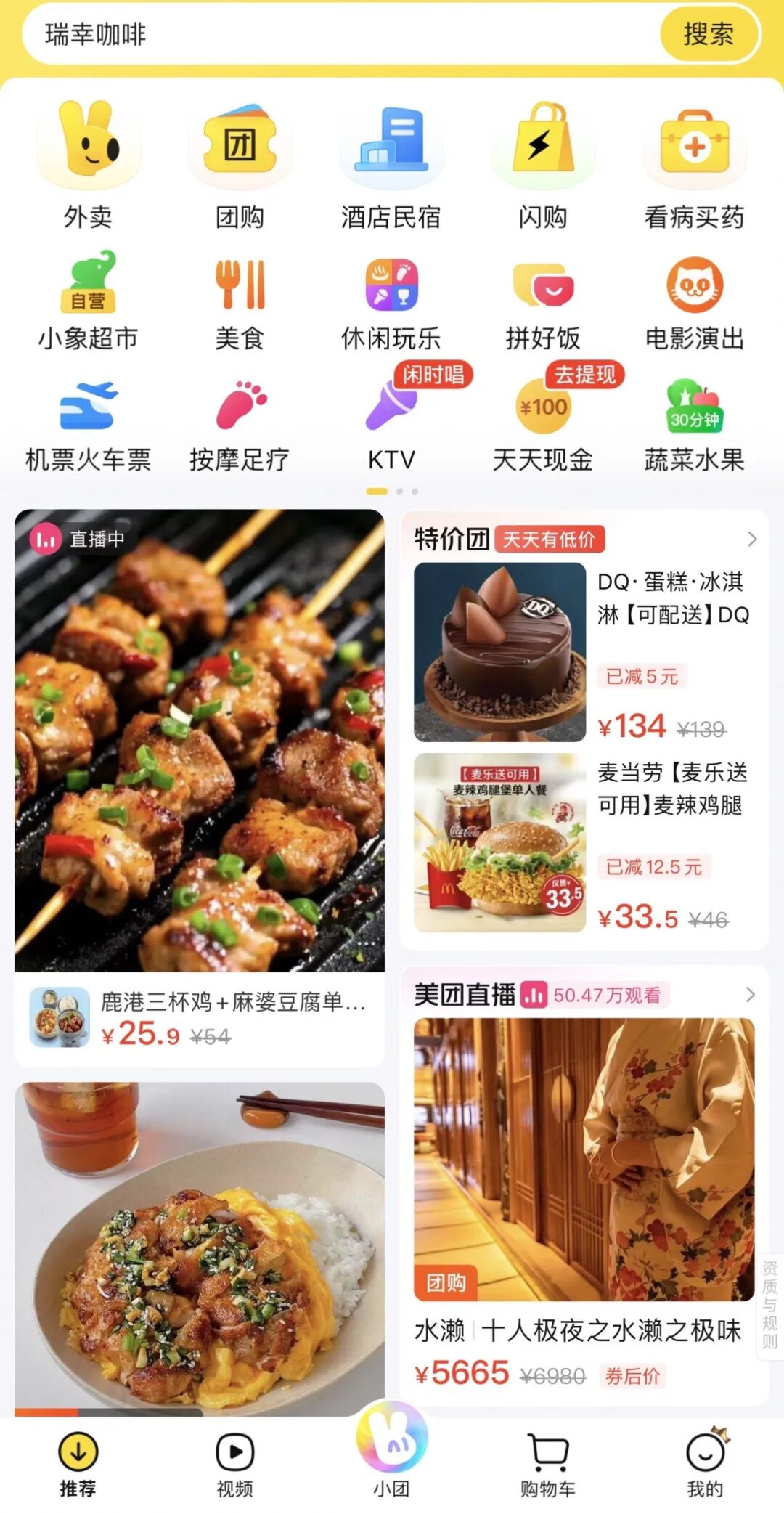
◉ The Meituan app homepage. Xiaoxiang Supermarket currently operates nearly a thousand locations across 20 major cities nationwide. Image source: screenshot from the Meituan app.
Yet in the physical world, Xiaoxiang Supermarket locations tend to be tucked away in residential neighbourhoods or narrow alleys, easily overlooked even by those who pass them day in, day out.
The day of my interview was also the first time I came across a Xiaoxiang Supermarket station. Beneath a large green logo sign, three delivery riders in matching green uniforms were squatting, all appearing to be in their early twenties. One had his head bowed, dozing with his eyes half-shut, whilst the other two were chatting. Outside the entrance, several more riders stood waiting for orders to come through. Heading further down the alleyway adjacent to the station, the damp wall bore the painted words “Riders Only”. A long line of electric bikes was parked along it, with four or five riders squatting nearby, scrolling through their phones.
Unlike Meituan’s yellow-uniformed delivery riders, these riders in green work exclusively on orders for Xiaoxiang Supermarket. It is their daily, life-or-death race across the roads that sustains the myth of Xiaoxiang Supermarket’s “30-minute express delivery”.

◉ October 2025, Beijing. A Xiaoxiang Supermarket delivery rider, travelling too fast and carrying an excessive load, skidded forward after slamming on the brakes and collided with an e-bike crossing the road, scattering the delivered mineral water bottles across the pavement. Image: Foodthink.
Yet the workforce behind this myth extends far beyond the delivery riders. It was only when I stepped into this depot that I realised that within that far-from-spotless alleyway, inside that fresh-produce warehouse glowing brightly day and night, I too would become a part of the thirty-minute myth as a sorter. And the time allotted to me is merely three minutes.
Three Minutes to the Limit
“Everyone calls me Sister Lin.” On my trial day, veteran employee Sister Lin quickly walked me through the depot’s layout and workflows, with the aisles of shelving rushing past the edges of my vision.
The entire depot is a large warehouse of roughly two to three hundred square metres, with shelving units occupying most of the space and stacked densely with merchandise. Ambient, medium-temperature, chilled, and frozen zones divide the warehouse into four sections. A sorter’s job begins the moment an order appears on their PDA: they must dart between the different zones, swiftly gather all the items on the list, and head to the packing counter. The entire process must be completed in under three minutes. As soon as one order is picked, the PDA displays the next. The moment “Accept Order” is tapped, a new sprint begins. And so the sorters continue, locked in an endless, breathless three-minute loop.
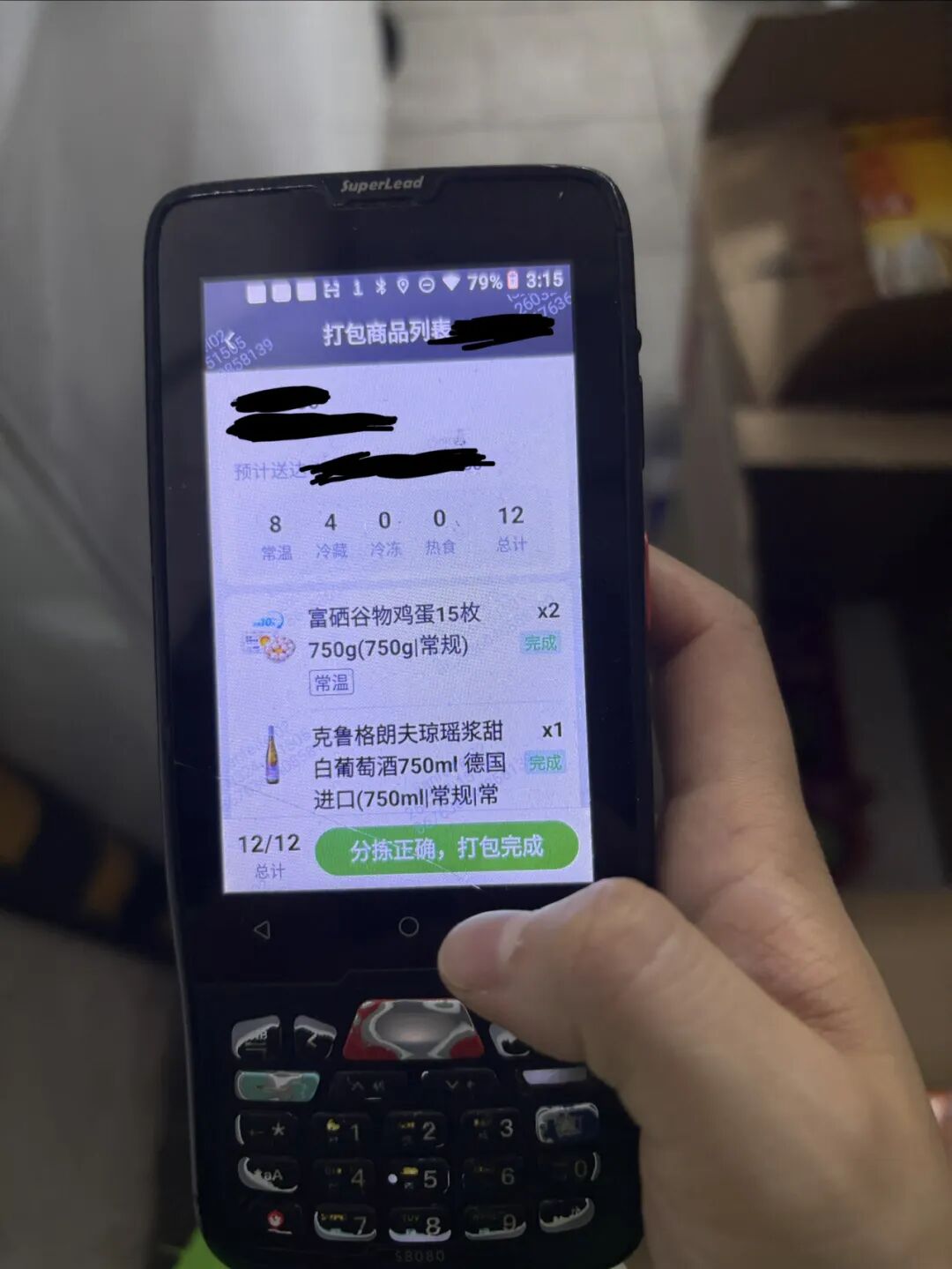
◉A PDA is a handheld device used to accept orders and scan items. In a forward warehouse, the PDA functions like a factory conveyor belt, dictating the pace and direction of both the pickers’ movements and the flow of goods.
I’ll use a specific order I picked as an example to show you just how much a person can get done in three minutes under extreme pressure.
At that moment, a new order appeared on the PDA. Even without knowing how many items it contained, I didn’t hesitate to press the ‘Accept Order’ button.
First item: cantaloupe. Medium temperature, 03-02-02-01. These digits, combined with ‘medium temperature’, form the stock code for the cantaloupe. In a warehouse this vast, a code is all you need to find anything. Third row, second column, second shelf, first slot. I located the fruit, scanned the QR code on the shelving unit with my PDA, then scanned the one on its packaging. With the first item secured, the plastic bag hooked over my arm instantly grew heavier.
Second item, millet peppers: medium temperature, 03-01-06-01. The sixth tier is the highest, and I can’t quite reach it. The shelving units stand about 1.8 metres tall. Goods on the top tier are usually stored in plastic crates, and when I reach up, my fingers can barely brush the edge of one. Stepping onto a stool would be the sensible option, but the whole process—locating a stool, dragging it over, climbing up, grabbing the item, scanning it, and jumping back down—would take a good thirty seconds. I simply couldn’t afford to spend a sixth of my three-minute limit on a single item.
In the end, I chose to climb the shelving—balancing on the second tier to grab items from the top rack. I picked up the trick from other pickers around my height. At first, it felt recklessly dangerous, but everyone else was doing it, and it genuinely shaved seconds off the clock. Sometimes I’d even brace myself with a foot on two different bays at once, as it gave me a steadier centre of gravity. My stomach would churn at the thought of the whole rack toppling over, but with time running out, I’d push aside the dread and scramble up and down as fast as I dared.
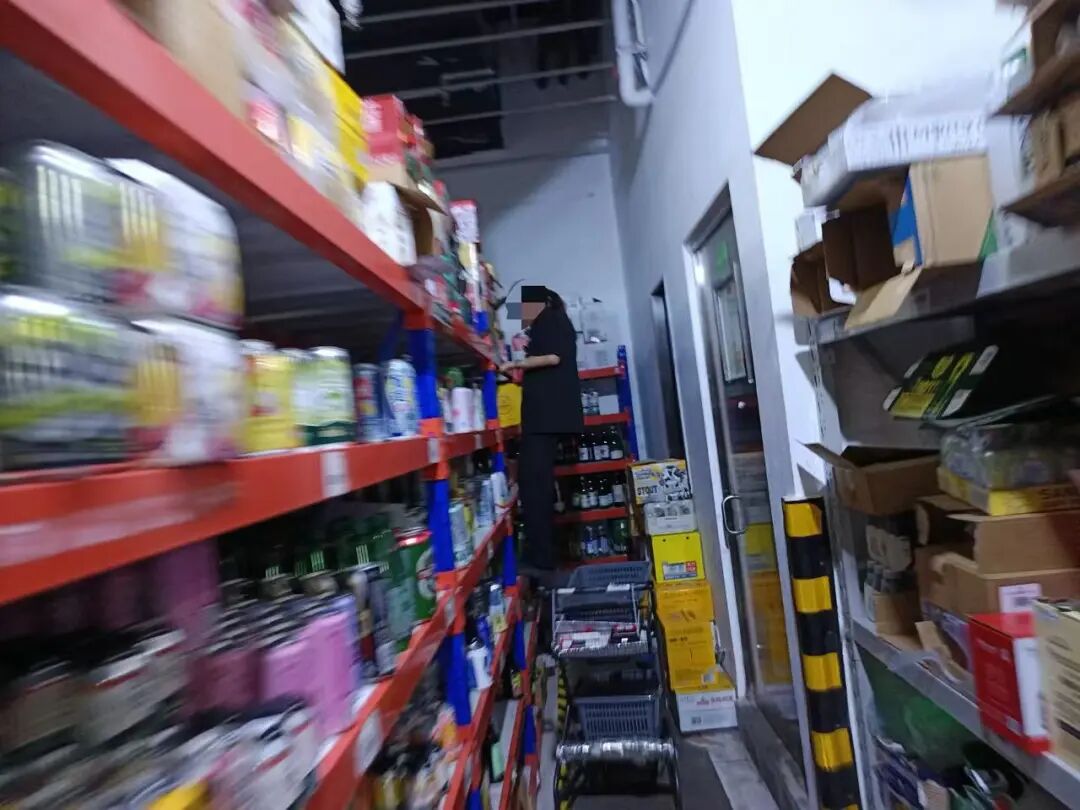
◉ Warehouse shelving usually bears “No Climbing” signs, but under the relentless pressure of impending time limits, sorters are forced to take the risk and climb.
Third item: blueberries, chilled, 07-02-04-03. Fourth item: ice cream, frozen, 02-03-01-06. I let out a long sigh. It was time to step into the freezer. Thick thermal curtains hung over the entrance, crusted with layers of ice, while more than a dozen cooling units hummed away inside. I stiffened my neck, hunched my shoulders, and thought that if people could roll, I would have instantly curled into a ball to get through.
Spend more than a minute and a half in -20°C, and thoughts of death begin to creep in. A few times, after frantically rummaging through cardboard boxes only to fail to find the right item, I’ve wondered whether I’d freeze to death or pass out right there. In those moments, the instinct to survive and the dread of missing the time limit wage a battle in the mind. To avoid frostbite, even though it meant the order would be severely overdue, I would step out to warm up before heading back in.
Fifth item: bread, ambient, 11-04-06-01. Top shelf again. I climbed up the racking. Two minutes had already passed. The PDA in my hand gave a warning: “Order about to time out.” Just two items left. It seemed hopeless, but I took off running anyway—just like every other sorter, sprinting through every corner of the warehouse. I still remember my trial shift. I’d watched colleagues rush past me—some power-walking, others jogging—while the “Order about to time out” alerts echoed relentlessly across the floor. Now, I’m one of them.
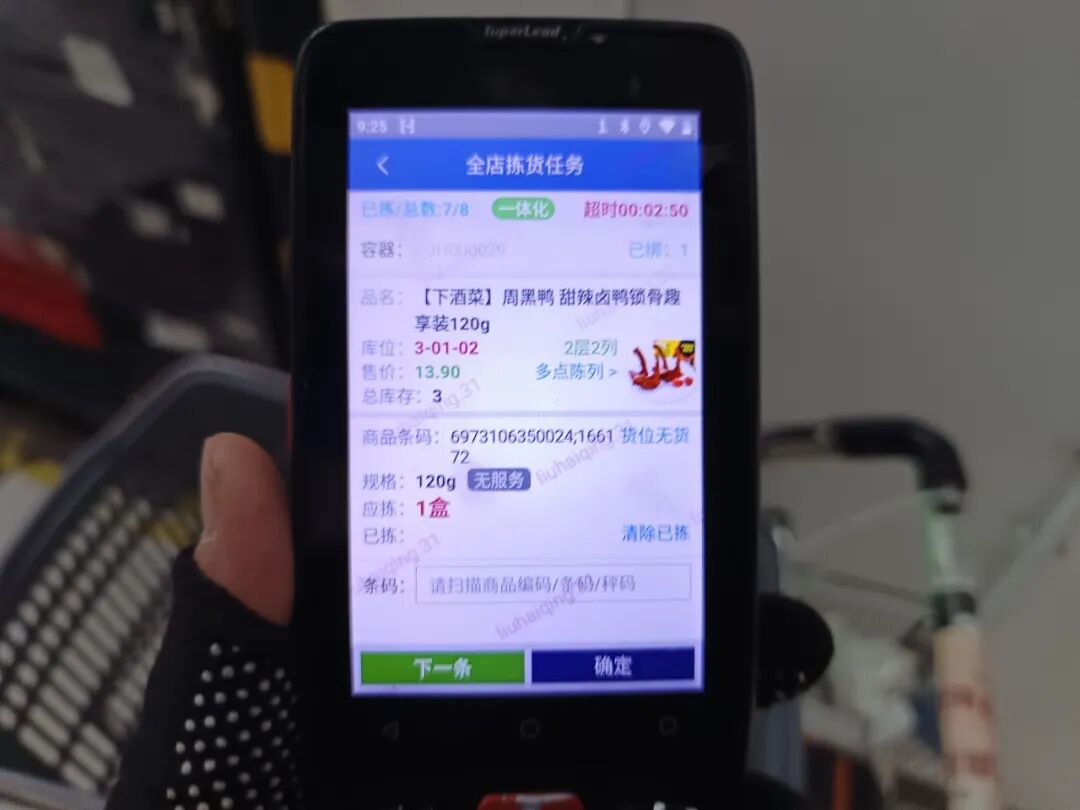
◉ The red number in the top right corner of the PDA screen indicates that the sorter has exceeded the time limit. Photo: He Siqi
Item six: mineral water, ambient temperature, 03-01-02-01. Frankly, this is one of the products I least look forward to seeing. Mineral water, oil, rice, and drinks are all bulky and heavy. The heaviest order I’ve dealt with consisted of four five-litre bottles of mineral water, a large bag of rice, a large bottle of oil, plus six smaller items. One hand carrying the oil, the other gripping a plastic bag and the large sack of rice, I’d pant my way to the packing station, double back, and then haul the four bottles of water. By then, I stopped caring whether the order would run late or not; all I wanted was to drop everything and catch my breath.
“Effective working hours”
Constant activity and quickened steps define the scene for most of the day. During off-peak hours, however, pickers sometimes retreat to the medium-temperature and chilled zones—further from the station manager’s desk—to chat and laugh. One time, while hunting for vegetables in the medium-temperature zone, I overheard a young picker complaining to a restocker: “With wages this piffling, am I supposed to be stupid?” The restocker chimed in, “Yeah, it’s like this every day, shit! Besides, when the fines come, he bears the brunt of it and we only take a minor hit.” They were gossiping about the station manager, just ten metres away, but the two intervening temperature zones and heavy door curtains created a relatively safe little bubble.
Each city is dotted with numerous Xiang Supermarket stations that compete fiercely on metrics such as on-time delivery and low complaint rates. Yet if a station’s performance dips, it is invariably the station manager whose wages bear the brunt of the penalty.
However, the station manager is not left to shoulder this anxiety and loss alone. A large monitor hangs in the station, displaying the station’s on-time rates, 30-minute delivery figures, and other key metrics. It seems as though every second of every worker’s time is held accountable to these numbers.
Beyond this, every worker’s real-time performance is laid out in stark detail: average sorting time per order, items processed per hour, live order breakdowns, sorting on-time rates, effective working hours ratios… alongside sorting volume rankings and staff flagged for close attention. This is how pressure filters down layer by layer from the platform, channelled through the flow of data.
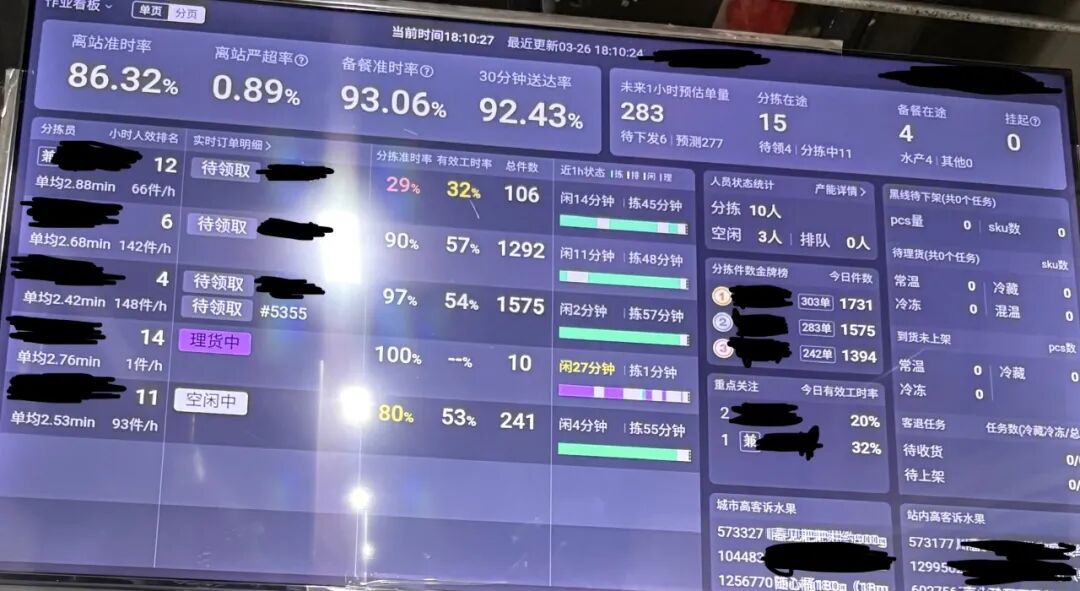
◉ On the large screen, data generated by everyone rushing around the warehouse updates in real time.
Part-time shifts are typically scheduled for weekends and daily peak hours, from 4:30 pm to 7:30 pm. During this period, order volumes surge, and nearly everyone is working at full speed.
The recruitment app lists a part-time rate of 20 yuan an hour, but that’s only if you work fast enough. If I can’t pick 100 items an hour, my hourly rate drops to just 13 yuan. Under this system, even without a boss cracking a whip, workers will keep running just to earn a little more.
On my first day, I found myself on the “Closely Monitored” list. Fortunately, as a newcomer, I was spared a reprimand from the station manager. On the screen, my “effective working hours rate” sat below 30%. The concept of “effective working hours” completely baffled me. We were clearly already working on the premises, so why were these hours still divided into effective and ineffective?
I later learned that if an order was marked complete but the next one wasn’t taken up straight away, the time in between would be flagged by the system as “idle time” – effectively, unproductive working hours. To avoid timing out, pickers would usually tap “packing complete” before actually packing the items. The packing process itself takes a minute or two, and if the fruit and vegetables require a careful inspection, it means an even longer stretch of logged “idle time”. Though we were never actually resting, the system still marked us as idle. We had no choice but to keep moving relentlessly, without even a moment to catch our breath before sprinting to the next order.
In an environment where efficiency reigns supreme, I also felt a profound sense of isolation.
Once, while picking orders, I accidentally knocked over a box of tangerines, scattering more than a dozen across the floor. I hastily dropped what I was holding to pick them up one by one, but in my rush I couldn’t help but fumble. There were two or three other sorters working right beside me, yet no one came to help. Everyone was too busy racing through their own orders.
I asked myself: if another sorter needed help, would I put down my own work to lend a hand? The moment I realised the answer was “not sure”, I grasped the true horror of this job. It fosters competition, prioritises efficiency, erodes mutual support, and deepens isolation. It makes asking for help feel like a burden, and turns offering a helping hand into self-sacrifice.
Who is making our “perfect” lives possible?
“This won’t do; there’s a flaw on every single one.” On my trial day, Lin asked me to help her check a box of oranges. I took a look and thought they were fine, but she pointed out the blemishes and scratches on the peel, saying that fruit in this condition could easily trigger a complaint, and told me to swap them out. I was genuinely surprised. These marks don’t affect the fruit’s quality or flavour at all; in fact, they’re just natural signs of growth.
With eggs and soft fruits like blueberries, strawberries and grapes, it’s impossible to judge their condition at a glance. We’re required to inspect each item individually for rot, damage or scratches before packing. This routine alone can easily take a minute or more.
The issue is that to avoid breaching time limits, sorters often click “Packing Complete” before the order is even packed. As soon as they do, the delivery rider gets a notification to pick up the order, and the ticking clock that disappears for me is instantly passed on to them.
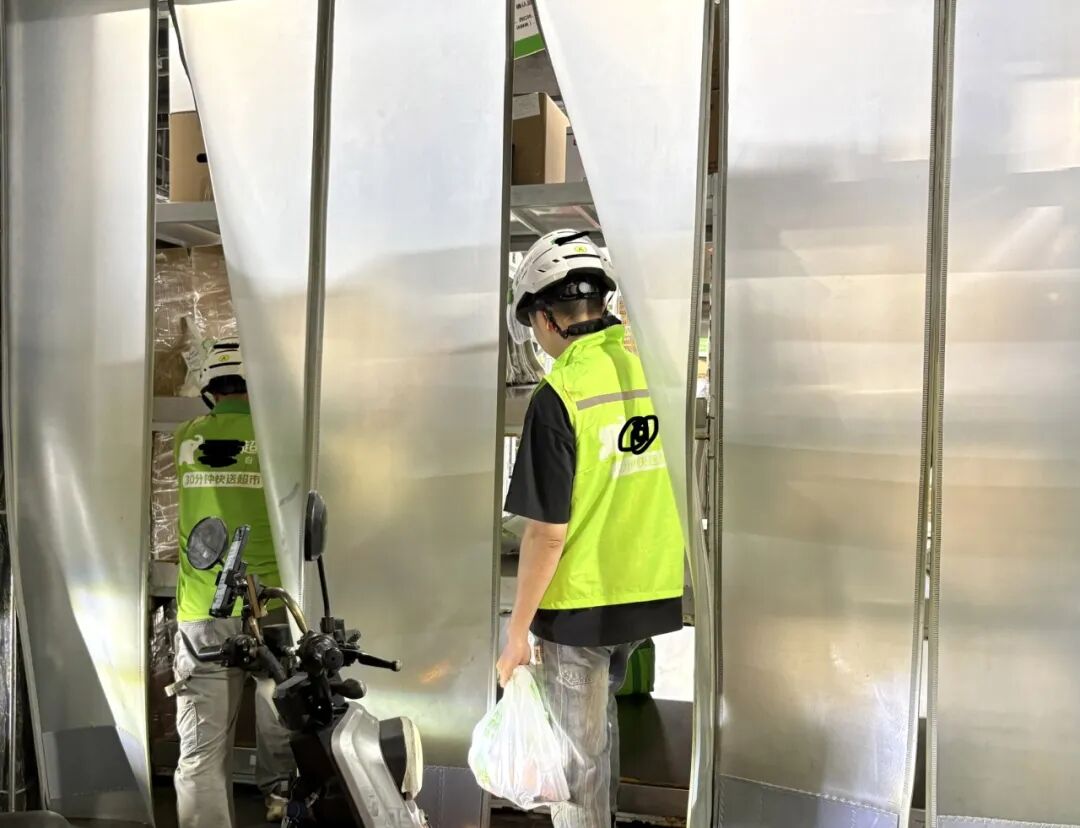
◉ A delivery rider waiting for a sorter to finish packing.
In that moment, my interests and the rider’s were completely at odds. If I didn’t mark the order as packed early, it would certainly breach the time limit; if I did, but the rider stood there waiting for the parcel, the system might flag the pickup as late. Lin advised me: “Hurry up. If a rider waits more than a minute, they might hit “Appeal”, and you’ll lose five yuan on that order. If you’re running behind, just be polite, alright? Say a few kind words and ask them to wait.”
In most cases, the riders never actually submit an appeal. At most, they’ll send a “nudge” or call out from outside. Meanwhile, the sorters keep their hands moving at lightning speed while maintaining a gentle, accommodating tone. There are usually around fifteen sorters at the station each day, three-quarters of them women, while the riders coming to collect orders are almost exclusively men. It struck me then that Lin was teaching me a deeply gendered survival strategy.
On my final day, I still received a customer complaint. I was fined ten yuan with absolutely no room for negotiation. Working on the basis that each order contains eight to ten items, a part-time sorter earns less than two yuan per order. A single complaint wipes out the earnings from five orders.
Aside from blemished produce, incorrect or missing items are also frequent grounds for complaints. Once you get past the probation period, you move from sorting a single order at a time to handling two simultaneously. This means that while you’re hurrying between shelves, you have to figure out which items belong to the first order and which to the second, dropping them into the correct plastic bags. Given that speed is paramount in this role, misplacing items in the wrong bag is an easy mistake to make.
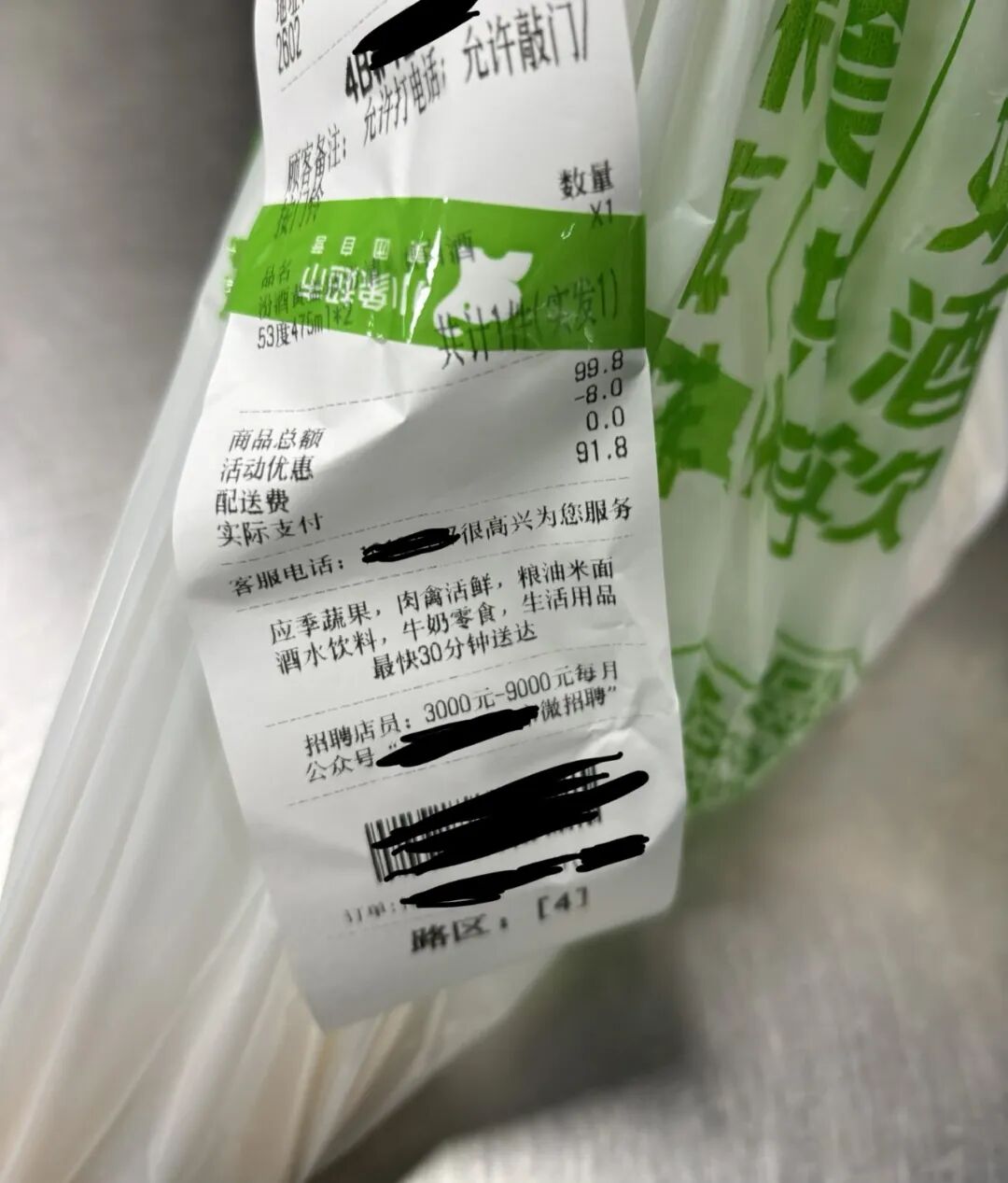
◉ The sorter’s name is printed on the customer’s receipt, listed directly after the order number.
It suddenly occurred to me that I, too, had once clicked ‘Complaint’ on the platform interface simply because I hadn’t received the items I ordered. Yet I never truly grasped what was happening behind the scenes, or what my complaint actually meant. Only when I no longer held the ‘power to penalise’ that the platform lent to consumers, and instead found myself the one being penalised, did it become clear.
In our time, people do indeed live in separate spaces and contexts. Yet, amidst the effortless convenience of today, these divisions have only grown more entrenched and invisible.
We want “perfect” fruit and a “perfect” life, yet we rarely realise how many hands it passes through before it reaches ours. What must those who grow it, store it, transport it, and sort it sacrifice? How must they adapt their bodies and lives to collectively bring about this kind of “perfection”?
But is this way of life truly perfect? Who gets to define perfection? Is a blemish-free piece of fruit really the ideal? Does an efficient, convenient lifestyle truly equate to perfection?
At the very least, when we recognise that behind every food delivery lies a host of workers—including delivery riders and sorters—labouring under stress and anxiety to uphold this notion of perfection, we must ask ourselves anew: what does a truly perfect life actually look like?
– This is Foodthink’s 798th original article –

Foodthink
Author
Yakou
I have no full-time position, so I take on odd jobs that require both mental and physical effort. I’ve recently returned to fieldwork and writing—a quiet light in a flawed world that can’t be taken away.
Unless otherwise stated, all images in this article are provided by the author.
Editor: Yuyang
Layout: Xiaoshu