
Elderly Sugarcane Farmers Face a Market Glut: Unable to Sell, Yet Forced to Plant Again
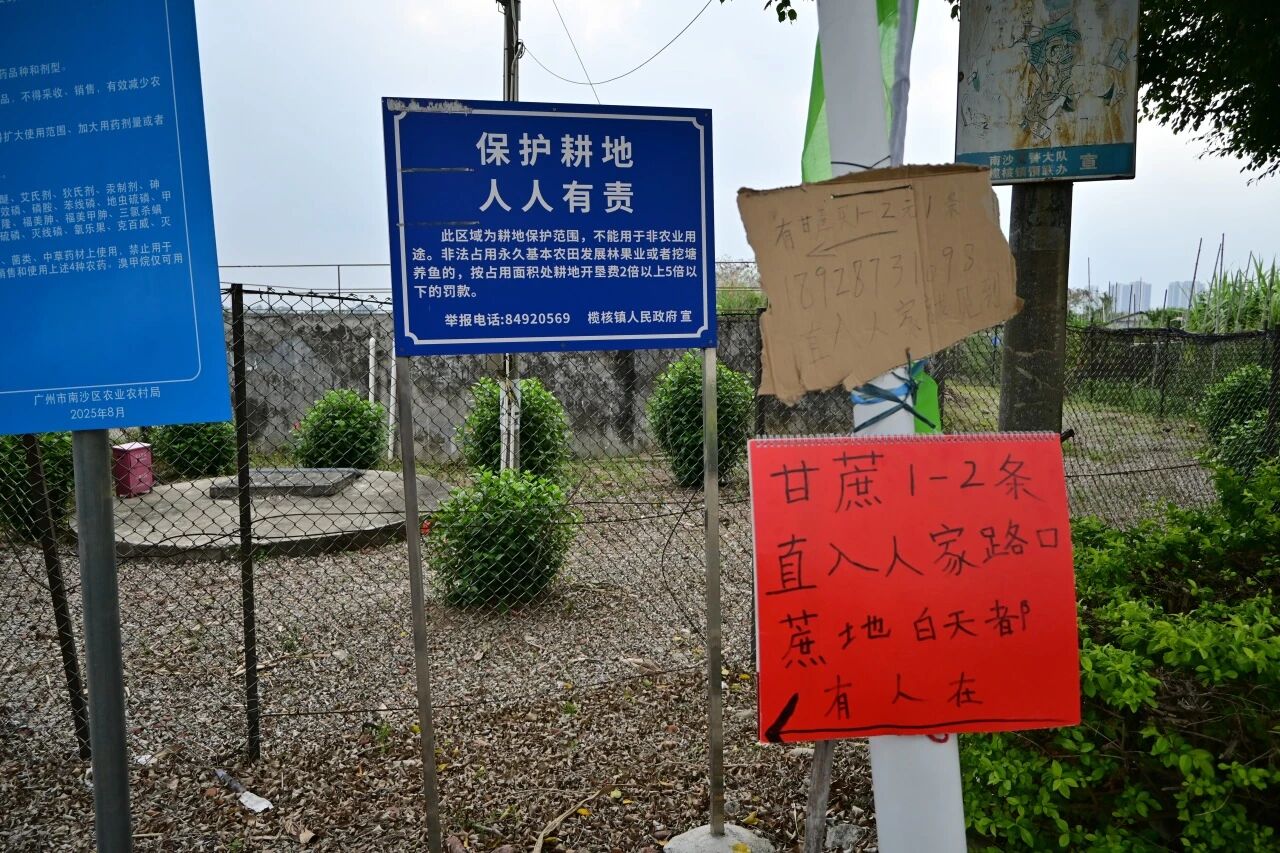
At around seven in the morning, 65-year-old Aunt Zhen arrives at her sugarcane field. She props her heavily scratched phone against a stalk, connects to a neighbour’s Wi-Fi, and opens Douyin. She recites the steps under her breath: “Tap the plus sign, swipe left, start live stream.” The camera points forward. In the centre of the frame hang two pieces of cardboard attached to the cane, reading: “Sugarcane 1–2 yuan per stalk, Shunhe Village, Lanhe Town. Hosted by an elderly grower.” Her son taught her how to do this just a week ago. By broadcasting for an entire day without showing her face or saying a word, she hopes to draw the attention of well-meaning buyers and clear the unsold stock.
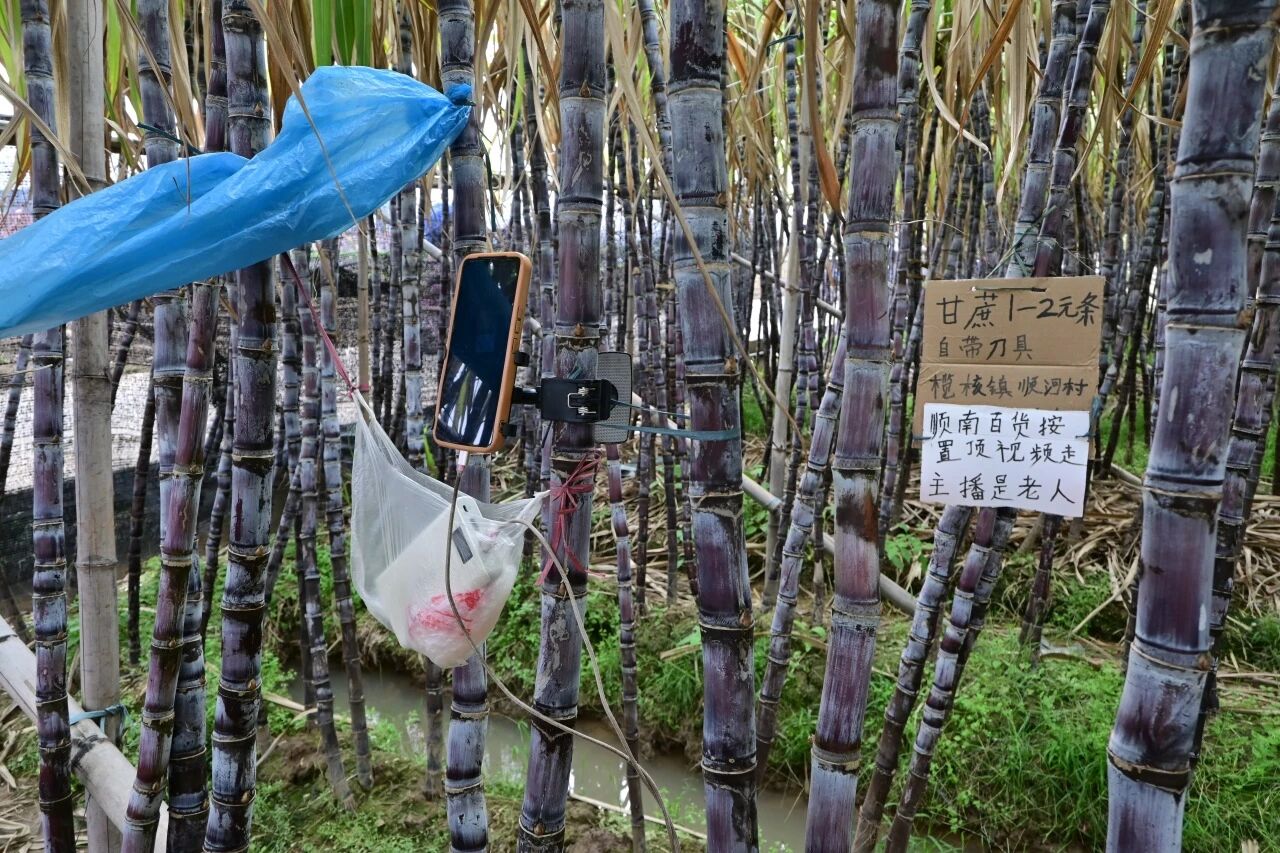
In late March in Nansha, Guangzhou, spring rain comes and goes. The air grows increasingly muggy, heavy with the sweet, fermenting scent of decaying cane leaves. Stands of black-skin table cane pierce the fields like so many needles, a truly heartbreaking sight. Fearing they will miss the spring planting window, growers are giving their cane away for free to buyers, simply hoping for a swift harvest. Every mu (0.067 hectares) cleared at no cost represents a loss of more than 6,000 yuan.
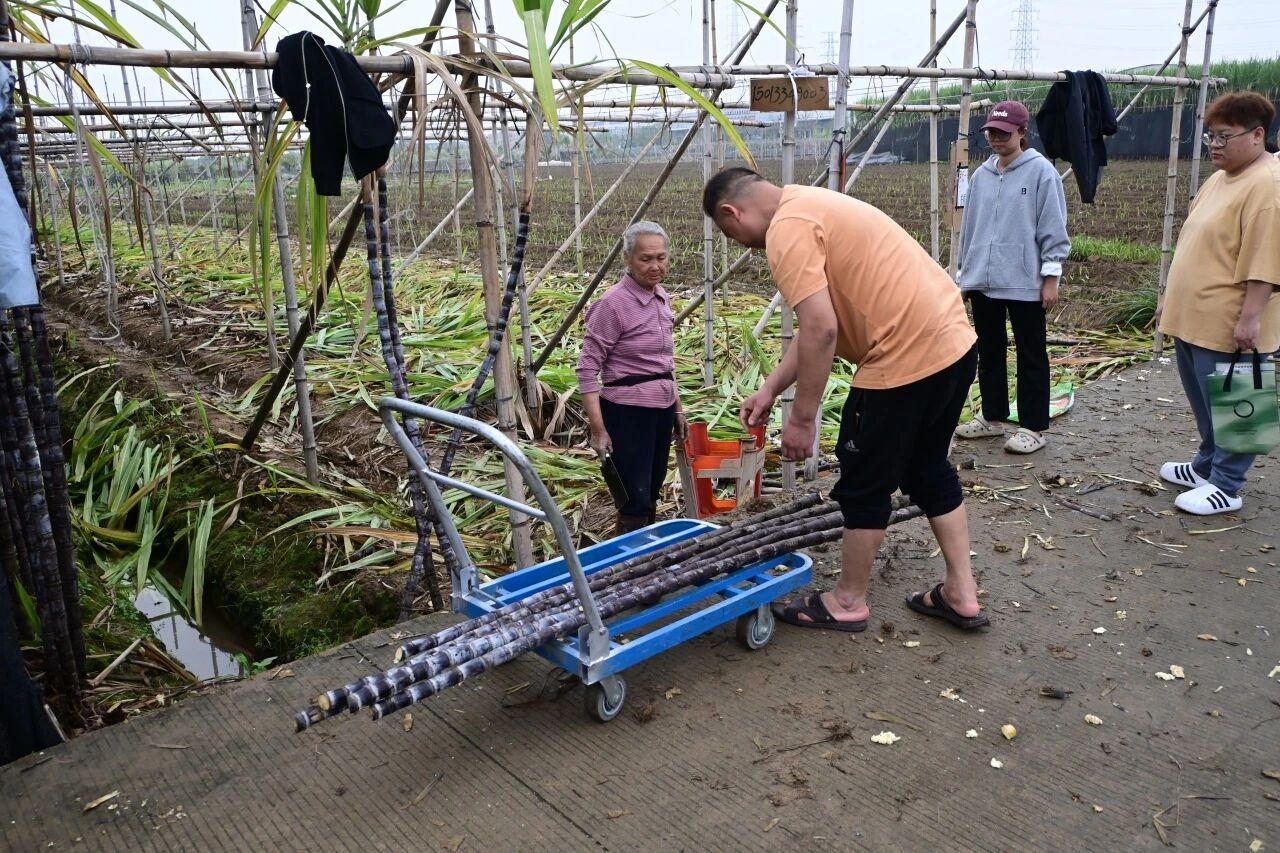
Most local growers are over fifty. Facing a market glut, many like Aunt Zhen feel powerless, with little choice but to hang signs reading “One yuan a stalk, support local growers” at field entrances and road junctions, waiting by the crops.News of the unsold cane in Nansha has drawn visitors to buy or cut the stalks themselves. At 1 to 2 yuan a stalk, a mu can yield around 3,000 yuan, allowing growers to recoup nearly half their costs.
Many other growers spend every day busy harvesting cane. Starting work at 6 am and labouring until dark, they strain ageing bodies as they heave canes weighing over 50 kg onto their shoulders, hauling 2 tonnes a day for an income of just over 400 yuan. It takes more than half a month of continuous hard work just to make up for the losses on a single mu.
On the fields where spring planting has already begun, fresh green cane leaves are sprouting in thick clusters. “What else could we possibly plant?” the elderly farmers have no other choice. “We’ll take another gamble this year.”
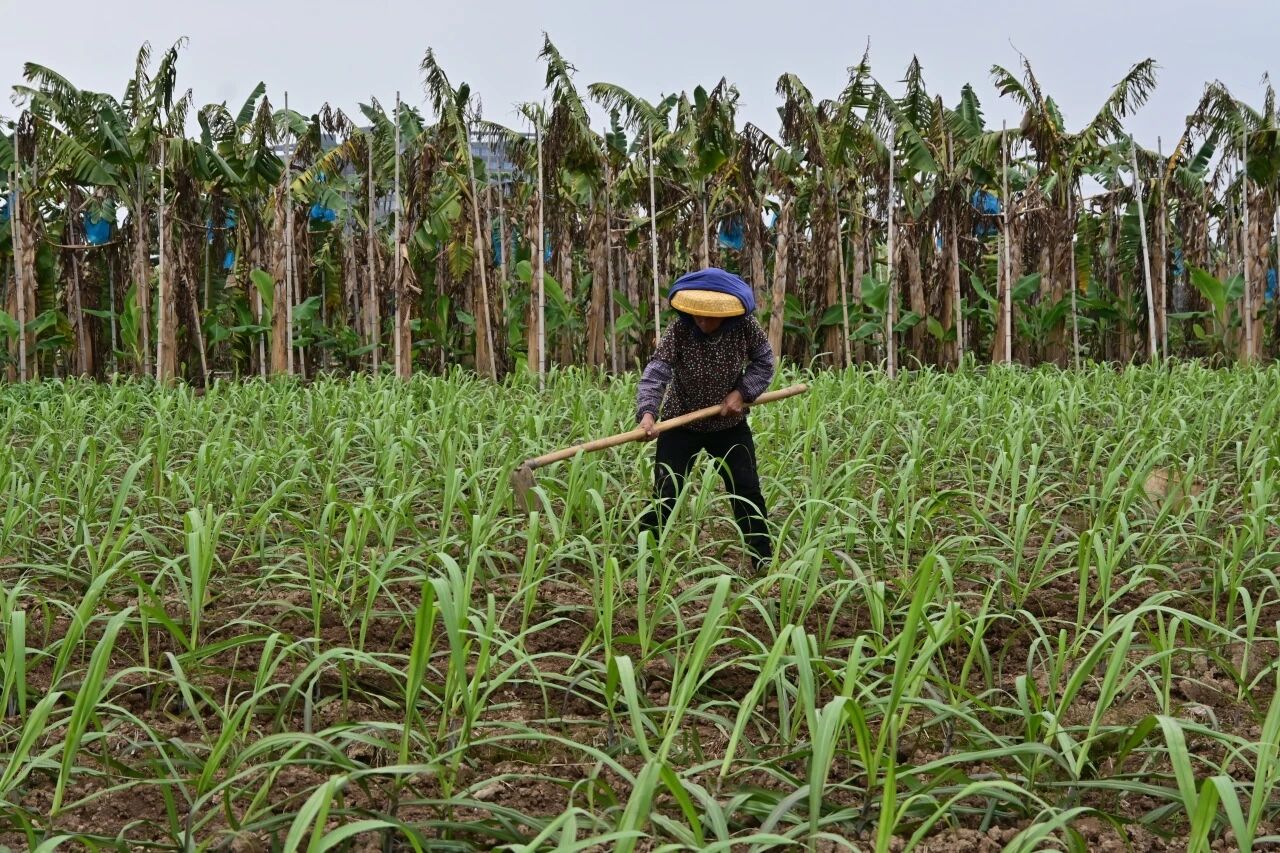
I. Sugarcane Farmers Forced to Set Up Street Stalls
But this year’s market conditions caught everyone off guard. After the final cold snaps of 2025, Nansha’s black-skin table cane reached its peak consumption period, yet few actually began harvesting. From New Year’s Day through the Lunar New Year, she waited through two holiday seasons without a single merchant coming to ask for prices. How was the market? Aunt Zhen had no idea. Most sugarcane growers are older, relying mainly on word-of-mouth from acquaintances for information. Without sales channels, they could only wait. Yet by March, large swathes of sugarcane remained unsold.
Aunt Zhen usually harvests vegetables from her fields, transports them on a tricycle, and sells them at roadside stalls near local markets. Her tricycle is old, its seat worn almost through. Since December last year, she has been cutting thinner stalks from her field and hauling them to Nansha and Shunde to sell. With a weathered, dark complexion, loose trousers, and legs that never quite touch as she walks with a swaying gait, she keeps to herself. When urban management officers confront her, she does not argue. Sometimes they confiscate her scales and sugarcane, and she does not try to get them back, fearing fines. Sugarcane can be sold by the stalk, so scales are unnecessary. If she manages to sell throughout a day, she can earn over a hundred yuan. But one mu yields more than 2,500 stalks, and with no bulk buyers, she cannot sell them all no matter how hard she tries.
Aunt Zhen has a son and a daughter. Her son and daughter-in-law work and care for their child in Tanzhou, Zhongshan. Her daughter suffers from a mental health condition and does not work. At 20 yuan per dan, the elderly couple would not only see a year of toil wiped out but also face losses of over 10,000 yuan. Already living on a tight budget, her clothes are gifts from friends, and her shoes were bought on Pinduoduo for 8 yuan each; she bought two pairs. The ones on her feet have holes worn through them, exposing her two big toes. The other pair, worn for six months, has completely worn-down heels but she refuses to throw them away. If she accepts this price, relying on their pension of merely 600 or 700 yuan a month, they would not even be able to repay the credit they took last year for pesticides and fertiliser. She turned down the only sugarcane broker who had offered a price this year.
II. Not Even Given a Quote
Chen Shun hoped to wait until the cane matured further, aiming for a better price. Waiting until New Year’s Day, he grew anxious and contacted a sugarcane broker he knew, eventually selling those two mu for 70 yuan per dan (50 kg). Two years prior, such crop could fetch over 100 yuan per dan. Half a month later, another mu was sold at 60 yuan per dan. During the Spring Festival, 7 mu were sold off at 40 yuan per dan. Factoring in land rent of 1,500 yuan per mu and labour costs, this rate barely broke even.
After last year’s Spring Festival, prices for black-skin table cane rose significantly. This year, however, offers from sugarcane brokers plummeted from 40 yuan to just 5 yuan per dan. For lower-grade stalks, buyers would not take them even for free. Chen Shun’s remaining 7 mu of sugarcane remained unsold well into March.
“Large swathes of sugarcane do not even get the chance to be sold.” A village cadre in Yansha Village, Lanhe Town, explains that in late March, households registered over 500 mu (33.3 hectares) of unsold sugarcane, more than 400 of which were black-skin table cane. Village resident Chen Jiao, in her sixties, farms over ten mu of the crop. Her husband passed away years ago, and her children help in the fields on weekends when they are not working overtime. Land rental and seasonal labour push the cost per mu over 7,000 yuan. With a strong market last year, a year’s hard work could yield 100,000 yuan. This season, however, her sugarcane has drawn no interest. “Not a single person has come to ask for a price.”
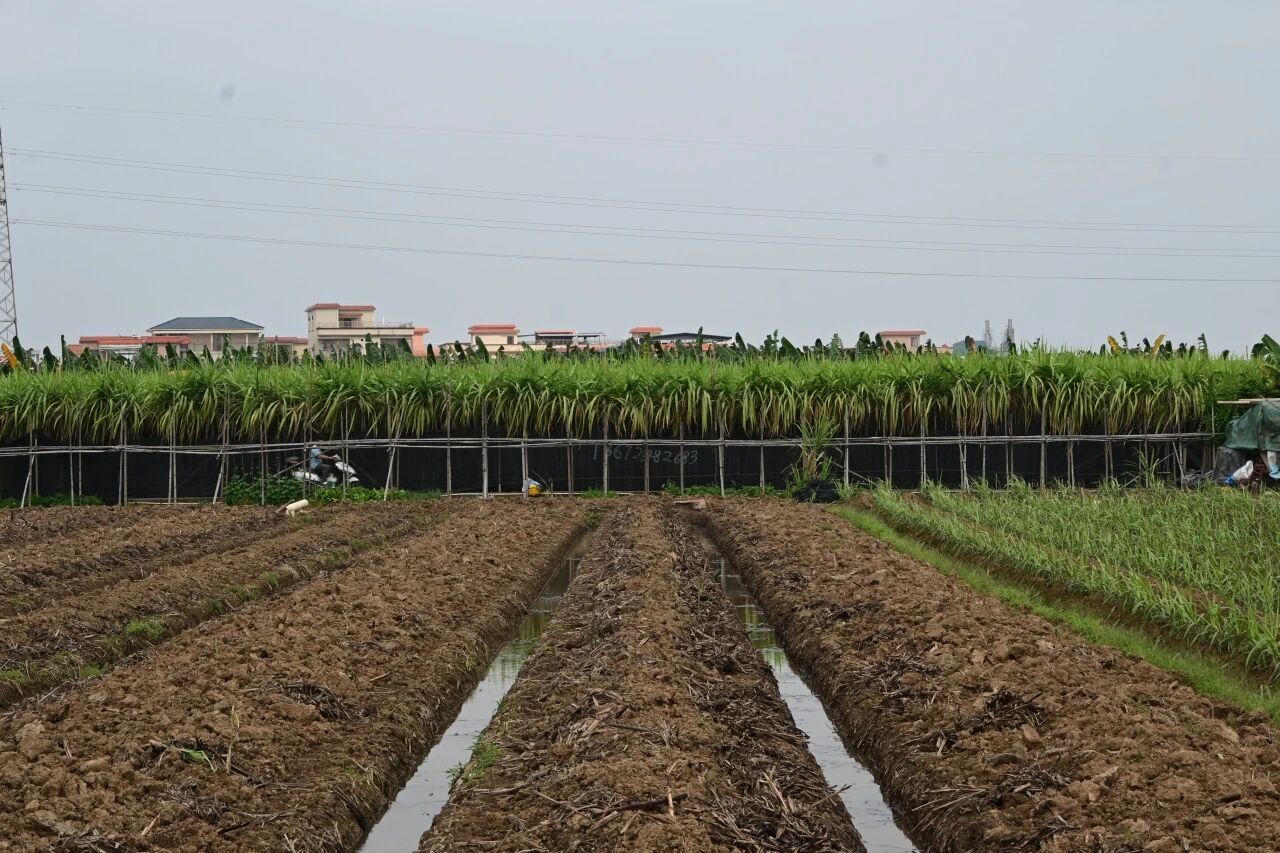
In Nansha, every sugarcane plot is wrapped in black shade cloth. Typically, after the sixth lunar month, the cane grows taller and the sun grows fiercer, requiring shade to prevent the stalks from turning red. High-quality black-skin table cane has a deep, glossy black skin. Farmers also write their phone numbers on the shade cloth. After the Mid-Autumn Festival, if brokers or merchants show interest, they call, and some place advance orders. Once a plot is booked, farmers mark “Sold” on the cloth.
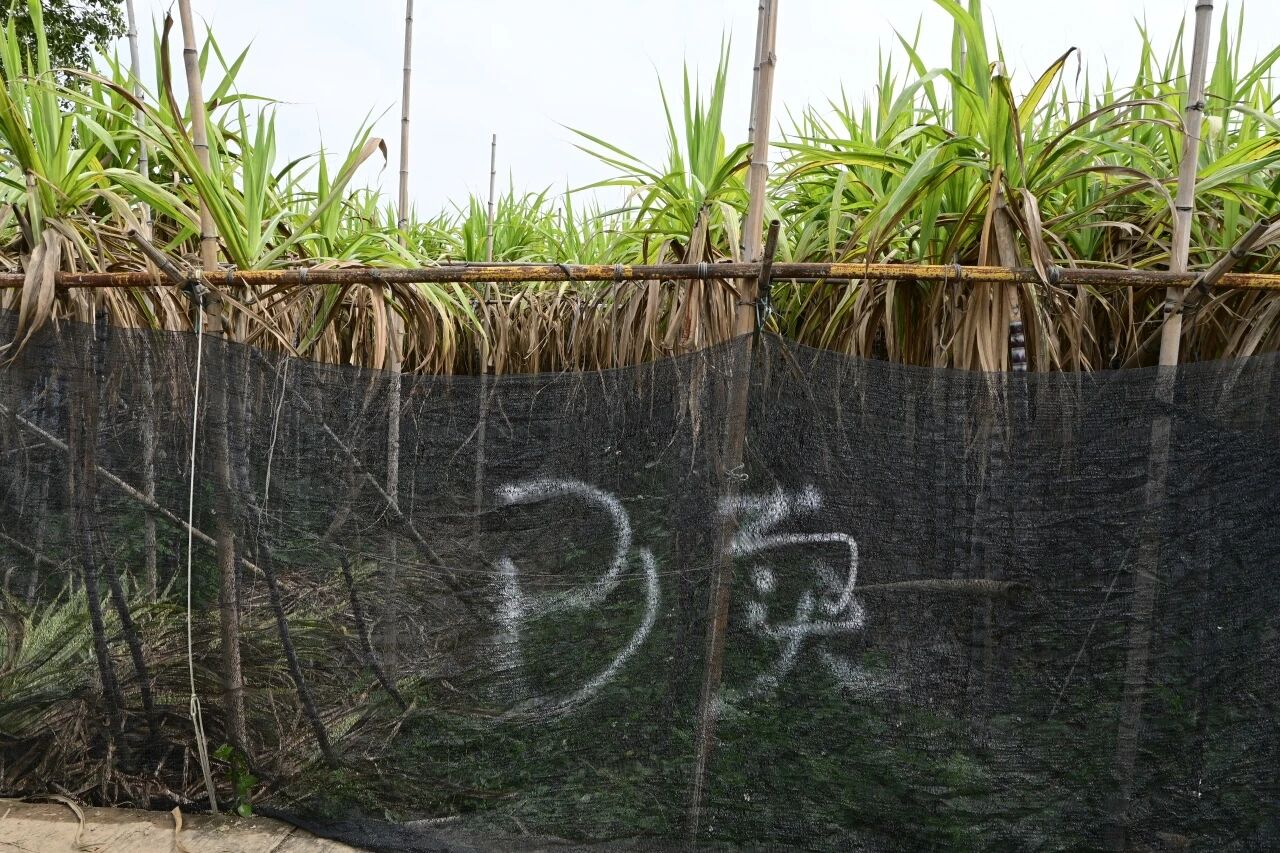
Chen Jiao wrote her number on her shade cloth early on, but still has received no purchase enquiries. The growing cycle for Nansha table cane is roughly one year; for local growers, “spring planting” effectively begins the previous winter. To get the new crop of black-skin table cane maturing by year-end, March is the deadline. To avoid delaying spring planting, Chen Jiao gave her earlier, soon-to-be-past-season cane to brokers at extremely low prices or even for free, urging them to clear it quickly. “If we wait any longer, we will not be able to plant at all.”
Locally, there is a folk saying: “Sugarcane around Qingming is more poisonous than a snake.” As the Qingming Festival approaches, rising temperatures and humidity cause improperly stored sugarcane to easily mould and turn red, producing a neurotoxin called 3-nitropropionic acid.
“The quality of out-of-season black-skin table cane declines,” the village cadre notes. Yellow-skinned cane can be sold year-round; it is primarily the black-skin variety that growers are desperate to offload. In response, governments, schools, hospitals, and well-meaning citizens have joined efforts to support farmers, but according to feedback from village cadres, these efforts are largely a drop in the bucket, falling far short of what commercial purchasers would clear: a single trailer load from a sugarcane broker can haul away 35 tonnes from 4 mu (0.27 hectares), while thousands of visitors might still not be able to clear a single mu. Consequently, the local government has introduced a clearance subsidy, rewarding brokers or other farmers hundreds of yuan for each mu they clear, running until 5 April.
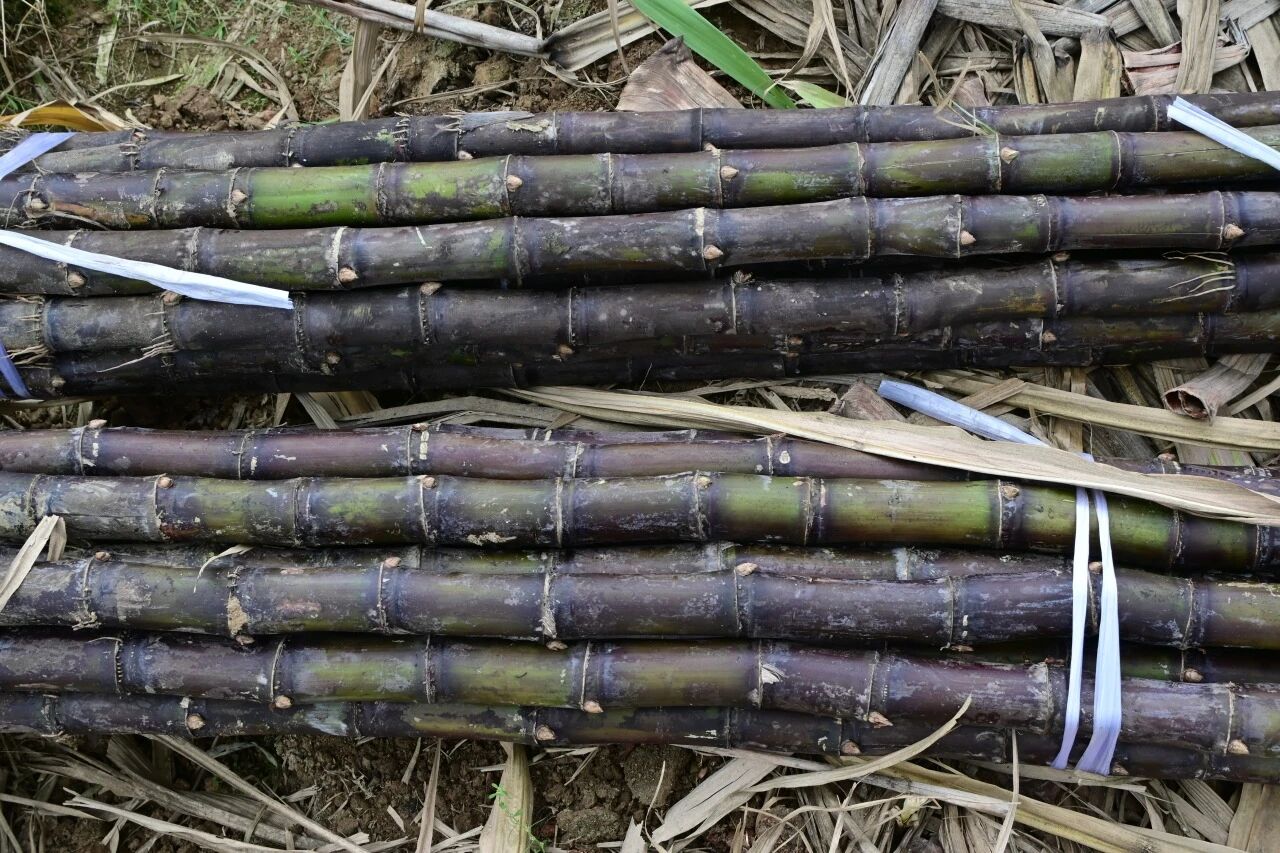
To clear the land quickly, Chen Shun rushed to clear 5 mu (0.33 hectares) by mid-March, selling them at a mere 1,000 yuan per mu. “If I have to clear the field myself in the end, I will still have to pay for labour.” For the remaining two mu, his wife, Aunt Huang, guards the field edge daily, calling out to passing tourists. At first she priced them at 2 yuan a stalk, now 1 yuan.
Aunt Huang previously worked at a frozen meat processing plant. In 2025, her 50th birthday arrived alongside a redundancy notice from the factory. “Once you hit 50 on your ID card, the factory does not want you anymore.” She lost her income, while her younger daughter had just entered senior high school, placing in the “advanced class”. Anxiety drove her to become a sugarcane farmer.
After a year of dealing with cane and soil, she remarks, “Growing sugarcane is exhausting at every stage.” Beyond mulching, earthing up, and frequent fertilising and spraying, cultivating table cane requires building and raising support trellises.
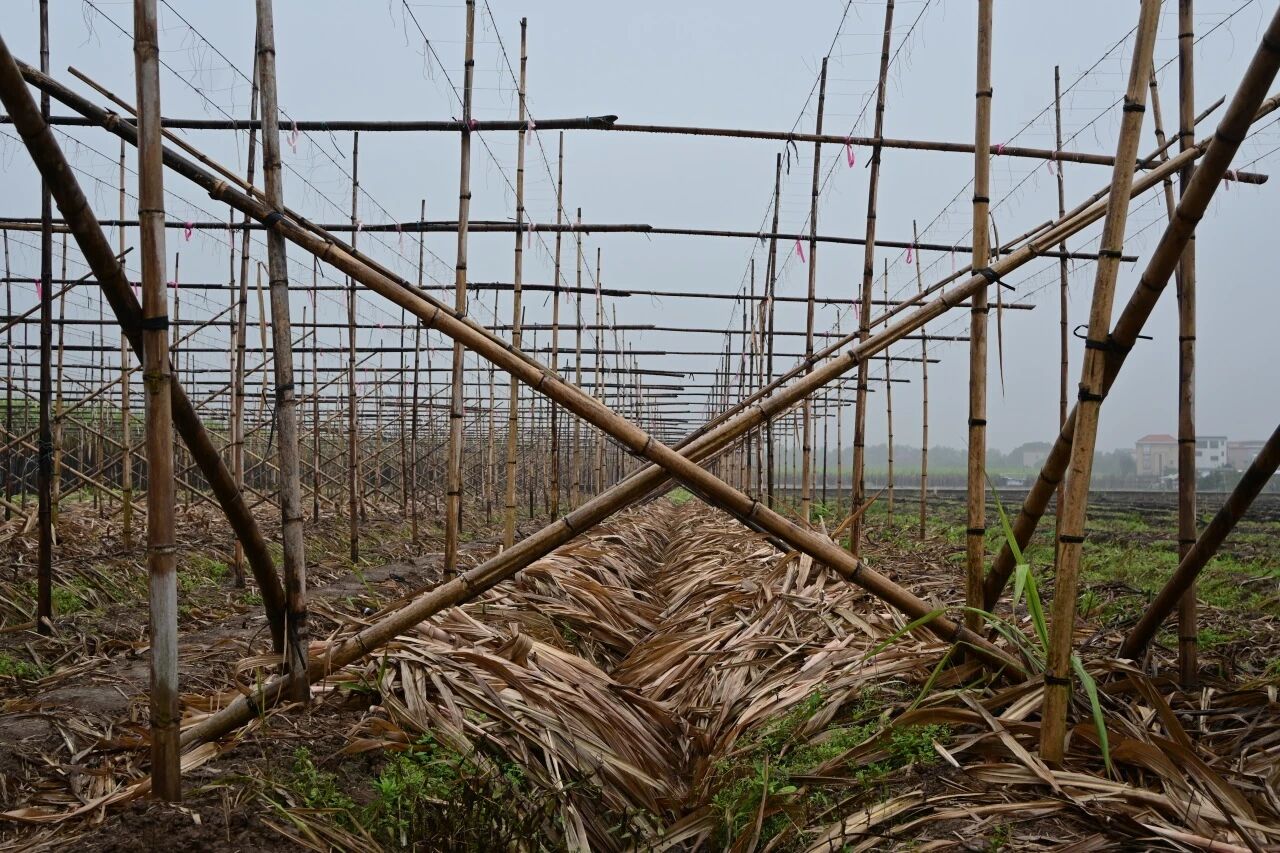
Sugar cane grown for extraction does not matter if it grows crooked. But table cane for direct consumption must be straight and uniformly thick to fetch a price. Therefore, around the fifth lunar month, when typhoon weather begins to increase and the cane reaches about a metre tall, farmers must erect bamboo frames in the fields.
Bamboo poles as thick as a soup bowl are driven half a metre into the ground, braced diagonally with additional poles, and connected horizontally at the top with thinner bamboo. Finally, ropes are strung. Two thick ropes run along the ridges, framing a row of cane. Thinner ropes crisscross in the middle, forming square compartments. Each compartment frames two stalks, guiding them to grow tall and straight to prevent wind damage. Afterward, as the cane grows taller, the bottom five leaves are stripped, and the top bamboo frame and netting are raised slightly. Black-skin table cane can grow up to 4 metres tall, requiring the trellis to be raised around six times.
III. The Harvesters Are Elderly Too
In previous years, cutters would start getting jobs right after the Mid-Autumn Festival. Harvesting begins before 6 am daily, meaning most have to rise between 4 and 5 am. Each team has a foreman who liaises with the sugarcane broker on location, volume, and price. The brokers build long-term partnerships with the cutting teams through these foremen.
A typical crew of a dozen or so divides up the work. Those at the front each take a row, using iron shovels to sever the roots, lever the cane out of the ground, and trim away the root fibres. The harvesting shovels are custom-made, roughly a metre long with a narrow, elongated blade and a flat, sharp tip. The uprooted cane is usually propped back into the soil. With the support trellis still intact and ropes holding the tops in place, it won’t topple.
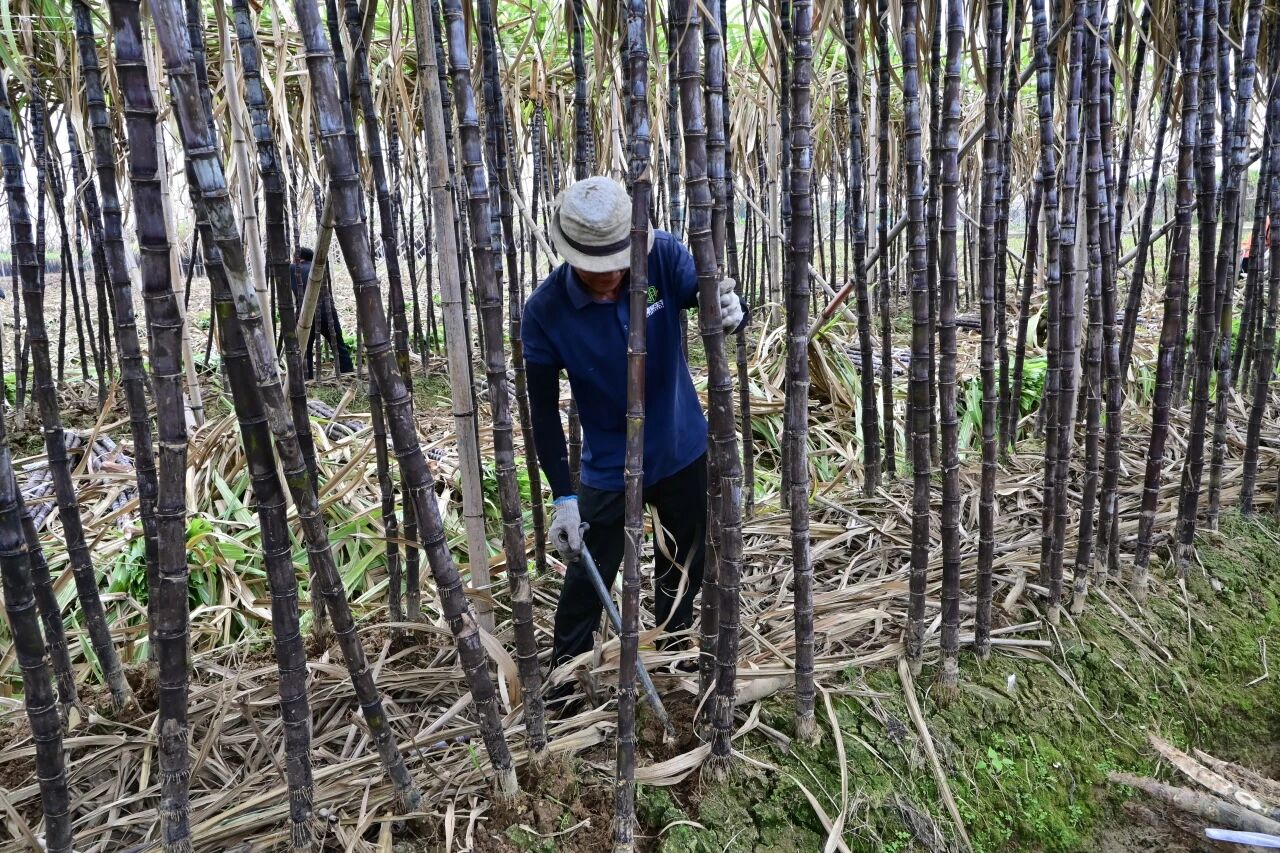
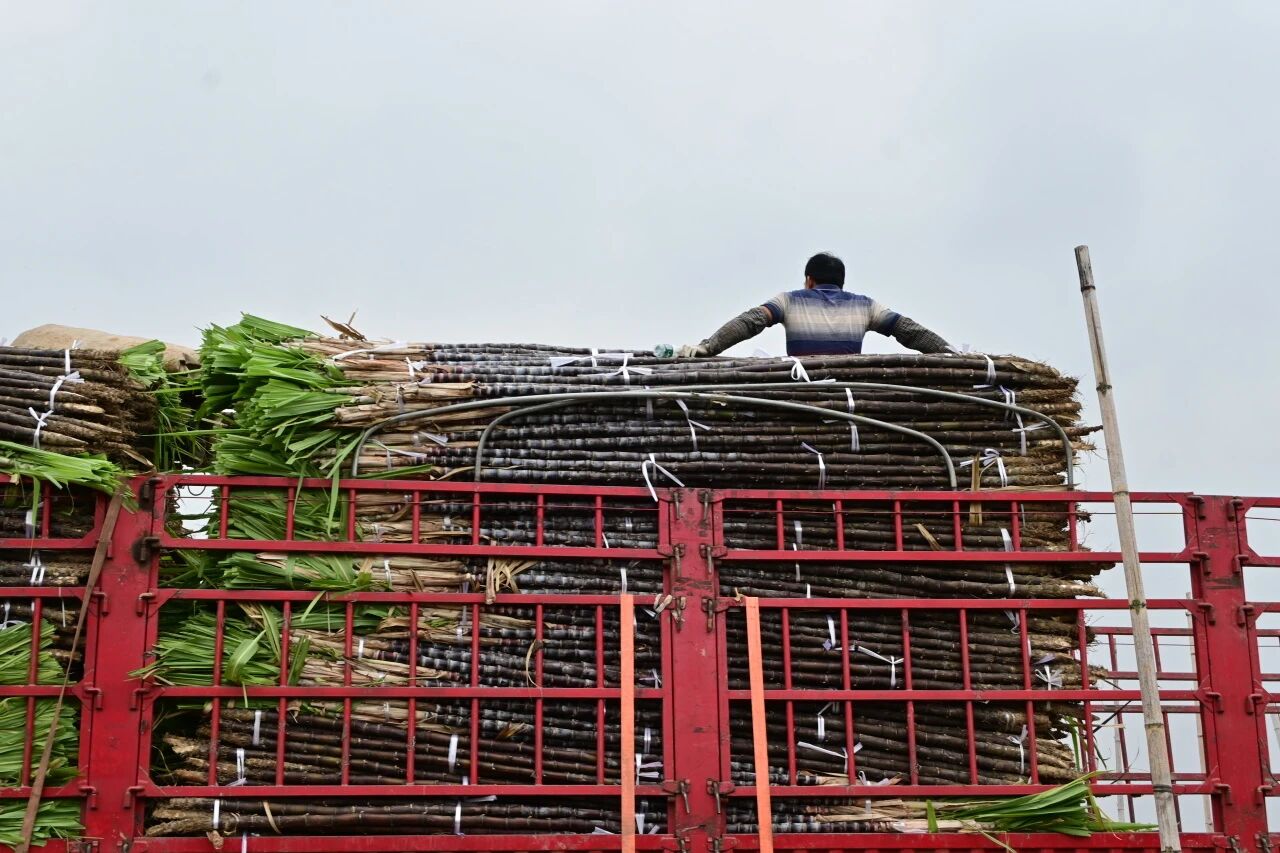
Once the cane is up, the whole crew operates like an assembly line. One group pulls out the trimmed stalks and strips the leaves from either side of the top. Another holds metal stools upside down, stacking the cane one by one into the V-shaped grooves formed by the legs. Bundles of 12 to 14 stalks weigh over 50 kg each. Once stacked and tied, four bindings are needed to secure a bundle, and the leaves at the bottom are cut in half. This is cane sold “with leafy tops intact”, a method that preserves freshness and withstands long-haul transport.
The cane leaves are razor-sharp. Farmers who forgo full protective gear to beat the heat end up with rows of scratches on their hands and necks. The cuts are shallow and rarely bleed, but they swell and redden. Exposed to sun, debris, dirt and sweat, they sting fiercely.
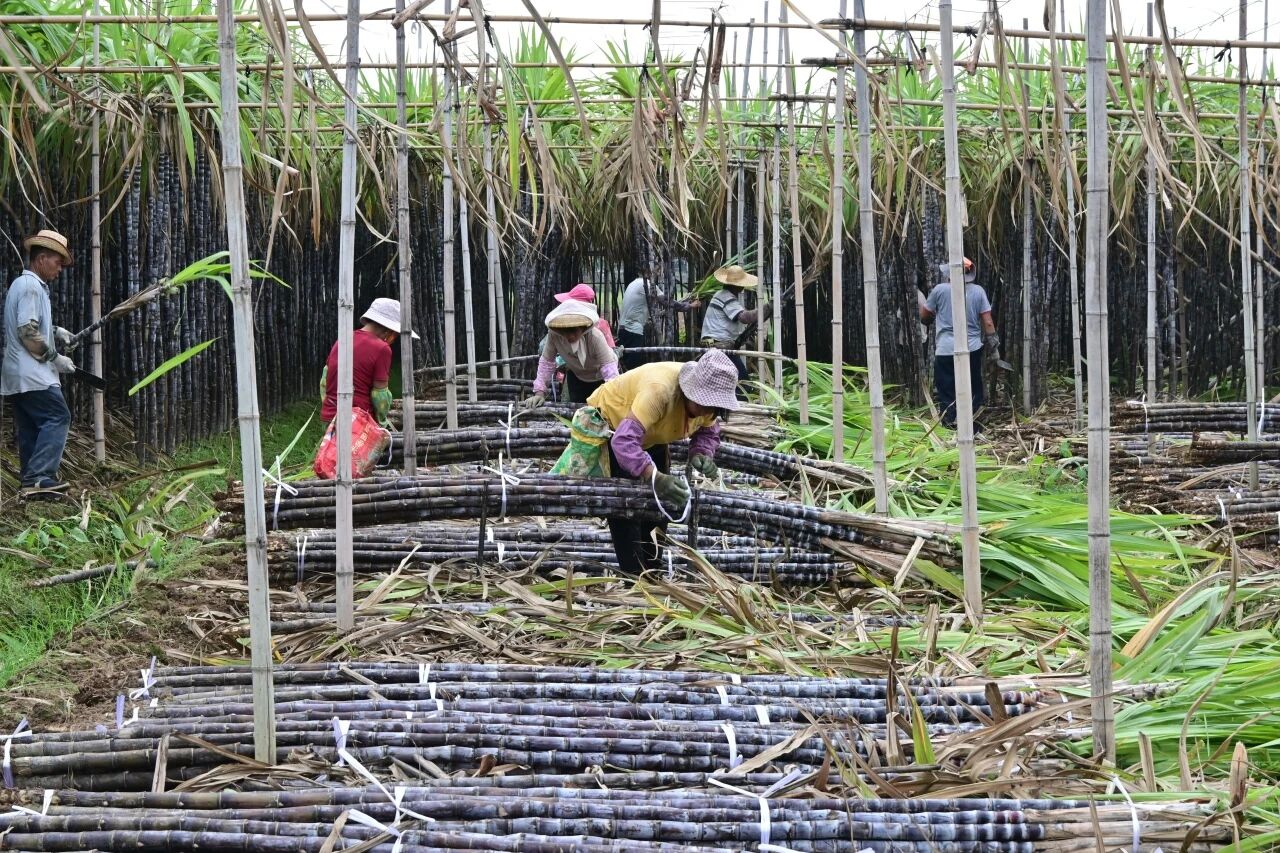
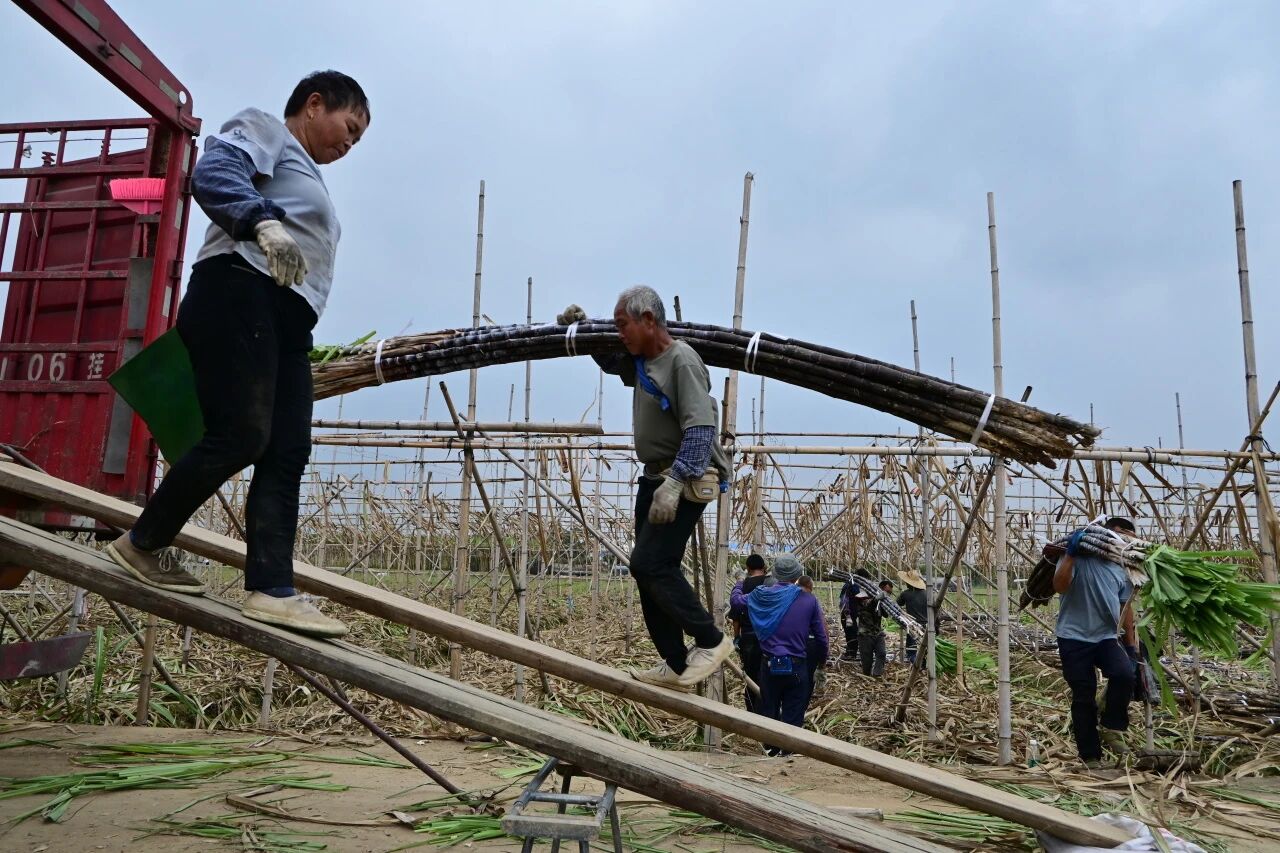
The most exhausting part is hoisting the bundles onto the lorry. Each bundle is too heavy for one person; two men lift from the sides while a third angles their head and shoulder to bear the weight from the middle. The hard stalks chafe terribly against bare shoulders. Workers usually pad the spot with a cloth, a folded woven sack, or a piece of cardboard.
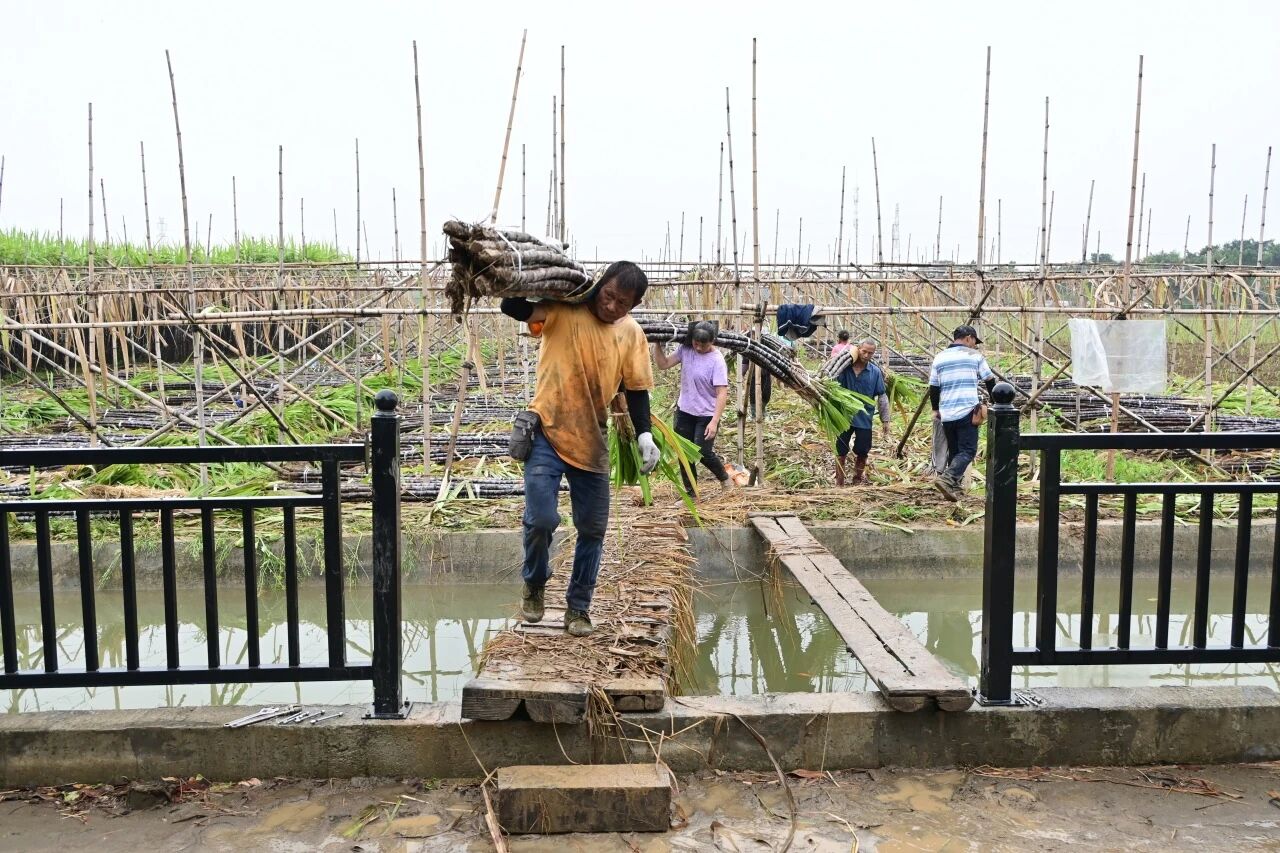
The uneven fields demand careful footing. Plank bridges are laid from the field to the road verge, and from the road to the truck bed. Climbing the plank is the hardest part. The long stalks weigh heavily on the elderly farmers, etching strain onto their faces.
On 24 March in Shajiao village, Lianhe town, a sugarcane broker hired 17 cutters to harvest roughly 0.27 hectares (4 mu). A buyer from Anhui purchased the crop at CNY 15 per 50 kg (dan). The buyer also paid labour fees: CNY 1.10 per 50 kg to the broker and CNY 11 per 50 kg to the cutters. At 47, Uncle Wang is the youngest in the crew. Their average age is over 55, with the eldest 72. Uncle Wang says nearly every year sees a cutter collapse in the field. The hours are too long, the labour too grueling, and the heat too fierce—it can be fatal.
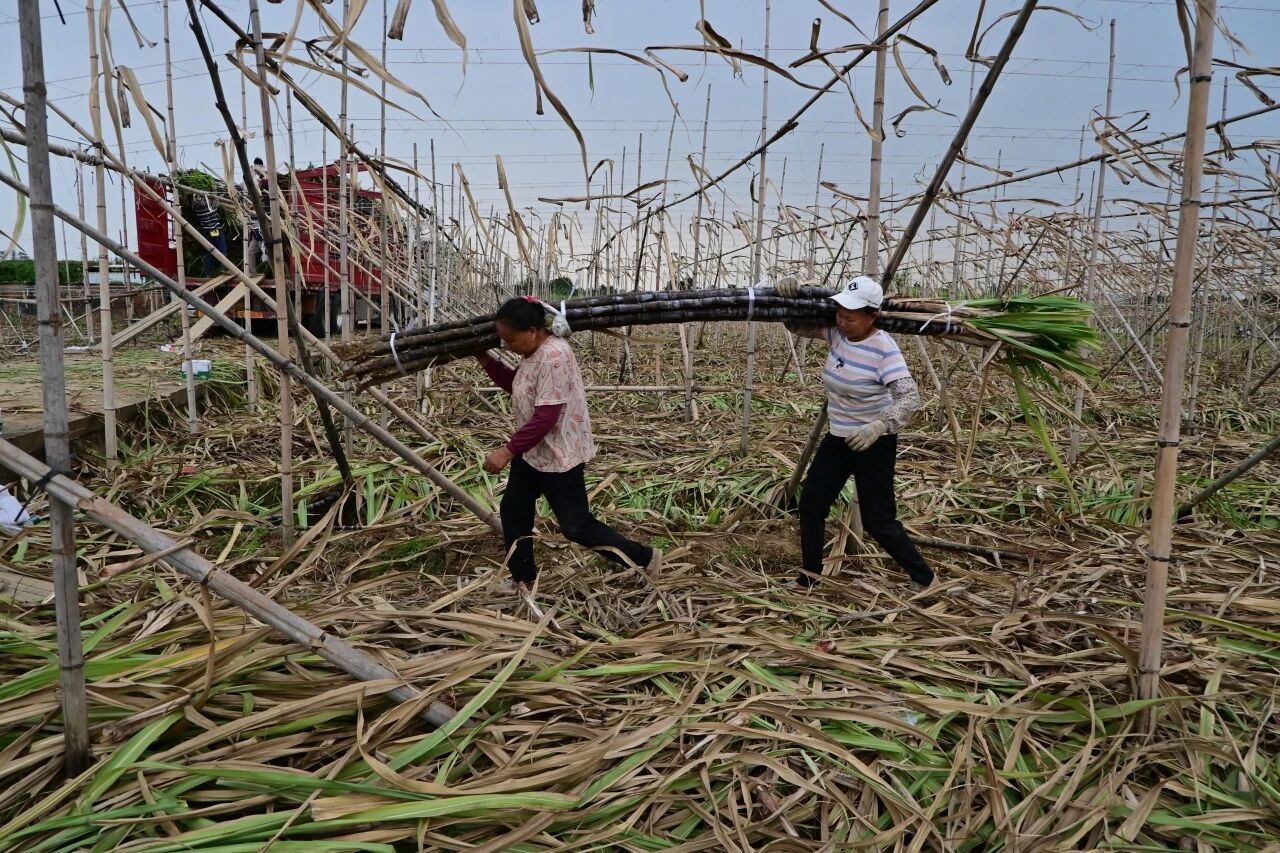
Rainy days are the most dangerous. Once work starts, the broker will not allow a break for rain, as they need to meet delivery deadlines. The fields turn to mud, the roads slick; walking on the wet planks requires extreme caution.
A few years ago, Uncle Wang’s elder brother slipped off a plank bridge while carrying cane onto a lorry. He suffered comminuted fractures to three toes on his right foot. Medical bills ran to CNY 40,000, and he can no longer do heavy labour. Only with Uncle Wang’s help in negotiating with the broker did he secure CNY 20,000 in compensation. With permanent steel pins now in his foot, his brother once worriedly asked Uncle Wang: “Does this mean I’ll never get to fly on a plane?”
The cutters fend for themselves at lunch, usually gathering at a local food stall and splitting the bill. The women sit together, drinking tea. The men gather separately, sharing Liujiang Shuangzheng – a rice wine that runs under 30% ABV. After roughly 200 ml goes down, their furrowed brows relax, and the day’s fatigue seems to lift.
Finishing time depends on the day’s quota. On good days, they wrap up before dark; otherwise, it can drag on past 8 pm or later. On Uncle Wang’s shift, the target was 35 tonnes, and they cleared it by 6 pm. At the end of such a day, the sugarcane broker walks away with CNY 770, while each cutter earns CNY 450. Aside from selling their own cane, this remains their most vital source of income throughout the year.
IV. Thirty Years of Monoculture Inertia
A village cadre in Shangni Village explained that while local cutters are usually swamped during the festival period, most stayed idle at home this year. There was little cane to harvest in the village. Stock that had been pre-ordered remained in the fields, and some buyers demanded price cuts. A few even preferred paying breach-of-contract penalties rather than taking delivery.
The primary reason for this year’s oversupply of table cane is overcapacity. Last year, planting areas and yields expanded significantly in Yunnan, Guangxi, Fujian, and parts of Guangdong, including Qingyuan, Zengcheng, and Shaoguan. Several village officials noted that table cane from regions like Yunnan is of higher quality, and this year’s market favours yellow-skin varieties, whereas Nansha primarily cultivates black-skin table cane. In the face of such fierce competition, Nansha’s table cane has fallen behind.
Aunt Zhen recalled that since marrying into the village forty years ago, she has only grown rice on these plots for around a decade, dedicating the rest of the time to black-skin table cane and bananas. The elderly couple owns just over 0.27 hectares (four *mu*) of land. Growing rice and vegetables yields far less than bananas and cane.
“When the market is good, planting 0.07 hectares (one *mu*) of bananas and cane can bring in a profit of over ten thousand yuan a year,” a cadre in Lü Village, Lvanhe Town, explained. The village is home to more than 2,000 people and has over 10 hectares (1,500 *mu*) of arable land, leaving less than 0.07 hectares (one *mu*) per capita. Those currently farming these plots are predominantly middle-aged and elderly residents over fifty. Most who have begun receiving pensions earn only six or seven hundred yuan a month. Financial pressure has forced households to pin their hopes of increasing income on their limited land, which is why rice was the first crop ruled out when deciding what to plant.
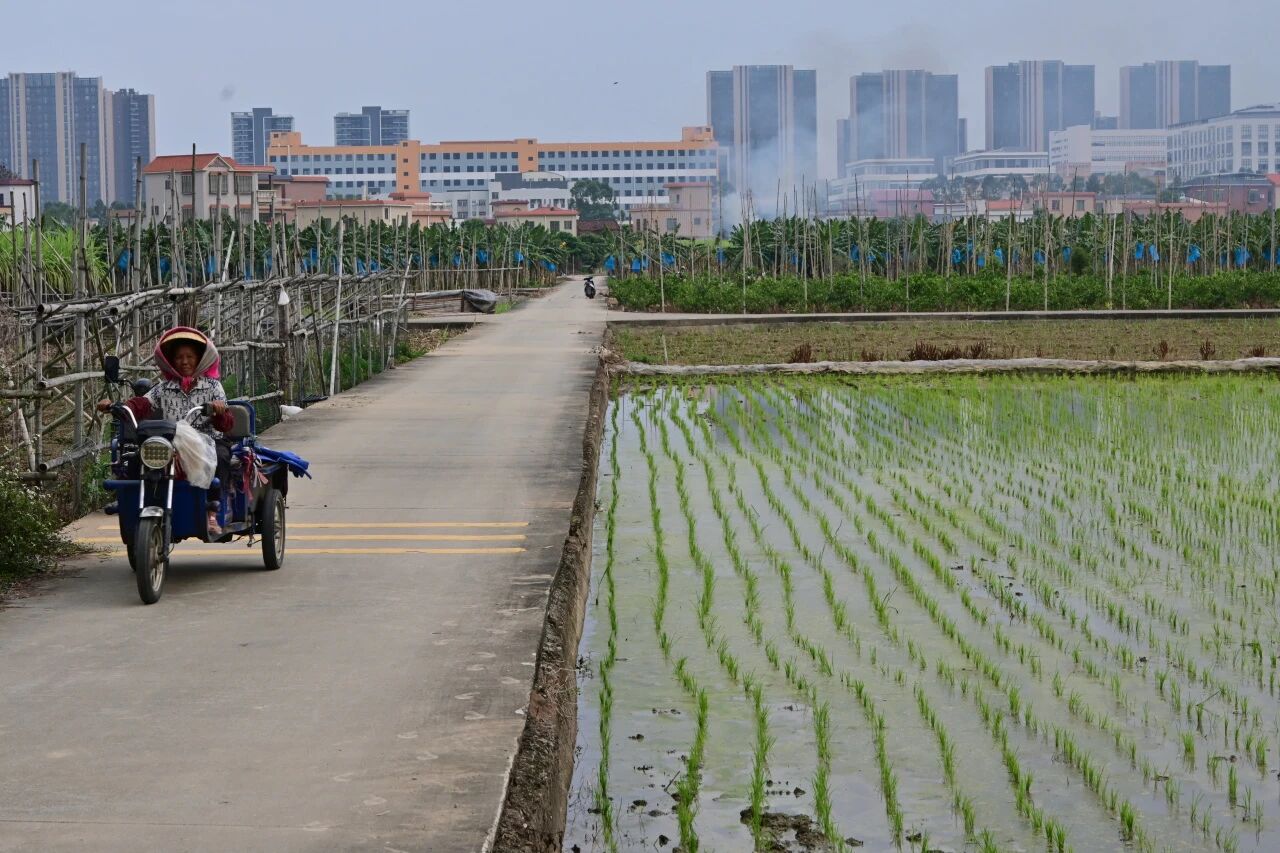
Continuous cropping leads to soil degradation and heightened disease pressure. Long-term cultivation of cane and bananas has driven down both quality and yield. A few years ago, many local banana crops suffered severe losses or failed entirely due to yellow leaf disease. “The quality of the cane is subpar now, too. The internodes are shorter, the thickness is uneven, and it cannot compete with the newly expanded crops in Yunnan and Fujian.”
Uncle Wang has been growing cane in Shajiao Village for nearly twenty years. He has observed that ten years ago, applying four or five bags of fertiliser (each weighing 50 kilograms (100 *jin*)) to 0.07 hectares (one *mu*) was sufficient to reach harvest; now they need at least ten bags. But excessive fertiliser use further degrades the soil conditions. “If you apply too much, the cane just stops growing.”
In recent years, the price of a single bag of fertiliser has risen above 300 yuan, meaning fertiliser alone costs over 3,000 yuan per 0.07 hectares (one *mu*). To maintain quality and yield, cane farmers must continually invest in top-grade fertilisers and pesticides. He estimates that when factoring in land rent, bamboo scaffolding, and labour, the cost per 0.07 hectares (one *mu*) exceeds 8,000 yuan. Even on their own land without hired hands, costs still run to at least 6,000 yuan.
V. No Choice, Just Cane
Nansha has roughly 90 square kilometres of arable land, nearly two-thirds of which is concentrated in the northern towns of Lvanhe, Dongchong, and Dagang. These are precisely the main growing regions for Nansha’s cane and bananas. The *Nansha District Arable Land Protection Special Plan (2021–2035)* notes that grain cultivation yields significantly less than cash crops, and farmers’ lack of enthusiasm for growing grain means the problem of “non-grain land use” remains severe.
A cadre in Yansha Village explained that policy dictates arable land must be used for grain, as well as non-grain crops such as cotton, oilseeds, sugar crops, and vegetables. Cane falls under the sugar category, whereas planting higher-value fruits like bananas, papayas, guavas, and citrus is classified as “non-grain land use” and is not permitted.
In recent years, Nansha has intensified its efforts to rectify “non-grain land use”. An open report published in late December 2022 showed that in under two months, Lvanhe Town completed 86 rectification cases covering 15.8 hectares (237.41 *mu*), with “non-agricultural” and “non-grain land use” rectifications accounting for over 30% of the total. After clearing out bananas and other crops, the only option left for local households was cane.
“With bananas cleared out, cane planting areas have grown year on year,” a Yansha Village cadre revealed. In 2025, the village’s cane cultivation exceeded 226.7 hectares (3,400 *mu*). Public reports show that in 2022, Lvanhe Town’s table cane area was just 92 hectares (13,800 *mu*), rising to 113.3 hectares (17,000 *mu*) by 2025. The heavy burden of “food security” has been placed on elderly farmers, who have chosen to reject the least profitable crop, rice, opting instead for cane from the government’s permitted “white list”.
Safeguarding food security cannot be the sole responsibility of farmers. A cadre in Lü Village recalled that every town and village’s push to rectify “non-grain land use” met with widespread opposition. The government also encouraged households to grow other crops on the “white list”, such as vegetables. But vegetable farming offers lower returns and requires farmers to spend all their time in the fields.
For farmers, planting bananas and cane is driven not only by nearly thirty years of agricultural inertia, but also by the freedom it leaves to take on casual labour during slack periods. After the cane harvest, Uncle Wang travels to other provinces to help fellow farmers erect sheds. Chen Shun has already paid rent for 0.27 hectares (four *mu*) but does not intend to farm it; after the spring planting on his other plots, he will return to construction sites. Aunt Zhen and her husband are relatively frail; on ordinary days, they pick vegetables and sell them at street stalls.
Even with this year’s market glut, many have chosen to keep planting. They rely on cane to cover losses and sustain their livelihoods.
March is drawing to a close, and live streaming has indeed brought Aunt Zhen a fair amount of business. Someone travelled all the way from Shunde to cut over 100 stalks. Her husband helps him in the fields. Buyers usually want only the middle sections, so he cuts off the top 30 centimetres, still bearing leaves, for use as next season’s seed cane.
They are planting cane again this year. She refuses to buy disease-free seedlings, which would represent another significant expense for her, especially since she still needs to buy fertiliser on credit this year.
Interviewees are named under pseudonyms
Editor: Xiao Dan