Are non-profit organisations becoming greenwashing tools for polluters?

Foodthink’s Perspective

“Unsustainable production and consumption patterns are pushing the planet towards destruction.” This is the opening statement used by the United Nations to introduce Zero Waste Day, observed annually on 30 March. For urban residents in China, the vast majority of single-use plastic waste in daily life is linked to food consumption, particularly takeaway deliveries. In fact, the takeaway industry has single-handedly created a massive waste stream; behind its rapid annual growth lies a mountain of single-use plastics, which have become a primary driver of environmental pollution and a threat to consumer health. Who is responsible for overseeing these companies to ensure they reduce pollution and protect public health? Beyond the government, social organisations representing the public interest can play a vital role—for instance, by conducting research and advocacy to expose polluting practices, urging companies to reduce their impact, and holding them accountable for remediation. However, Foodthink has noted that among the environmental organisations funded by the delivery giant Meituan are those specifically dedicated to reducing plastic waste. These organisations were once highly critical of the takeaway industry, producing data-driven research that explicitly named names. In the last two years, however, these voices have grown increasingly quiet.

This leads us to ask: when the very companies causing the pollution begin to fund environmental organisations, what does this mean for the organisations themselves? And what does it mean for the environmental issues we care about?

In the 46th episode of the “Food Talk” podcast, we invited two veteran environmental activists, Sun Shan and Ma Tianjie, to explore these questions. Using this as a starting point, we further discuss the complex relationships between companies that create environmental and social problems, the NGOs attempting to solve them, and the roles played by the government, the media, and the public. This article is a curated summary of that podcast episode.

● Click the image to listen to this episode.

Guest of the Episode

Sun Shan

Ecological practitioner and co-founder of the Mountain Nature Conservation Centre. Since 2015, she has been engaged in farming, exploring the intersections of land, agriculture, food, ecology, and the lifestyle of homesteading. Now based in Canada, she runs the “Chi Garden Ecological Farm and Fermentation Kitchen”. In 2022 and 2024, she attended the 15th and 16th Conferences of the Parties (COP) to the UN Convention on Biological Diversity in Montreal and Colombia, respectively.
 

Guest of the Episode

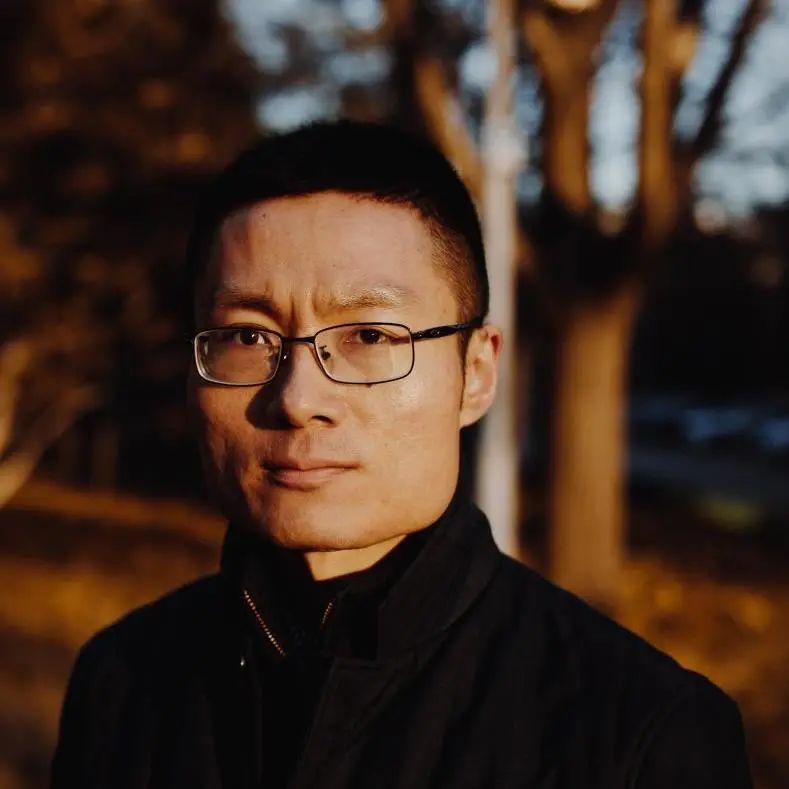
Ma Tianjie

Freelance writer specialising in the environment. He has been involved in environmental advocacy since 2004 and has previously served as the head of an international environmental organisation. He has long focused on environmental governance issues in China, writing analyses and commentaries for various media outlets. His new book, *In Search of Green China*, was published this February.



Host of the Episode

Tian Le

Founding Editor of Foodthink and convener of the Beijing Organic Farmers’ Market. Due to a distaste for single-use waste and the exploitation of delivery riders, they avoid ordering takeaways, yet they still struggle with feelings of guilt and anxiety over the environmental and social costs of their daily consumption.


I. Polluting Companies: Why Fund Environmental Organisations?
Tian Le: I would first like to ask our guests—when a company like Meituan begins providing philanthropic funding, does this affect the independence and operational logic of environmental organisations that advocate for waste reduction and oppose the use of single-use plastics? Ma Tianjie:  I think the Meituan case demonstrates that the relationship between corporations, environmental organisations, and environmental issues has become far more complex; it is difficult to say simply whether this change is positive or negative. When we entered the field over twenty years ago, the relationship between environmental NGOs and polluting companies was relatively straightforward: an NGO and the media would criticise a polluter, the company would be pressured into making changes or commitments, and the matter would be settled. Now, having been tempered by various social movements, corporate strategies for handling these issues have evolved. They no longer simply react to crises as they occur; instead, they think one step ahead by establishing their own foundations or funding existing ones to participate directly in environmental initiatives. The corporation transforms itself into what is called “part of the solution.” In this scenario, environmental organisations must maintain a critical eye and carefully analyse whether the corporate-led solutions are genuinely beneficial to the cause.

● Click the image to view the first public disclosure of the SEE Zero Waste Planet—Qingshan Public Clean Nature Action, funded by Meituan.
● The second phase of this Meituan-funded project makes “Zero Waste Community Construction” and “Plastic Reduction Action” its core priorities, making the intention quite obvious. Click to see the funding details.
Sun Shan: This trend is also visible internationally. Take the UN Biodiversity Conference as an example; biodiversity used to be a relatively niche topic. In 2022, only 700 companies participated, but by 2024, that number had risen to 3,000, including many from the agri-food sector. It was the most corporate-heavy summit in the history of the conference. In recent years, private companies have become increasingly deeply involved in ESG (Environmental, Social, and Governance). They are not only proactively learning and organising forums, but are also attempting to define their own ecological impact and set industry standards; their tactics have become highly sophisticated. Many NGO researchers have also joined the corporate social responsibility departments of these companies, helping them handle these issues more professionally. Tian Le: I think these companies are actually adopting a principle that we in environmental organisations use: the precautionary principle. Companies may not even realise what their actual problems are; they simply feel that rather than being criticised by the public, the media, and environmental groups, it is better to position themselves as problem-solvers and set their own agenda. We must be cautious about this shift in the relationship between companies and environmental organisations. Our concern is that when companies that cause pollution fund the very environmental organisations meant to oversee them, this funding may dilute the critical and supervisory capacity of those organisations, undermining their ability to work effectively on specific issues.

II. The Asia Pulp & Paper Scandal and the Evolution of Grassroots Environmentalism
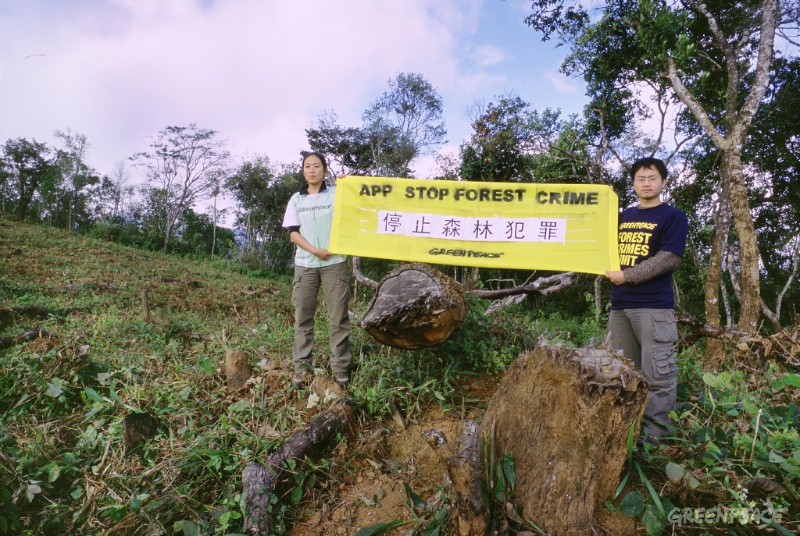
Tian Le: Actually, a similar incident occurred over twenty years ago. The deforestation activities of a multinational called Asia Pulp & Paper (APP) in Yunnan were exposed by environmental groups. At the time, the company also tried to “greenwash” its image by funding environmental organisations, but it met with widespread resistance. This incident is a classic domestic case of the power struggle between grassroots environmental groups and a multinational corporation. Tianjie, could you give us a brief overview of what happened and how the environmental organisations reacted? Ma Tianjie: Yes, this was a scandal around 2004. It began when APP planted a batch of pulpwood forests in Yunnan. Greenpeace conducted an on-site investigation and discovered that these pulpwood forests had actually been planted after primary forests were felled. Greenpeace released a report exposing APP’s deforestation, and a subsequent investigation by the State Forestry Administration confirmed that deforestation had indeed occurred. Many environmental organisations that followed the story united to boycott APP, including a grassroots organisation called the Zhejiang Provincial Hotel Association, which called on all its members to boycott APP products. APP responded by suing the Zhejiang Provincial Hotel Association for defamation, but under public pressure, they decided to withdraw the lawsuit the day before the trial. Later, grassroots organisations continued to investigate APP’s illegal activities in Yunnan and Hainan, engaging in a years-long tug-of-war and maintaining constant pressure on the company. The end result was that APP made an international commitment to stop destroying natural forests.

● 2004: Environmental organisations unfurl banners at a deforestation site to oppose the illegal logging and planting of fast-growing eucalyptus plantations by the APP Group in Yunnan. Image source: Greenpeace

Tian Le: There was a small side-story at the time. While environmental organisations were criticising APP’s deforestation, the company suddenly donated a large sum of money to a major national environmental organisation to sponsor their annual meeting.

Ma Tianjie: Exactly. This was part of their PR strategy: if you say I’m not environmentally friendly, I’ll donate to environmental groups and join environmental initiatives to craft a greener corporate image. However, this funding caused an immense controversy within that environmental organisation, and many members felt the money should not have been accepted.

Tian Le: Liao Xiaoyi, the founder of “Global Village”—one of the most important domestic environmental organisations in China at the time—was a board member of that alliance. She wrote an open letter stating that she could no longer serve as a board member because she did not agree with the acceptance of the funding. We can see that twenty years ago, our environmental organisations were capable of uniting to take a stand against polluting companies. Faced with corporate “buy-outs”, people were principled; at the very least, someone would speak out, and they would receive support and praise from their peers. But in the last couple of years, it seems my colleagues no longer pay attention to such things; no one even discusses how we should handle funding from polluting companies. How do you think this change happened?
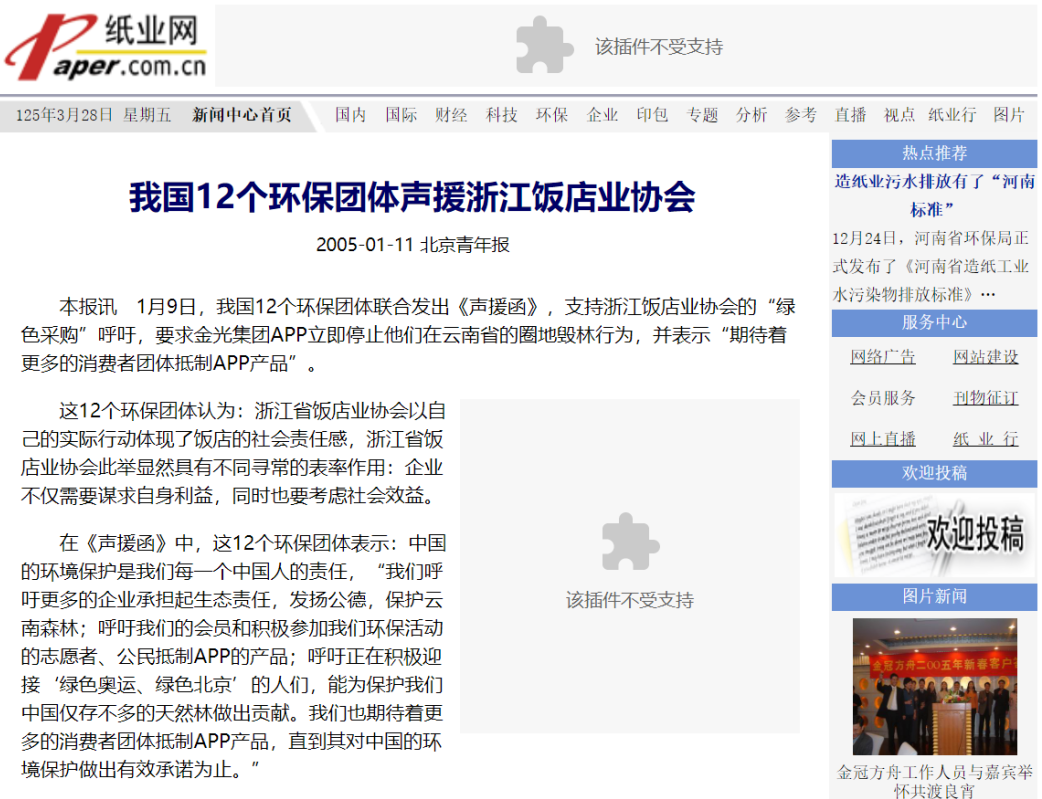
● November 2004: The Zhejiang Provincial Hotel Association calls on hotels across the province to resolutely boycott paper and related products from the APP Group. The APP Group filed a lawsuit against the association on the grounds of “defamation”. Subsequently, the Zhejiang Provincial Hotel Association received joint support from 12 environmental organisations. Image source: Paper Industry Network

III. The Dilemmas Facing Non-Profit Organisations

Sun Shan: Regarding the APP incident Tianjie mentioned, there is another reason why the boycott by civil society organisations was so successful. APP is a multinational corporation, and its deforestation practices across various countries had already been thoroughly documented internationally. Our domestic environmental organisations were able to oppose the company’s pollution based on that existing body of work. But returning to the Meituan example, currently, whether it is Chinese civil organisations or regulatory bodies, there is a lack of analysis, monitoring, and oversight regarding corporate footprints across different dimensions. For instance, there is no comprehensive database to trace where companies are failing in terms of social responsibility, the environment, or labour rights. In 2004, China’s civil environmental organisations were coming into their own, with a few leading figures and some notable public campaigns. But twenty years later, the development of these organisations and the growth of public environmental awareness have failed to keep pace with the scale of the Chinese economy; the growth of civil society remains underdeveloped. While the capacity of civil organisations has improved, it cannot keep up with the sheer volume of economic growth, the increase in pollution, and other burgeoning social issues. Non-profit organisations lack not only critical funding but also the fertile ground for civil society to flourish, leaving us without the necessary capability to tackle increasingly complex and hidden social problems. Meituan itself is tied to many labour and pollution issues, yet we aren’t having sufficient discussion about them; some people even feel the need to justify accepting their funding. In my view, this is quite heartbreaking.

● Issues regarding labour, food safety, and the environment on delivery platforms have already attracted widespread social attention, with even film directors focusing their lenses on these themes. However, to date, Meituan’s algorithmic systems, operational mechanisms, and the resulting social consequences remain a “black box” to the public and have yet to be fully understood. Source: The feature film *Another Hopeful Day*.

Tianle: Yes, while the economy has developed rapidly, the funding and support received by organisations actually doing environmental work have not increased proportionally.

Ma Tianjie: Right, and I’d like to add one point: in these incidents, it isn’t just a matter of corporations versus civil organisations; there should also be a regulator. But as the “elephant in the room”, the regulator is essentially invisible in the discussion. What role is the regulatory system playing? I think this is a question that needs to be addressed. A current phenomenon is that corporations are wielding increasing influence over the formulation of regulatory rules, particularly in international negotiations, where industry associations and corporate alliances are very active. They are highly attuned to changes in the rules; as soon as they sense the game might change, they intervene as early as possible to ensure the rules evolve in a direction favourable to their business models. They engage with a high degree of professionalism, using the banner of “evidence-based decision-making” to oppose the “precautionary principle”—which essentially means that if the evidence is deemed insufficient, they argue against rushing to implement a ban, suggesting a few more years of research instead.

Tianle: The same thing happens with domestic policy-making. The government is not entirely independent when formulating regulatory policies; corporate influence over the government is growing, while the power of environmental organisations and other agencies representing the public interest is weakening. In the agri-food industry, for example, corporations are directly involved in setting many food safety standards; they can push the government to amend rules so that policies lean in their favour. Meanwhile, consumers and small-scale farmers simply lack a force capable of countering this influence on equal footing. The standards pushed by large corporations often exclude small farmers, and for organisations like us that stand with small farmers, intervening in policy-making is fraught with difficulty—there is no funding, and the research and lobbying processes are incredibly time-consuming. Consequently, we see corporate PR and agenda-setting capabilities growing stronger, including the use of media to guide public opinion and the packaging of self-serving views as “science” or “common sense”, leading the public to accept them subconsciously. At the same time, civil environmental and non-profit forces are increasingly marginalised, often only able to clean up the mess after the rules have been set and the policies implemented. The overall balance of power has become extremely skewed; the rules of the game are gradually tilting in favour of large corporations.
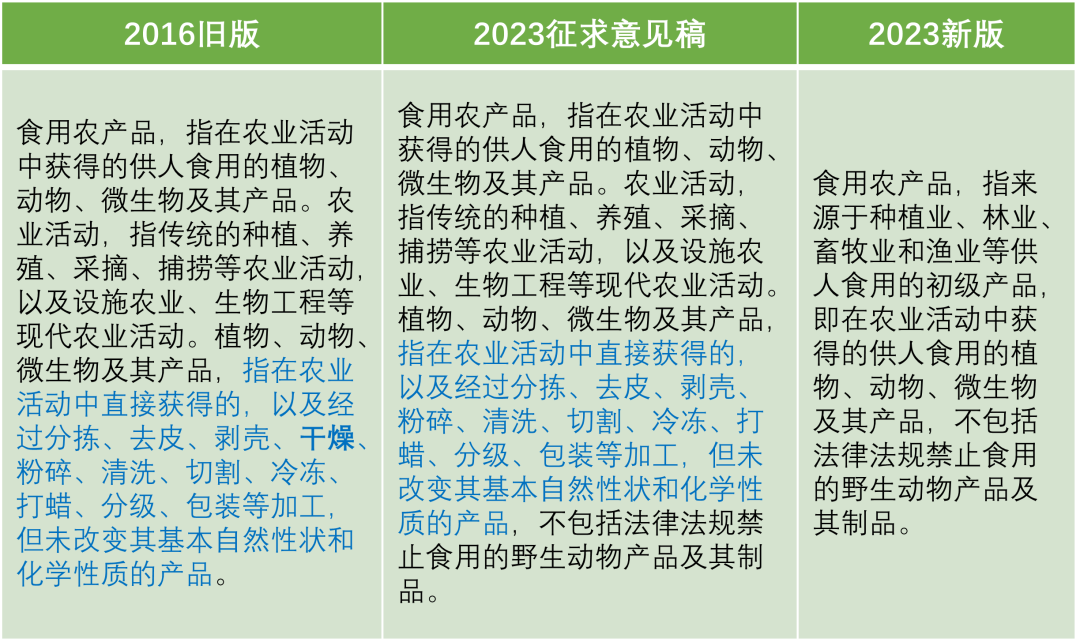
● For example, in 2023, the State Administration for Market Regulation (SAMR) released a draft for public comment on the *Measures for the Supervision and Administration of the Quality and Safety of Edible Agricultural Products Market Sales*. However, in the definition of “edible agricultural products”, the term “dried” was removed. This meant that dried goods produced by farmers could not be sold directly unless they obtained complex and expensive food production licences. To address this, Foodthink joined forces with farmers, sellers, cooperatives, scholars, non-profit organisations, and consumers to submit a joint proposal for amendments to SAMR. In the final regulation, SAMR adopted our suggestions. Click the image to learn more about this process.

IV. How non-profits “dance with the wolf”
Ma Tianjie: As we just discussed, the industry’s ecosystem has changed significantly over the past 20 years, particularly the nature of the companies involved. For example, the actions of Meituan do not just cause a specific pollution problem; rather, through its algorithms and logic, it exerts a systemic impact on the environment. In such cases, it is much harder to define corporate responsibility. Moreover, companies are striving to position themselves as part of the solution, partnering with environmental organisations to influence the agenda-setting of environmental issues. When environmental organisations “dance with the wolf”, they need to be mindful of the pace and who actually holds the lead. First, grassroots environmental groups should critically assess corporate initiatives and establish their own boundaries and rules for interacting with companies. Some international organisations with extensive experience in fighting corporations have such boundaries; for instance, they may appear in the same venue as a company or participate in the same platform or initiative, but they cannot accept the company’s money. Environmental organisations should also consider how they can guide companies in a specific direction during these initiatives and what more fundamental, systemic influence they can exert.

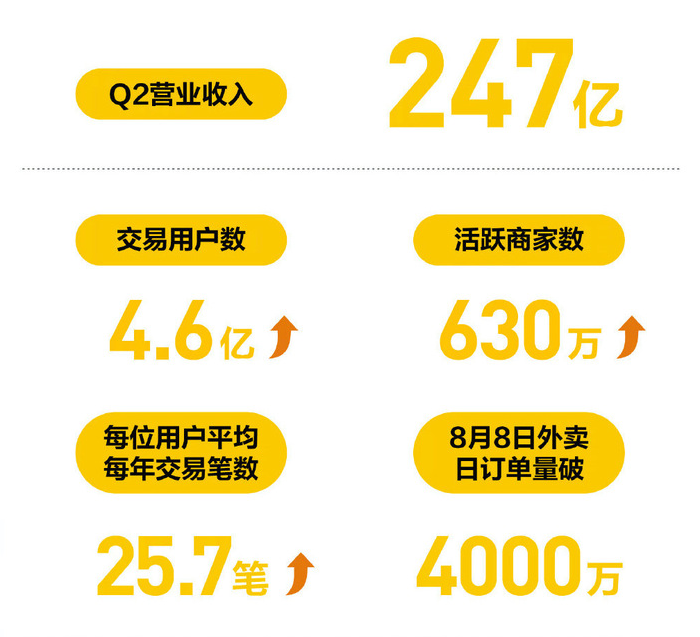
● Meituan tends to use figures to emphasise the social value it creates in terms of providing employment for riders, supporting small and medium-sized businesses, and serving consumers, while remaining silent on the negative environmental and social impacts it produces. Source: Meituan Q2 2020 Financial Report

Tianle: I even have a concern that, if this continues, will polluting companies and certain environmental organisations form a kind of collusion? As an environmental organisation, our original intention is for pollution problems to be completely solved; ideally, we should be “out of a job”. But the reality is that some companies generate pollution and reap huge profits, while donating a tiny fraction of that money to support environmental organisations so they can carry out superficial activities, such as litter picking or recycling. In this way, companies maintain a positive image, and environmental organisations can keep operating with those funds. The problem is, while environmental organisations are busy picking up bottles, they have no time to ask where these bottles come from or why rubbish is increasing. The result is a strange vicious cycle—the pollution problem isn’t actually solved, companies continue to operate as usual, and environmental organisations instead become tools for corporate greenwashing.

Sun Shan:Yes, it is actually quite frightening. This is even more evident at international negotiation venues. Outside the meeting rooms, various companies and industry associations set up booths and hold events; the scene is like a carnival, with corporate “green” promotion everywhere. But how much of this “green” is greenwashing, eco-whitewashing, or just fake green? Many non-profit organisations at these events end up acting as figureheads for companies, helping them greenwash. The truly “deep green” environmental organisations—such as small groups supporting indigenous land struggles and environmental justice issues—have very little voice in these settings.

It is indeed not easy for grassroots organisations to survive, but regardless of how the external environment changes, we must occasionally stop and ask ourselves: what values do we actually uphold? Who are we actually standing with? Currently, it is indeed harder to stand with the victims, small farmers, those who have lost their land, and indigenous communities, because it is inherently difficult for the vulnerable to unite. But if non-profit organisations do not stand with the vulnerable, who else could they possibly stand with? I believe the fundamental position of a non-profit organisation is to stand with the vulnerable, with Mother Earth, and with the interests of the planet. But now, this line has become blurred. Companies have started discussing biodiversity and providing solutions—is this a good or a bad thing? Non-profit organisations need to discern—what is real, what is fake, what is mere window-dressing, and what are actions that truly address the root of the problem? There is still far too little discussion within the industry about this process of discernment; it should become one of our most open and direct topics of debate.

Tianle: You just mentioned greenwashing and “fake green”; there are actually many false solutions nowadays. We often say that you cannot rely on the same logic that created the problem to solve it. Foodthink has a specific tag to describe these types of solutions: “false solutions”. For example, Meituan promotes how much waste is reduced annually because the platform offers a “no cutlery” option. In reality, however, Meituan’s business volume grows every year, and the absolute amount of waste produced has skyrocketed accordingly. Compared to this increase, the amount of disposable cutlery saved is negligible. Furthermore, in real-world scenarios, even if users select this option, merchants may still include cutlery out of fear of a bad review or simply because they don’t have time to notice the detail. This is a false solution. So, how should consumers and the public distinguish these?
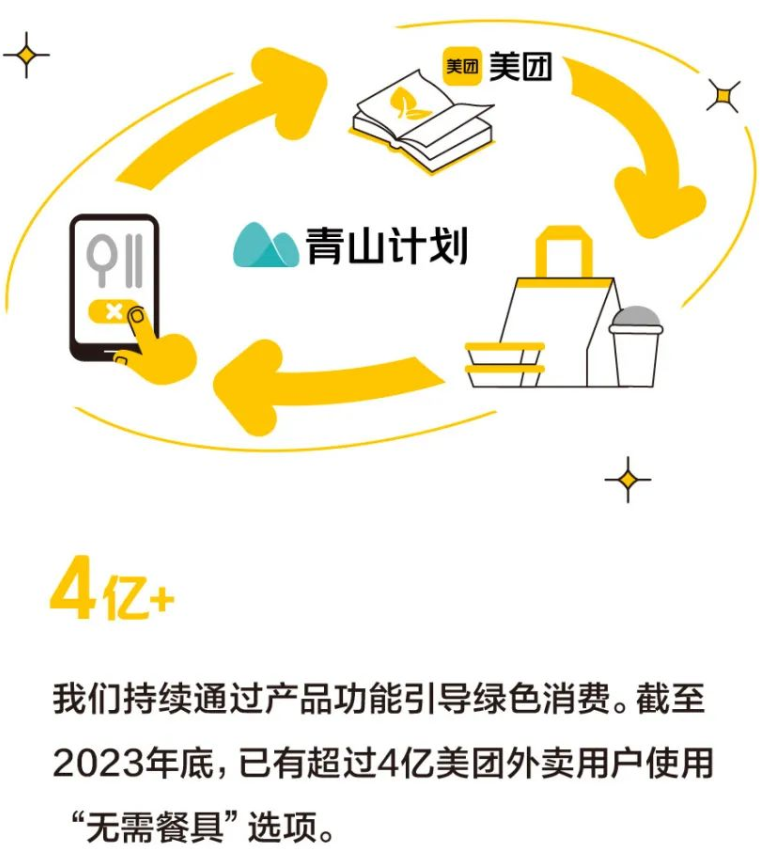
● In its 2023 Corporate Social Responsibility report, Meituan claimed that “over 400 million delivery users use the ‘no cutlery’ option”, yet in reality, many consumers reported that they still received cutlery after selecting “no cutlery”. Source: “Meituan 2023 Corporate Social Responsibility Report”
Ma Tianjie: If we expect consumers to distinguish this themselves, it is almost impossible. Even professionals sometimes find it difficult to clarify the truth, the differences, and the degree of the issue, let alone the general public. Therefore, the role of intermediaries that relay information—such as the media, non-profit organisations, and information platforms—becomes extremely important. Companies like ByteDance already play a central role in the flow of information; under the dominance of AI and algorithms, the dissemination of information has become more efficient and vast, but also easier to manipulate. The algorithms of these companies determine what the public sees and what information influences them. In such an environment, it is very difficult to discern the truth and provide authentic information. Tianle: This is where I feel that professionals in the environmental field and media personnel must be more aware of their mission. News itself is a product for the public interest; since we assume the responsibility of maintaining the public interest, we must guarantee our professionalism, independence, and authenticity, ensuring that the information we convey is accurate and complete.

Sun Shan: It is indeed quite difficult. I know that some journalists, unable to publish full reports in mainstream media, have started their own podcasts or self-media channels to share as much of the information they know as possible. You may not be an “influencer”, and your audience may not be large, but as long as you possess the truth, you should speak out as much as possible.

Tianle:But the reality is that many media reports have effectively become PR products. We have observed recently that perhaps over 70% of “in-depth reports” regarding agriculture and food are actually paid corporate PR content—companies pay media outlets to write stories that ultimately highlight the “good deeds” the company has done, shaping a positive public image while avoiding the company’s real problems. The firewall between editorial departments and advertising departments has been broken down; even serious journalists are now required to take on advertorial assignments, and are even asked to make these soft news pieces look like genuine news reports. Of course, some media outlets are still persevering. For instance, *People* magazine used an investigative piece to expose the plight and details of delivery riders trapped by algorithms, deeply influencing the perception of the issue among the public and policymakers. Not long ago, *Southern Weekly* also published an investigation into carbon credits, explaining how absurd “selling air” is and how much fraud exists within the carbon trading market. But such reports are becoming increasingly rare.

In the first half of this podcast episode, our two guests and the host discussed the challenges non-profit organisations face when companies intervene in environmental and social issues. So, how can we imagine, advocate for, and practise a better society? Please look out for Foodthink’s update next week, where the three of them will discuss several successful international and domestic cases. Stay tuned.
Planning: TianlePodcast Production: Little Grape

Transcription: Maomao

Editing: Yuyang, Tianle