
How much fossil fuel are you ‘eating’?
We often believe that as long as our produce is certified, thoroughly washed, home-cooked, and fresh, it will be healthy and natural. We scrutinise the origin of our meat and vegetables and pore over the ingredient lists of our condiments; surely nothing has been overlooked?
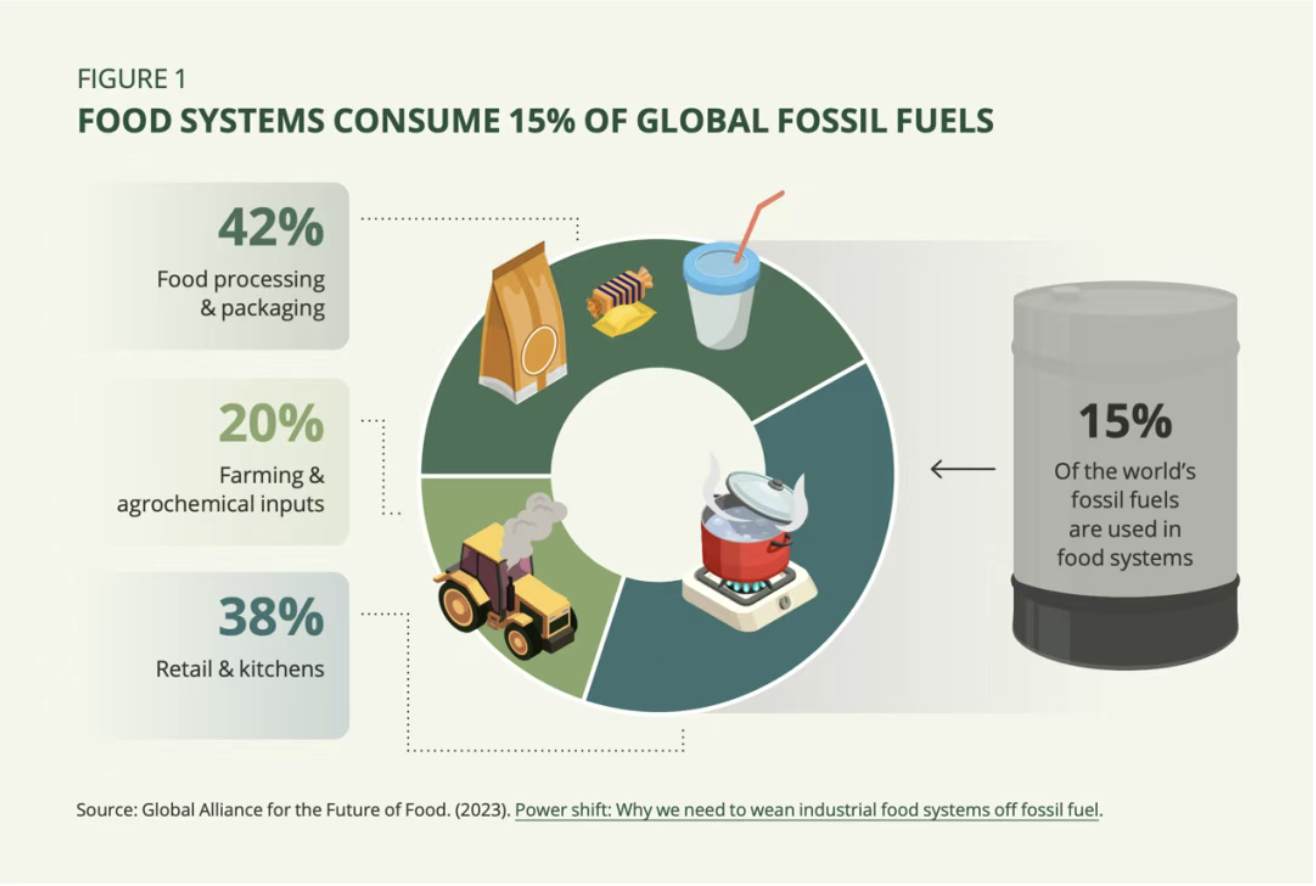
Yet, the cautious urban consumer may be overlooking a more systemic reality: from farm production, packaging and transport, to cold-chain storage and cooking, every stage of the food system is heavily reliant on fossil fuels. It consumes at least 15% of the world’s fossil fuels and 40% of petrochemicals—crucial derivatives of those fuels.
This is the central thesis of a new report titled *Fuel to Fork*, published in June by the International Panel of Experts on Sustainable Food Systems (IPES-FOOD). As a comprehensive review, the report synthesises the latest data from across the global food industry—spanning production, processing, sales, and cooking—to illustrate in detail how fossil fuels have become the lifeblood of the modern food system.
Specifically, data from the Global Alliance for the Future Food shows that of the fossil fuels consumed by the global food system, over 40% are used in food processing and packaging (42%), nearly 40% in retail and domestic cooking (38%), and the remaining 20% in cultivation and agrochemicals.
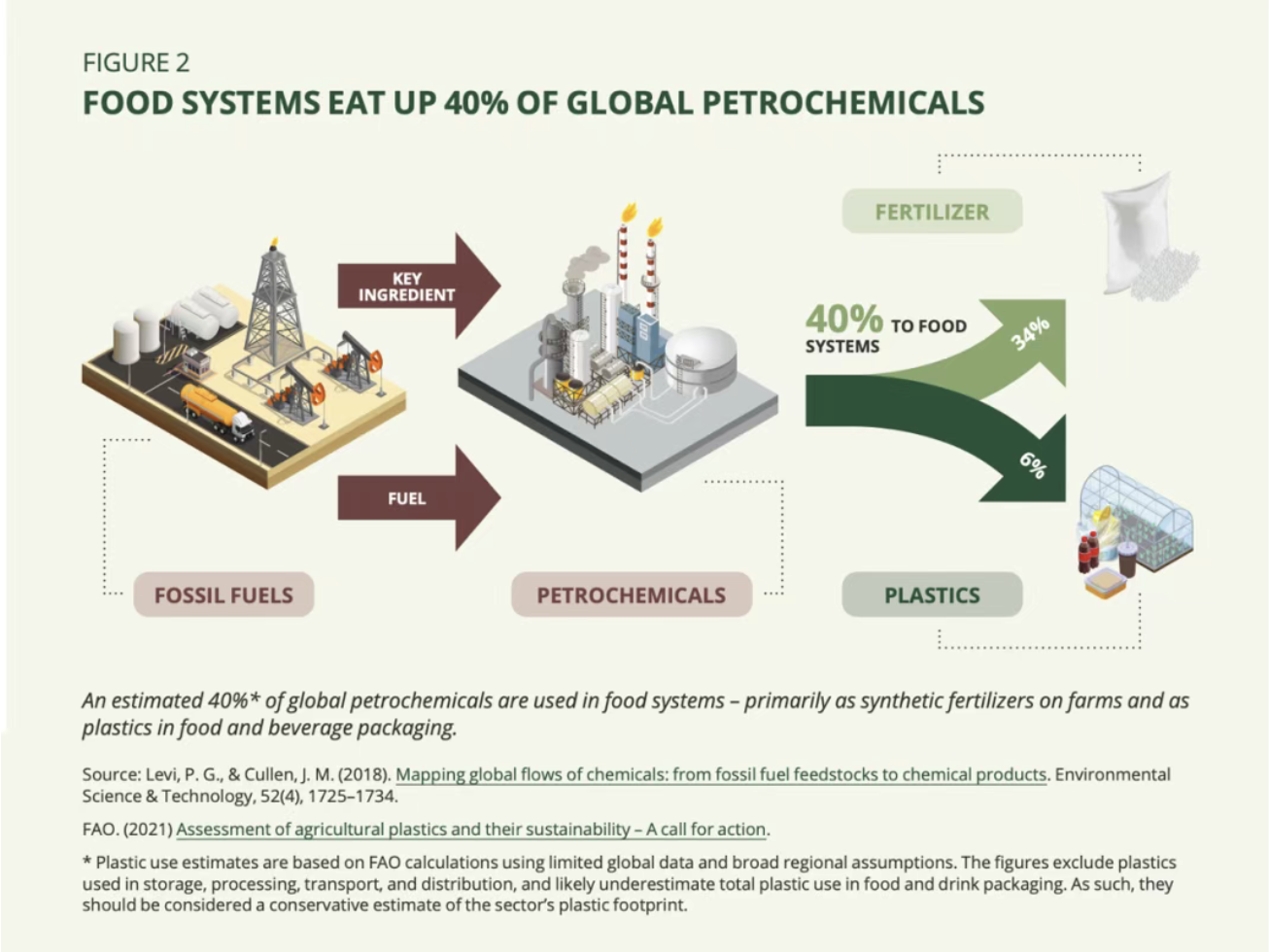
Beyond direct energy consumption, the food system also “consumes” 40% of global petrochemicals, 34% of which are used to produce fertilisers. The report notes that 99% of synthetic nitrogen fertilisers and pesticides are derived from fossil fuels, while 6% are used in plastic production.
I. Nitrogen Fertilisers: The Farm’s Number One Fossil Killer
Currently, the nitrogen fertiliser supply chain contributes 2% of global greenhouse gas emissions. Of all the carbon emissions from synthetic fertilisers, the production stage accounts for only 40%, while 60% originate from application in the fields. The nitrous oxide produced after fertilisation has a warming potential 300 times that of carbon dioxide. Since the Industrial Revolution, nitrous oxide has contributed 10% to global net warming. Consequently, the report emphasises that reducing emissions from fertiliser factories alone is futile, as the primary harm occurs in the soil.
The Earth system’s “nitrogen boundary” (Note: a critical threshold for the nitrogen cycle within the Earth system) was breached as early as 1970. Since then, total global nitrogen use has doubled.
Beyond exacerbating global warming, the report outlines other destructive impacts of nitrogen pollution. For instance, over half of the nitrogen fertiliser applied to crops leaches into the environment, polluting air, water, and soil; 3 billion people face threats of water scarcity caused by nitrogen pollution; nitrates from fertilisers and manure entering drinking water can trigger “Blue Baby Syndrome” (Note: a potentially fatal condition in infants caused by oxygen deprivation) and are linked to cancer incidence; nitrogen dioxide produced during fertiliser manufacture and application, along with ammonia from fertilisation, worsens air pollution, leading to respiratory diseases and deaths; nitrogen pollution is also one of the primary drivers of biodiversity loss…
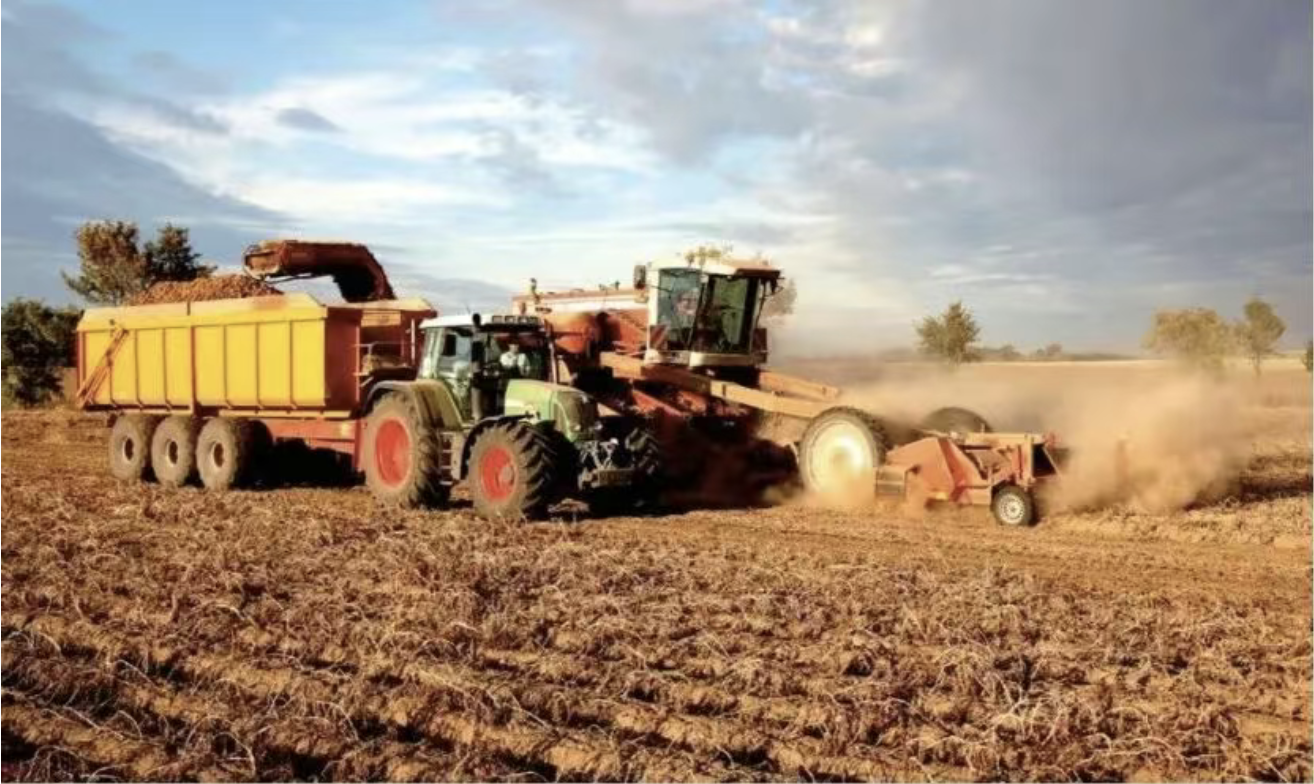
Fossil fuels are also used extensively to power tractors, harvesters, and other agricultural machinery. In the EU, the energy used for cultivating and ploughing accounts for nearly half of all on-field energy consumption. Foodthink previously highlighted the backlash and protests by German farmers in early 2024, triggered by large-scale cuts to diesel subsidies amidst highly mechanised agriculture (at a time when the Russia-Ukraine war further drove up fuel prices). In highly industrialised agricultural regions like the US and the EU, farming machinery urgently needs to transition toward cleaner, renewable energy sources.
In some cases, for example, key data has not been made public. In 2021, the Association of Equipment Manufacturers in the US and the pesticide lobbying group “CropLife” published a study claiming that precision agriculture has the potential to improve energy efficiency. However, the IPES team discovered that the core data supporting this conclusion was inaccessible.
More importantly, there has been significant hype surrounding “blue” and “green” nitrogen fertilisers. “Low-carbon fertilisers” produced by fertiliser companies through clean production methods allegedly capture and store carbon dioxide generated by burning fossil fuels during production (CCS technology), or derive hydrogen from water rather than fossil feedstocks to synthesise ammonia.
In the production of “blue” fertilisers or hydrogen, plants capture a portion of the carbon dioxide generated during the process. However, a review of existing research and practice by the report found that carbon capture rates in “blue” nitrogen production have never reached the 90%–95% claimed by the industry. In Enid, at the world’s second-oldest CCS fertiliser plant (operational since 1982), only 28% of carbon dioxide was captured.
Furthermore, this captured carbon dioxide is used to extract more oil from underground. Burning that oil produces new and even greater carbon dioxide emissions. The carbon used as a fertiliser raw material is simply released later in its life cycle.
As for “green” nitrogen fertilisers, they are still in their infancy, accounting for a tiny fraction of global fertiliser sales and using only 0.3% of global ammonia production.
Another study cited in the report indicates that the energy required to produce “blue” and “green” fertilisers is staggering. Compared to traditional fertilisers, the energy use for producing “blue” ammonia fertiliser increases by 58%, land use doubles, and water use triples; transitioning to “green” ammonia fertiliser would require 24 times more electricity (or 5% of global electricity), 30 times more land, and 50 times more water.
II.Ultra-processed foods are the most energy-intensive, with plastics “entangling” the entire food cycle
Of this, the food processing industry requires significant thermal energy (heat), which is often generated by burning fossil fuels rather than through electric heating. These processes—used for sterilisation, pasteurisation, baking, and drying—account for 60-70% of food manufacturers’ total energy consumption. Food processing breaks down maize, wheat, and soy into components such as sugars, oils, fats, proteins, starches, and fibres; the production of high-fructose corn syrup, in particular, requires wet milling and refining of maize, processes that are exceptionally energy-intensive.
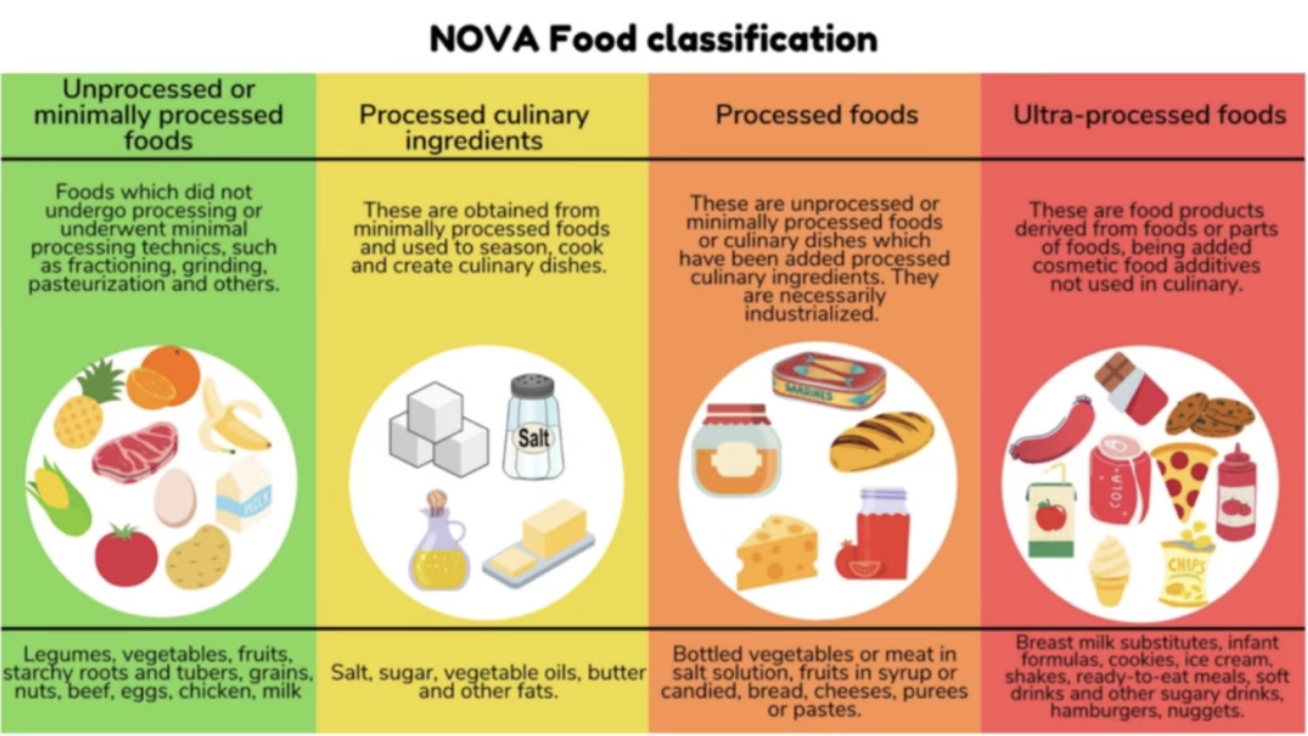
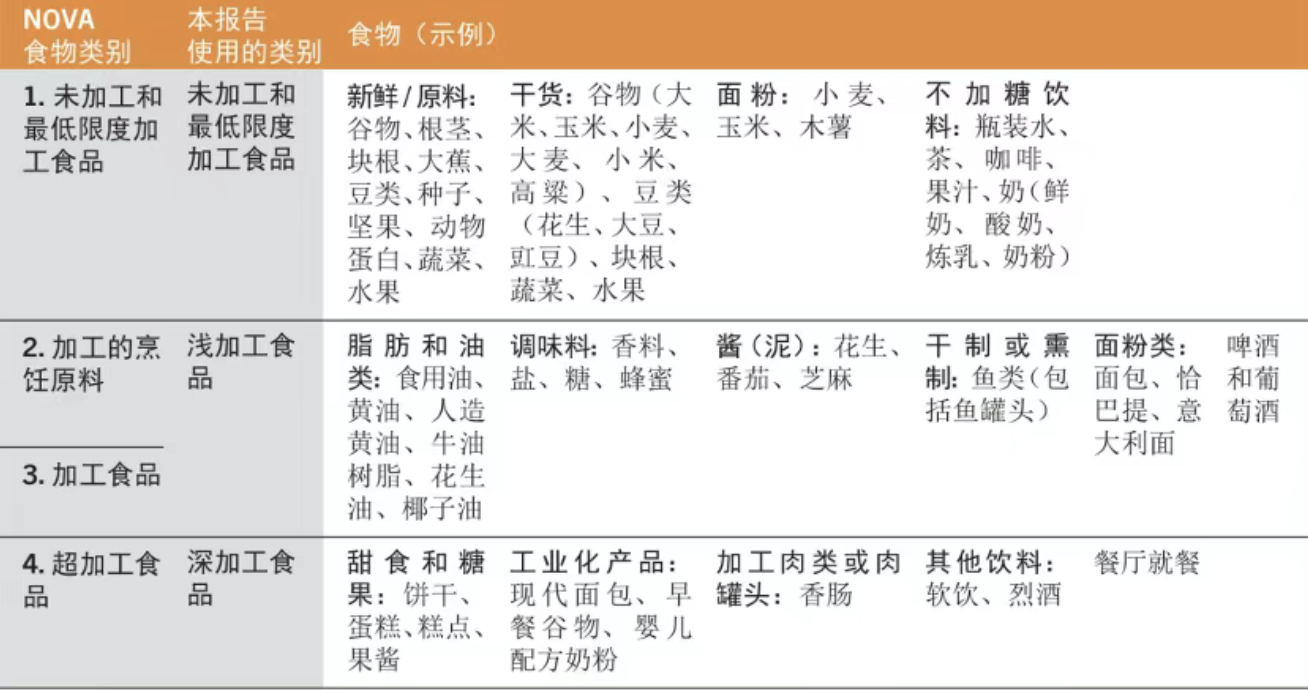
Within this category, ultra-processed foods (UPFs) are particularly noteworthy. Ultra-processed products are the primary destination for ingredients like high-fructose corn syrup. These industrially produced foods—including sugary drinks, processed meats, confectionery, and packaged snacks—rely on complex formulations and have a high energy intensity, with production energy requirements 2 to 10 times higher than those of natural foods. The report states that these products are often subsidised, heavily promoted, and highly profitable—accounting for 60% of total calorie intake in many wealthy nations, with consumption growing rapidly in low-income countries. As the production of ultra-processed foods increases and supply chains lengthen, the global scale of processing and packaging, as well as food miles, continue to rise.
Furthermore, the food system utilises 40% of the world’s petrochemical products, 74% of which are used in the production of plastics and fertilisers. Food production—particularly ultra-processed foods—is one of the biggest sources of excessive plastic packaging. Asia—especially China, India, Vietnam, South Korea, and Thailand—has seen a staggering amount of plastic packaging usage, accounting for over 43% of the global total in 2023, and is expected to continue growing at the fastest rate until 2030. China is the world’s largest producer and consumer of plastic packaging. Plastics are also widely used at the front end of the food chain on farms (in greenhouses, plastic mulch, and silage films used for lactic fermentation to preserve livestock feed).
The report predicts that global plastic production will more than double by 2050, at which point petrochemicals will become the “mainstay” supporting the fossil fuel economy, contributing to over 50% of demand growth.
Can recycling solve the plastic waste problem, as the industry claims? Less than 10% of plastic globally is recycled. Due to contamination and complex material mixtures, food packaging is one of the hardest categories to recycle. In China, while PET plastic bottles and HDPE/PVC rigid plastics are highly sought after in the recycling market, PP takeaway boxes contaminated with oil are avoided even by individual waste pickers.
As for the use of bio-based plastics—replacing all existing plastic packaging with them would require more than half of global maize production, fresh water exceeding 60% of the EU’s annual usage, and a land area larger than France. Moreover, such plastics are not necessarily non-toxic, nor are they guaranteed to biodegrade completely.
What can big food companies do? The report reflects that since global brand audits began in 2018, Coca-Cola, PepsiCo, and Nestlé have consistently been the top three plastic polluters. In the most recent audit, 83% of the collected plastic waste was food packaging, primarily bottles, wrappers, and containers.
Can food processing become “cleaner”? For example, through the electrification of gas equipment or the use of solar energy? Technically and financially, this is feasible. However, the Sustainable Development Goals (SDGs) set by many processing companies are not stringent, yet they remain unachieved. The report argues that the fundamental issue is the need to challenge the profit motives of ultra-processed food giants. Only by curbing their production can we maximise improvements in total energy demand, plastic packaging use, and overall human health.
III. From Freezer to Table
At the same time, the report provides another seemingly paradoxical figure: 620 million tonnes of food are lost annually worldwide due to insufficient refrigeration.
So, should we use more refrigerators or fewer? The report finds this data stems from a 2024 academic study. The study points out that the apparent contradiction arises from the stark difference in how energy is wasted in the food systems of developing versus developed nations: if cold chain systems were fully optimised so that no food spoiled, South Asia and Southeast Asia could reduce annual fruit and vegetable losses by 100 million tonnes, and sub-Saharan Africa could save over 700 million tonnes of CO2 equivalents. However, in developed countries, there is far less room for cold chain optimisation. Furthermore, regardless of the level of industrialisation, developing localised, low-industrialised food supply chains can save more food than even a theoretically optimised cold chain—reducing emissions by 300 million tonnes of CO2 equivalents in meat losses alone.
Additionally, cooking also consumes fossil energy—more than a third of the global population (approximately 2.3 to 2.8 billion people in 2020) rely on polluting solid fuels such as firewood, charcoal, and animal dung for cooking. This is particularly severe in sub-Saharan Africa, where over 80% of the population still uses polluting fuels; without significant intervention, this situation will persist until 2030.
2. Phase out agricultural chemicals
3. Promote agroecology
4. Rebuild local food supply chains
5. Significantly reduce plastic production and accelerate investment in alternatives and reuse systems
6. Reduce the consumption of ultra-processed foods and build healthy food environments
7. Eliminate food waste and promote clean cookstoves
8. Curb corporate power and democratise food system governance
IPES FOOD, Jun. 2025, “Fuel to Fork”. https://ipes-food.org/report-summary/fuel-to-fork/
Aaron Friedman-Heiman and Shelie A Miller, May, 2024, Environ. Res. Lett. 19 064038. https://iopscience.iop.org/article/10.1088/1748-9326/ad4c7b

A writer back on track, focusing on climate change, the ecological environment, and the individuals affected by these shifts